

Catalogue · Amarante, Portugal
Find your perfect tree.
Specimens grown over years on our 33 hectares in Amarante — ready for your garden from day one.
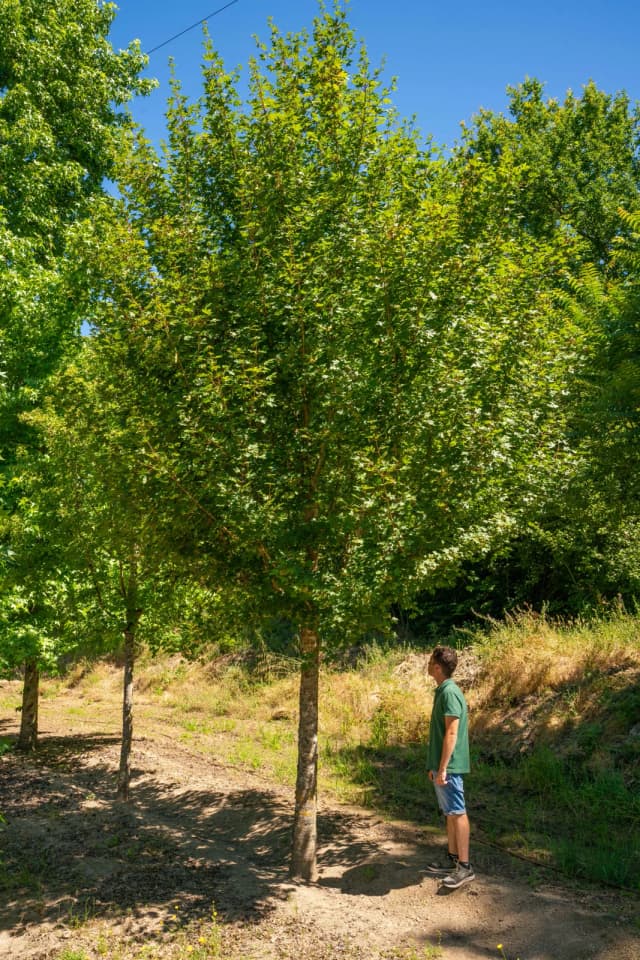
Acer campestre 'Elsrijk'
Field maple
A selection of field maple, it is distinguished by a crown that is narrower, more regular and more densely closed than the common form of the species. The combination of predictable architecture, tolerance of paving and high urban resilience has made it a European benchmark for street planting.
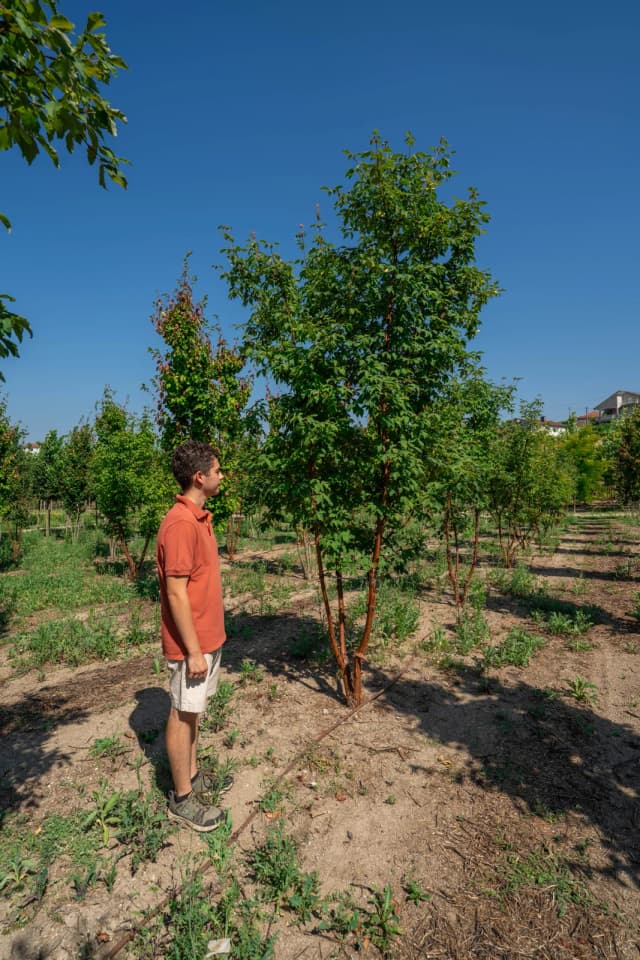
Acer griseum
Paperbark maple
One of the most expressive maples in winter, recognised by its cinnamon-brown bark that peels away in thin, translucent sheets. Slow growth gradually turns the trunk and main branches into a sculptural structure, complemented by trifoliate foliage and intense autumn colour.
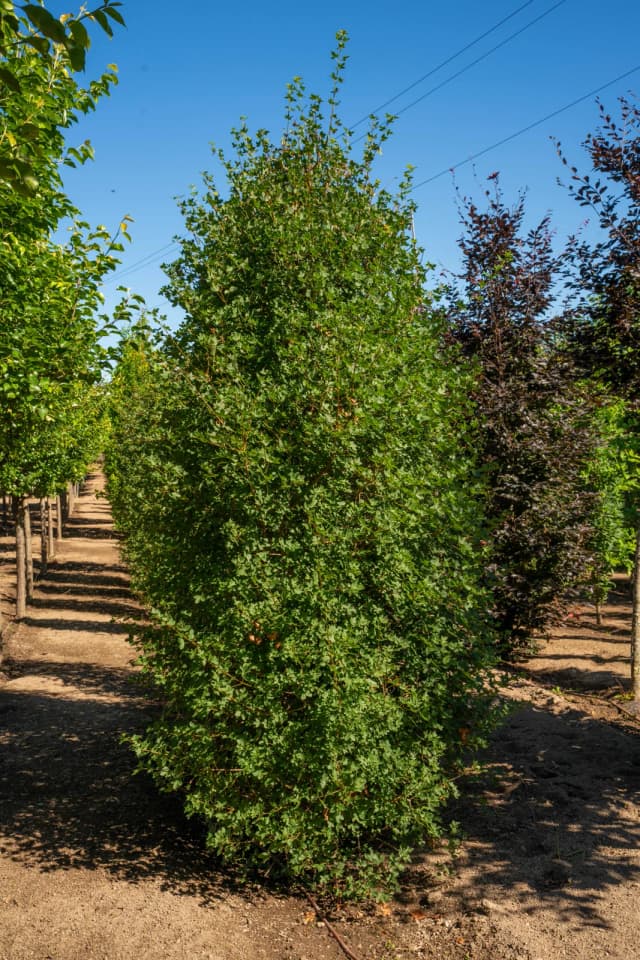
Acer monspessulanum
Montpellier maple
- SunFull sun, Partial shade
- Mature height5–10 m
- FoliageDeciduous
- Rate of growthSlow
- Maintenance levelEasy
A native maple of Mediterranean character, the Montpellier maple stands out for its ability to form a dense, cool crown in dry, stony, chalky soils. The small leathery leaves, divided into three rounded lobes, allow it to keep a delicate leaf scale without losing resistance to heat and drought.
Acer palmatum
Japanese maple
- SunPartial shade, Full sun
- Mature height4–8 m
- FoliageDeciduous
- Rate of growthSlow
- Maintenance levelModerate
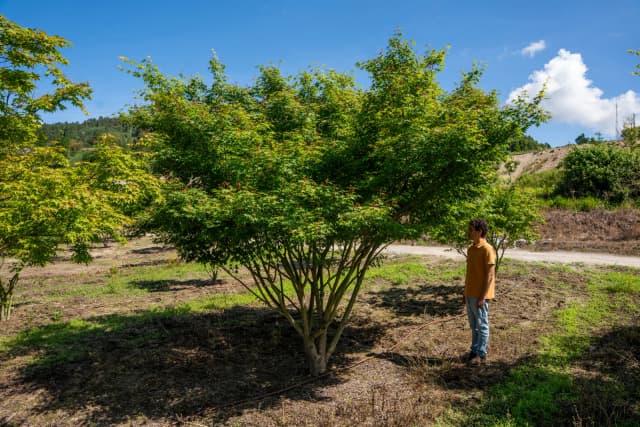
A central species in the Japanese garden tradition, it combines fine, progressively layered branching with palmate leaves that transform the expression of the crown through the year. The botanical form, with green foliage, keeps a more natural character than the many cultivars selected from this species.
Acer palmatum 'Atropurpureum'
Japanese maple
- SunPartial shade
- Mature height3–5 m
- FoliageDeciduous
- Rate of growthSlow
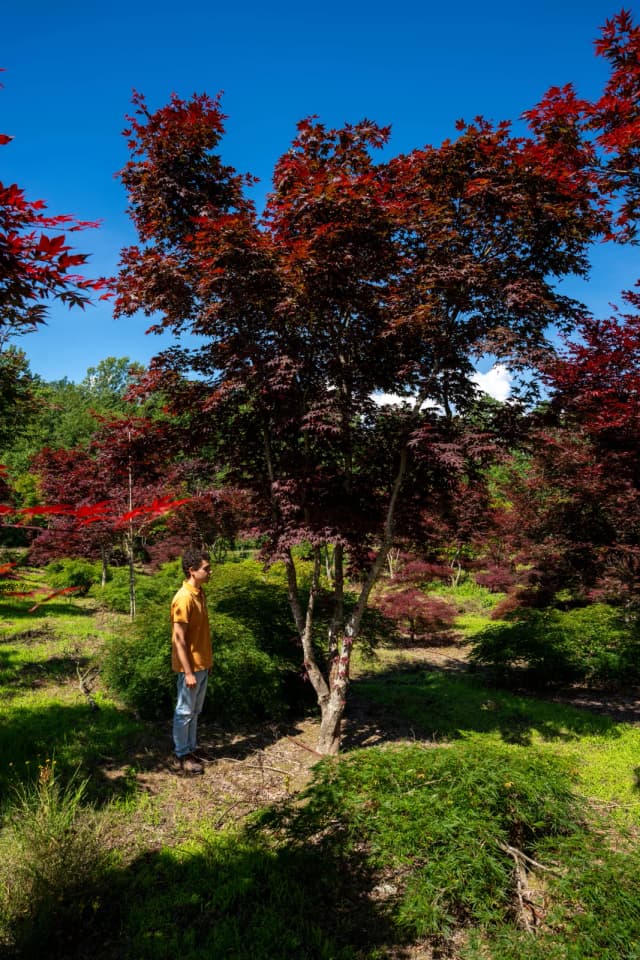
One of the classic purple-leaved forms of the Japanese maple, it stands out for its broad, densely coloured crown, which moves from the bronze-red of spring to wine tones and, finally, intense red in autumn. Unlike the Dissectum types, it keeps broad, palmate leaves, giving the crown greater visual presence.
Acer palmatum 'Bloodgood'
Japanese maple
- SunPartial shade
- Mature height4–6 m
- FoliageDeciduous
- Rate of growthSlow
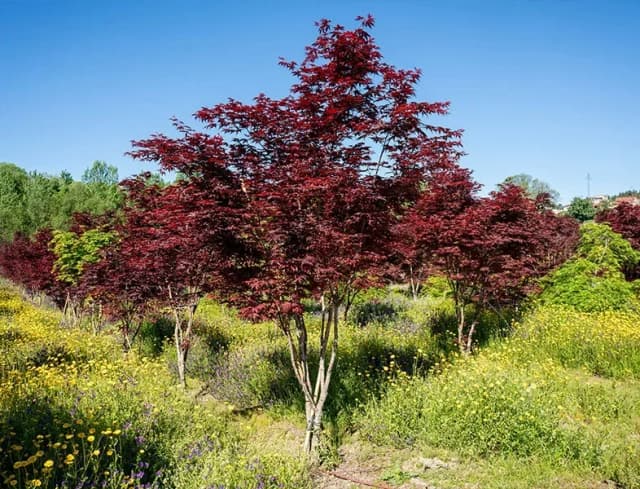
One of the most consistent purple selections of the Japanese maple, ‘Bloodgood’ holds its dark red foliage through the summer more reliably than ‘Atropurpureum’. The relatively narrow, upright crown brings an intense mass of colour without the lateral spread characteristic of other mature forms.
Acer palmatum 'Butterfly'
Japanese maple
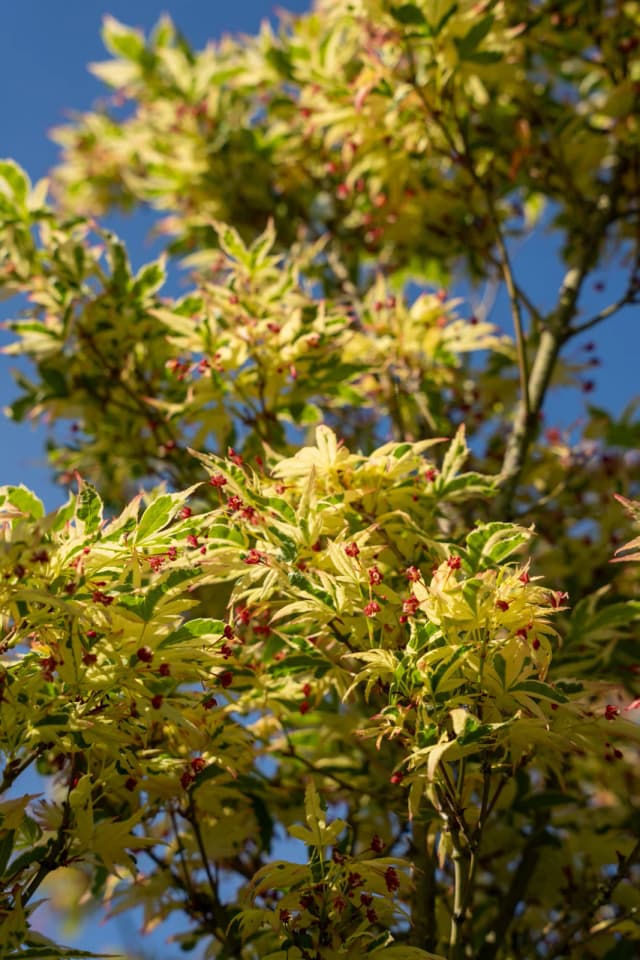
A variegated cultivar with a narrow, luminous crown, ‘Butterfly’ produces small grey-green leaves irregularly edged with creamy white and pink. As the distribution of colours varies from leaf to leaf, the crown takes on a fragmented, dynamic texture reminiscent of a cluster of butterflies.
 Boutique
Acer palmatum 'Dissectum Garnet'
Japanese maple
- SunPartial shade
- Mature height2–3 m
- FoliageDeciduous
- Rate of growthSlow
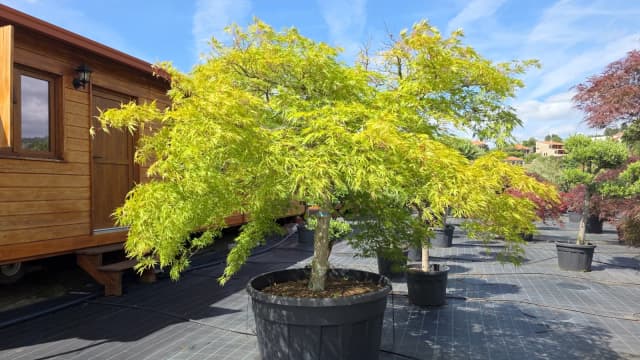
One of the most vigorous cultivars in the Dissectum group, ‘Garnet’ combines deeply cut foliage with a stronger, more upright structure than most weeping Japanese maples. The outer branches descend in successive layers, forming a crown like a wine-red dome or cascade.
 Boutique
Acer palmatum 'Dissectum'
Japanese maple
- SunPartial shade
- Mature height2–3 m
- FoliageDeciduous
- Rate of growthSlow
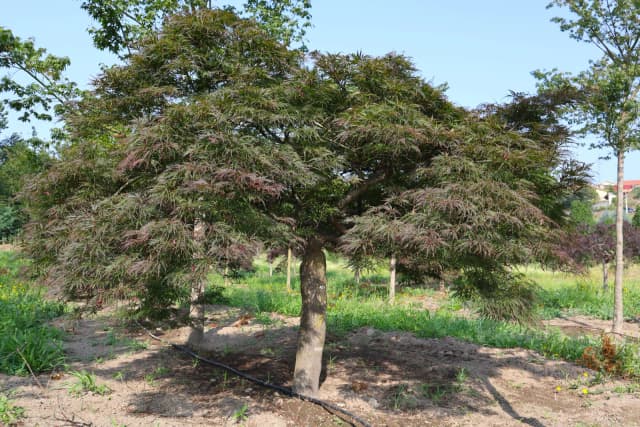
A historic Japanese cultivar that gave its name to the Dissectum group, it is distinguished by green leaves divided almost to the main veins and by a low, mushroom-shaped crown. The combination of lacy foliage and cascading branches produces a light, fluid structure that is recognisable even from a distance.
Acer palmatum 'Fireglow'
Japanese maple
- SunPartial shade
- Mature height3–4 m
- FoliageDeciduous
- Rate of growthSlow
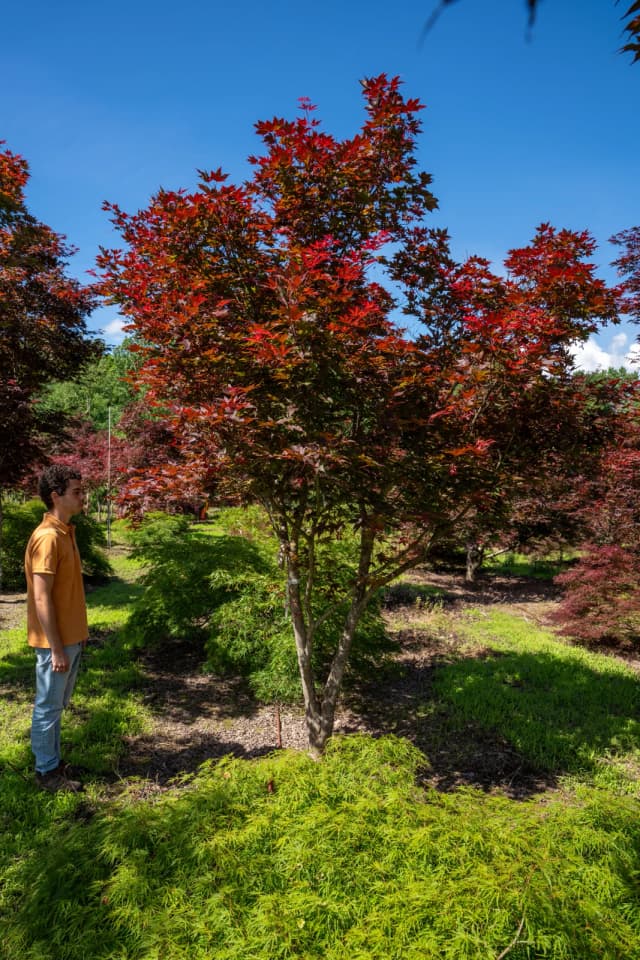
‘Fireglow’ owes its name to the way light passes through the red-purple foliage, producing a particularly intense scarlet glow. More compact and luminous than ‘Bloodgood’, it offers a strong colour presence without reaching the same scale at maturity.
Acer palmatum 'Osakazuki'
Japanese maple
- SunPartial shade
- Mature height4–6 m
- FoliageDeciduous
- Rate of growthSlow
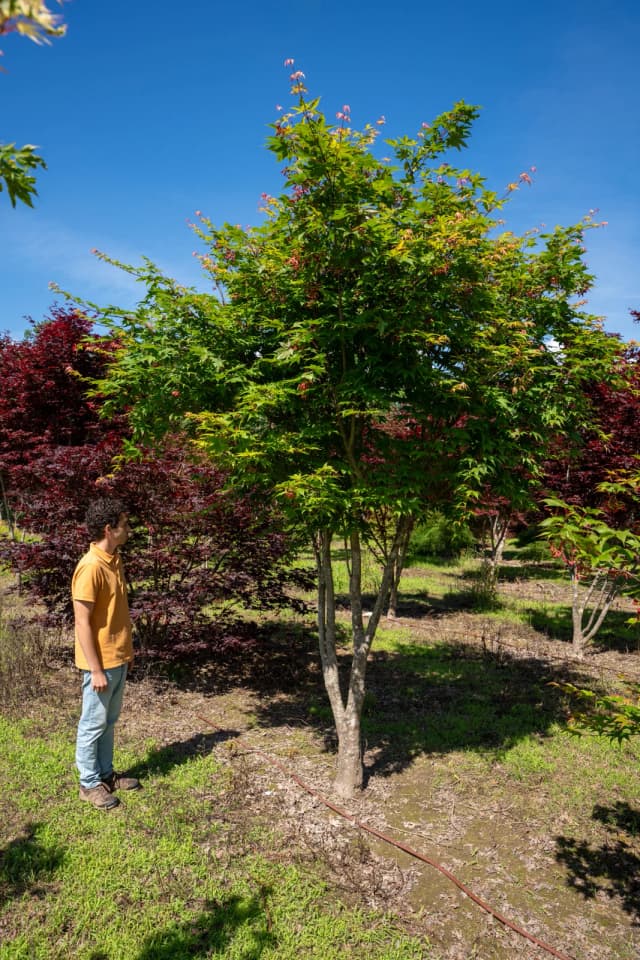
Considered one of the most expressive Japanese maples in autumn, ‘Osakazuki’ turns its broad green crown into a luminous mass of scarlet red and orange. The large, seven-lobed leaves give it a more solid presence than most selections with delicate foliage.
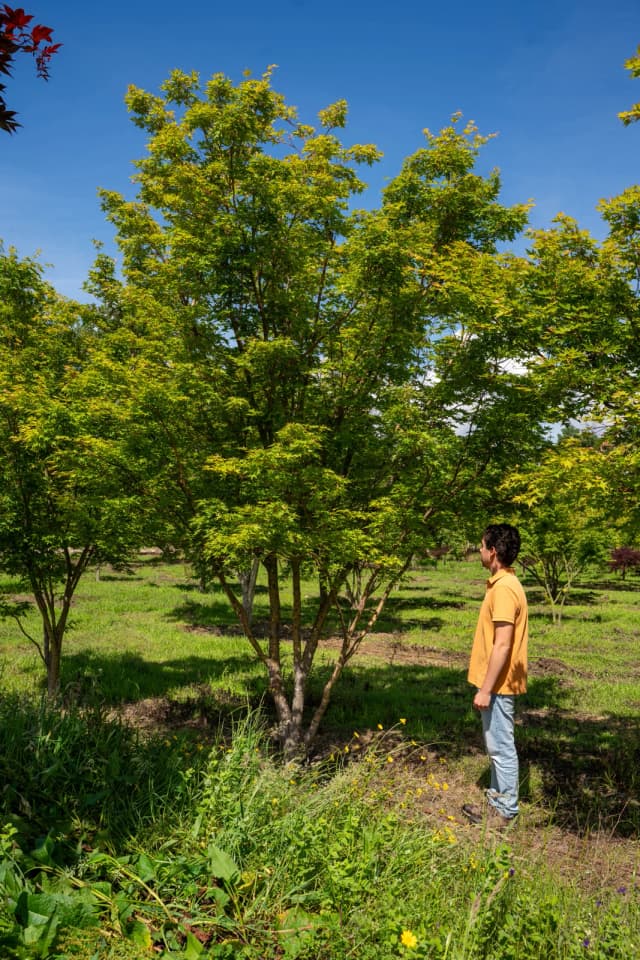
Acer palmatum 'Sangokaku'
Japanese maple
Known as the coral-bark maple, it extends the interest of the Japanese maple beyond leaf fall. During the winter, the young branches take on an intense coral red and turn the bare structure of the tree into its main ornamental feature.
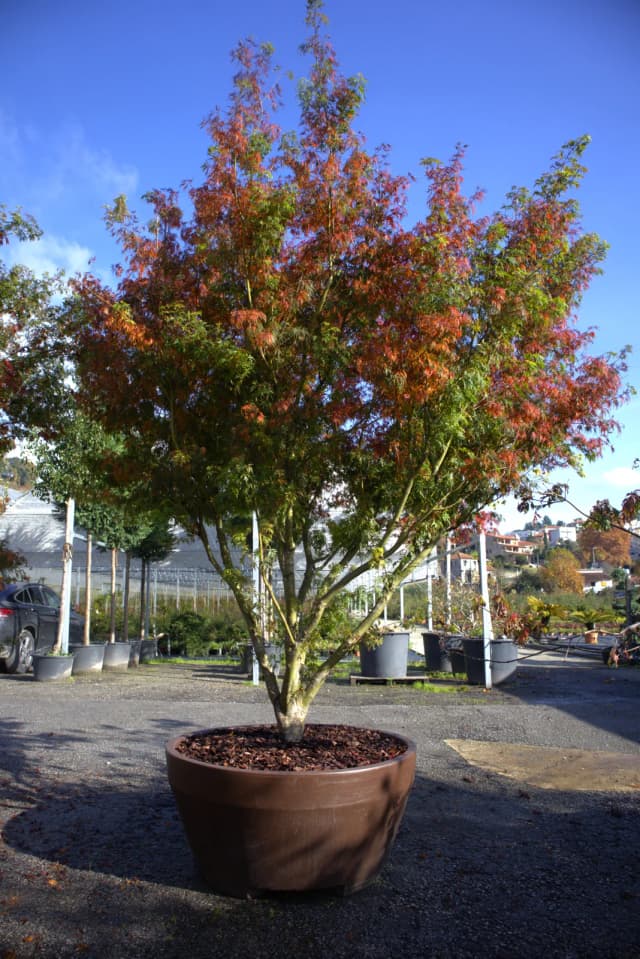
Acer palmatum 'Seiryu'
Japanese maple
- SunPartial shade
- Mature heightUp to 4 m
- Rate of growthSlow
It brings the delicacy of the deeply cut leaves of the Dissectum maples to a tree of upright growth. This unusual combination creates a vertical, light, transparent crown, very different from the low, weeping forms that characterise most cultivars in this group.
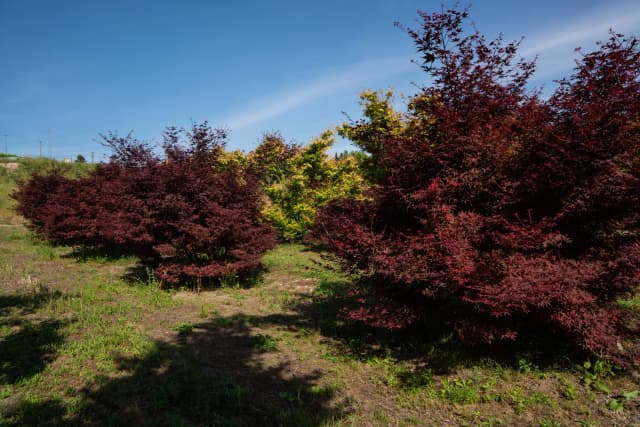
Acer palmatum 'Shaina'
Japanese maple
A compact selection of ‘Bloodgood’, ‘Shaina’ concentrates the colour intensity of the purple Japanese maples in a low, dense, heavily branched crown. The successive production of bright red leaves at the tips creates luminous contrasts against the darker foliage.
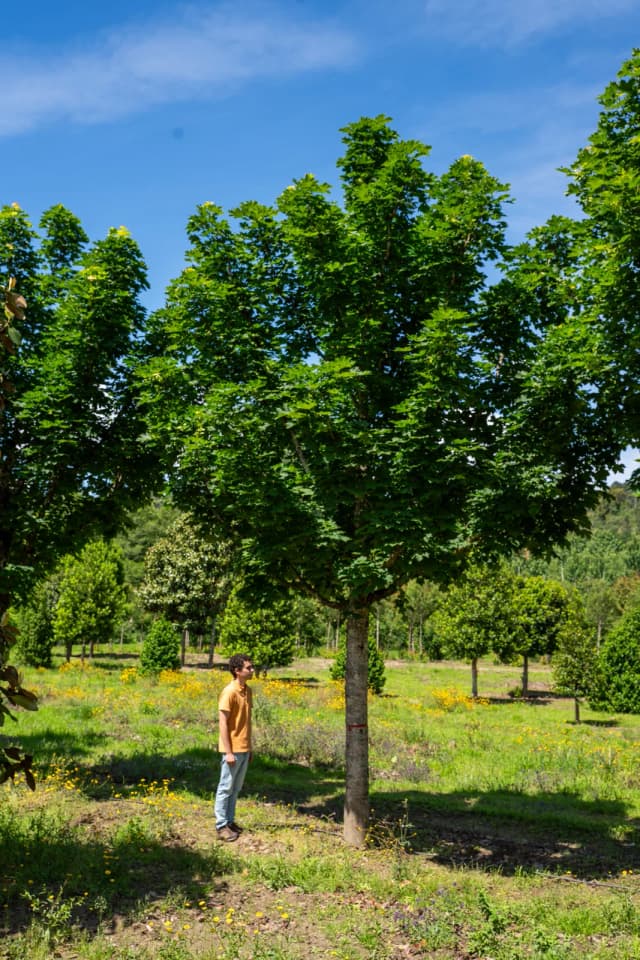
Acer platanoides 'Columnare'
Norway maple
A large maple whose dense, markedly upright crown brings height, shade and the rhythm of trees to streets with less lateral space. The spring flowering, the broad foliage and the golden colour of autumn add an expressive seasonal sequence to its regular architecture.
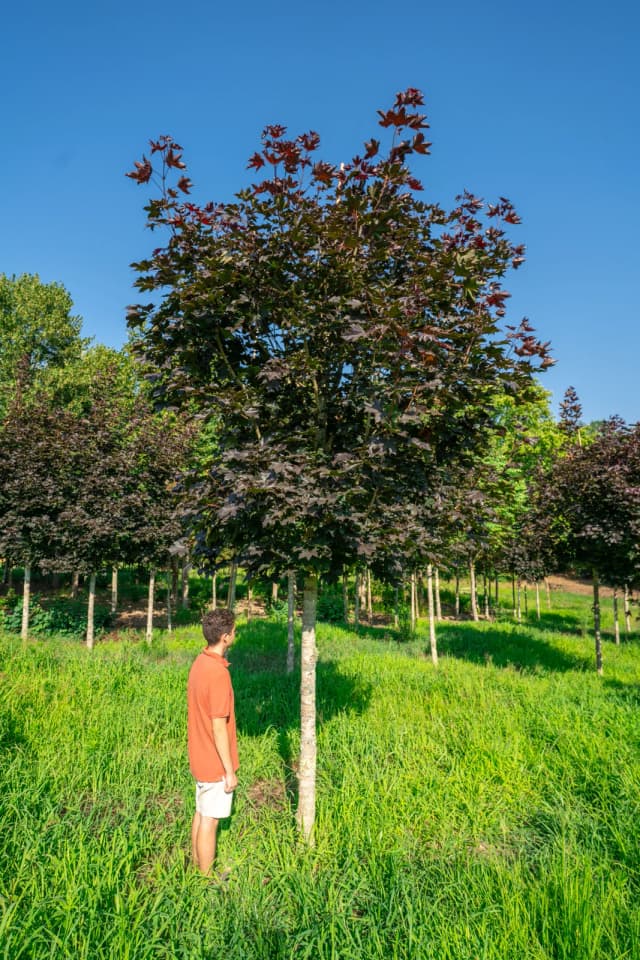
Acer platanoides 'Crimson King'
Norway maple
- SunPartial shade, Full sun
- Mature heightUp to 20 m
- FoliageDeciduous
- Rate of growthMedium
A tree with a broad, dense crown, known for the red-purple foliage that keeps its intensity of colour throughout spring and summer. The combination of expressive habit, abundant shade and permanent colour makes it a structural element for parks, large gardens and urban avenue planting.
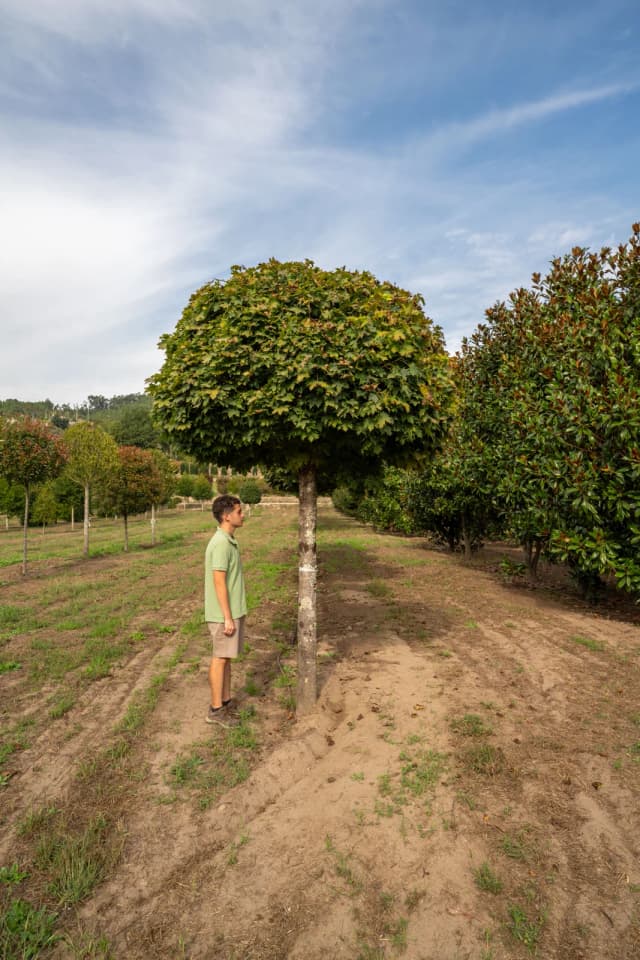
Acer platanoides 'Globosum'
Norway maple
- SunPartial shade, Full sun
- FoliageDeciduous
- Rate of growthSlow
A tree of controlled size, recognised by its naturally spherical crown, which becomes progressively broader and flatter. The regularity of its form, its dense shade and its golden autumn colour make it particularly suitable for squares, entrances, car parks and formal compositions.
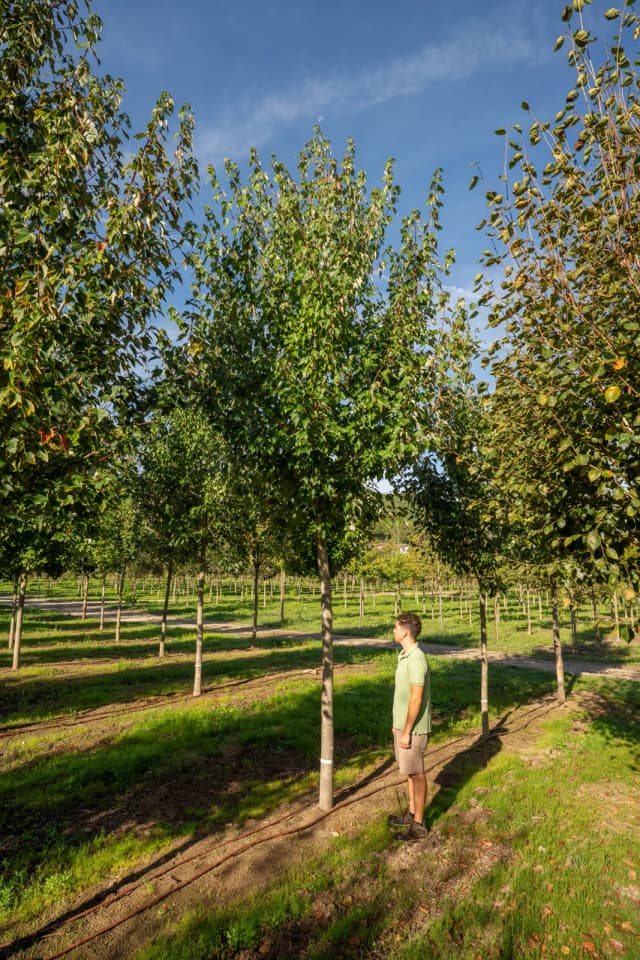
Acer rubrum
Red maple
- SunFull sun, Partial shade
- Mature height12–20 m
- FoliageDeciduous
- Rate of growthMedium
- Maintenance levelEasy
A medium to large maple, specified by landscape architects in parks, university campuses and residential streets on the acidic soils of the North and Centre, whenever the overriding criterion is the reliability of the scarlet autumn turn.
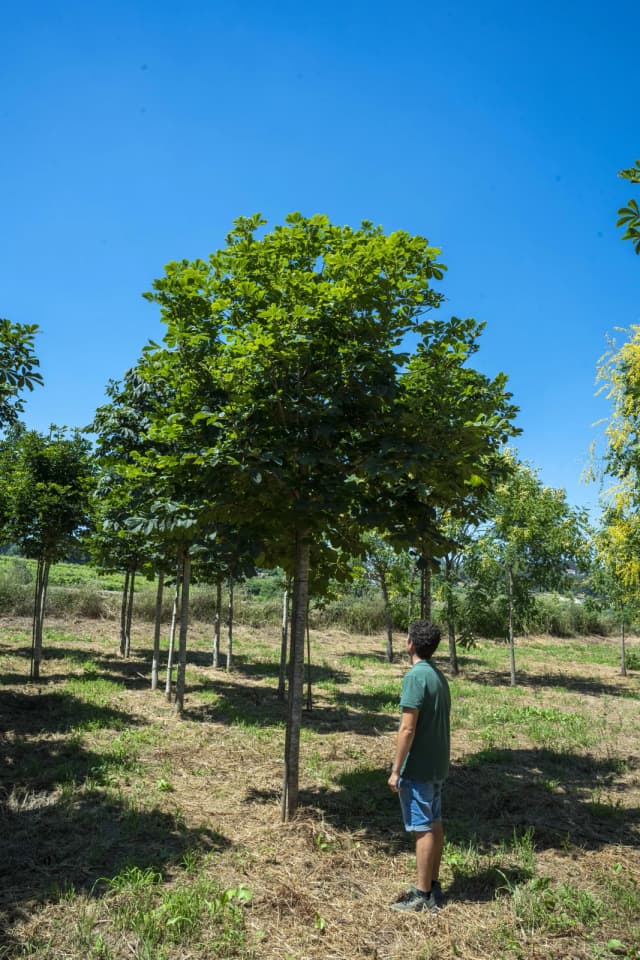
Aesculus hippocastanum
Horse chestnut
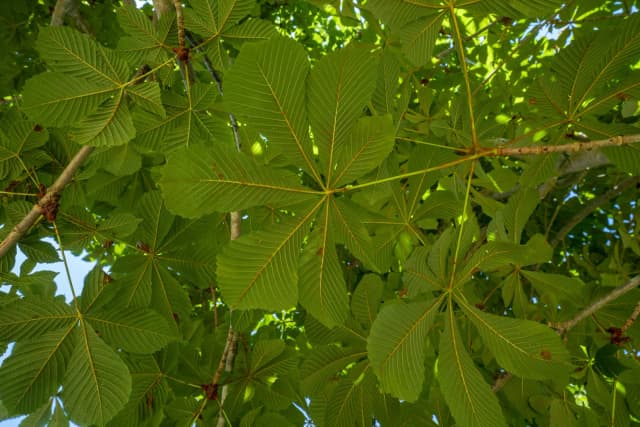
A monumental tree with a broad, dense crown, recognised by its large palmate leaves and the spectacular white panicles that rise above the foliage in spring. Its scale, its capacity to cast shade and its historic presence make it especially suited to parks, large gardens and spacious avenues.
Aesculus hippocastanum 'Baumannii'
Double-flowered horse chestnut
A historic selection of the horse chestnut that combines a monumental shade-giving crown with white, double and particularly long-lasting flowers. As a sterile cultivar, it does not produce the bulky spiny fruits of the species, which makes it especially valuable for large avenues, squares and other prominent urban spaces.
Aesculus x carnea 'Briotii'
Red horse chestnut
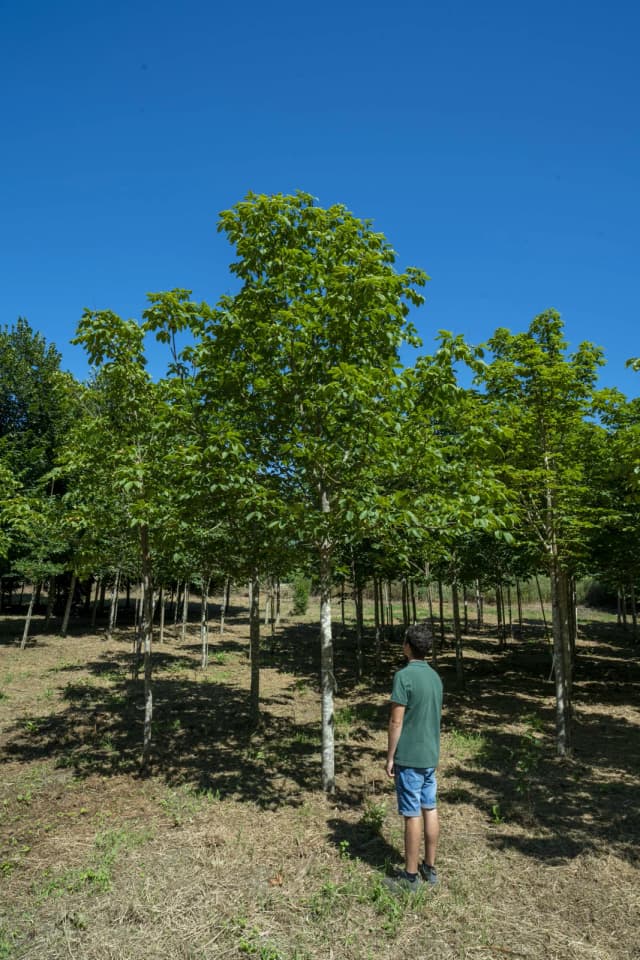
An ornamental hybrid that combines the architecture and foliage of the horse chestnut with the intense red flowering of Aesculus pavia. Its rounded crown, more compact than that of the straight species, and its reduced fruit production make it particularly interesting for avenues, parks and gardens where a shade tree with truly striking flowers is wanted.
Amelanchier 'Ballerina'
Juneberry
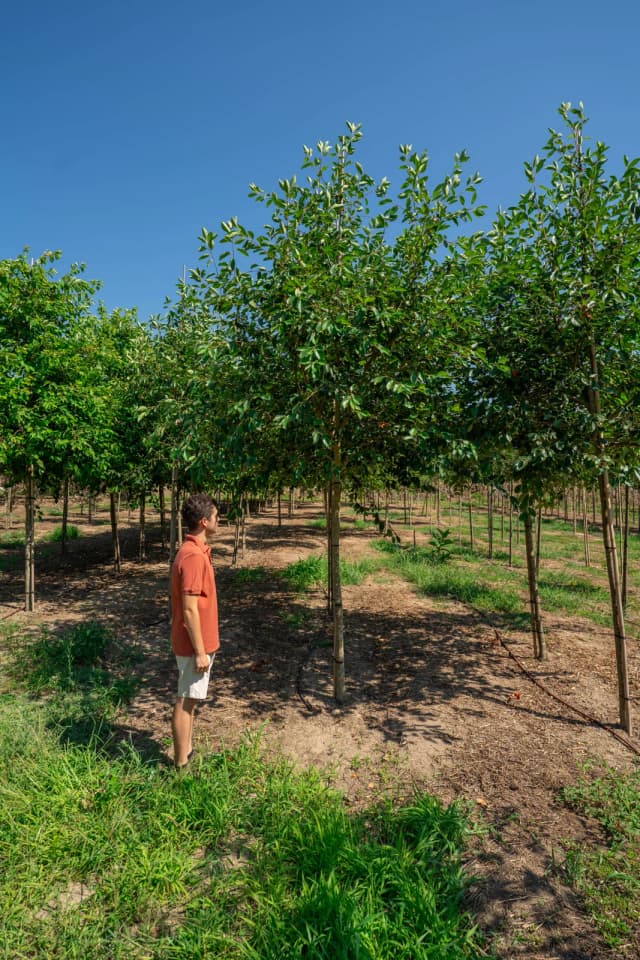
A small tree with a broad, vase-shaped crown, it combines abundant white flowering with a particularly generous crop of sweet, edible fruits. The fine branching, visible in winter, gives it an elegant presence even after leaf fall.
Amelanchier 'La Paloma'
Juneberry
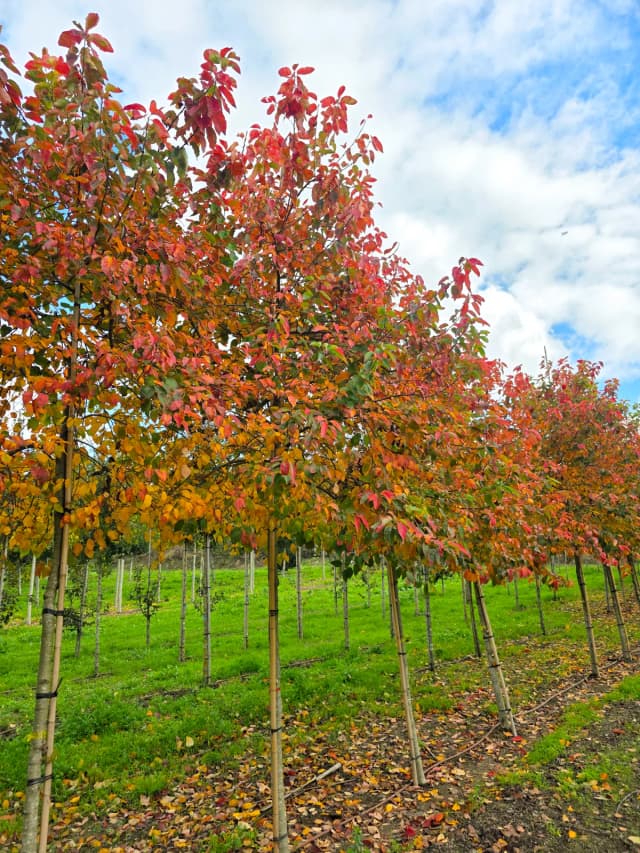
A small tree that combines particularly abundant white flowering with red-bronze new growth, creating a sharper contrast in spring than is usual in the genus. Edible purple fruits and intense autumn colour extend the interest of the crown through the year.
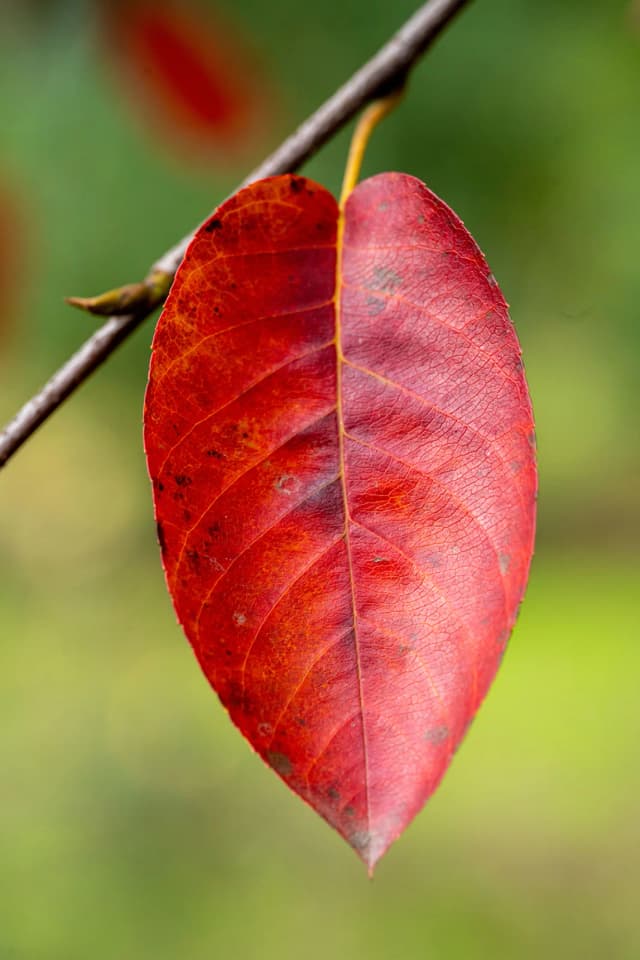
Amelanchier alnifolia 'Obelisk'
Juneberry
A selection with a markedly columnar habit, it turns the usual broad silhouette of Amelanchier into a vertical, dense and naturally narrow structure. In spring, the white clusters are spread along the ascending branches, forming a flowering column that needs little corrective pruning.
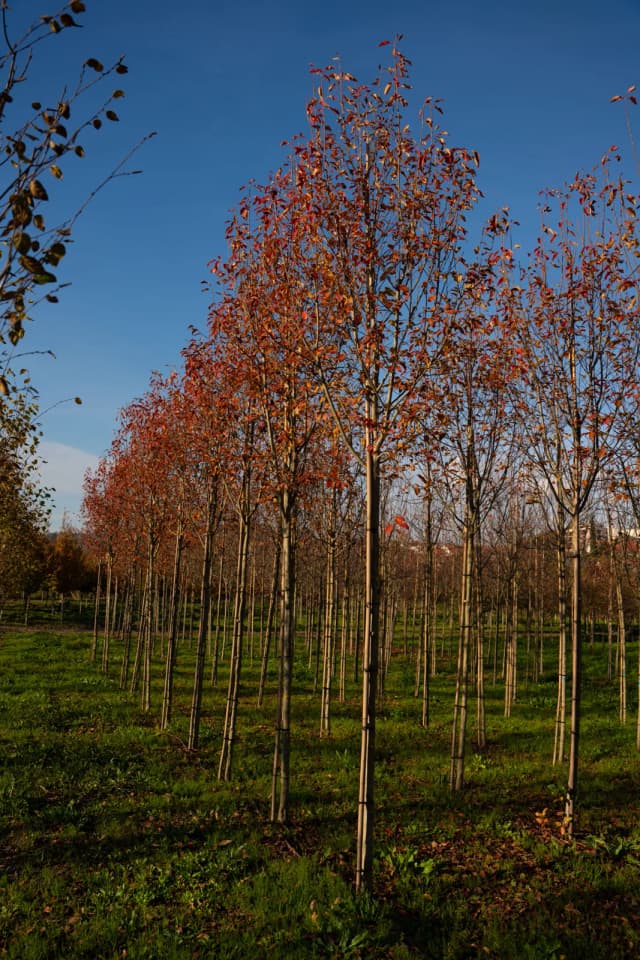
Amelanchier arborea 'Robin Hill'
Serviceberry
One of the Amelanchier selections with the most clearly tree-like character, it forms an oval, regular and initially upright crown, suited to avenue planting and urban spaces. In spring, the pink buds open into pale pink flowers that gradually turn white, creating a colour transition uncommon in the genus.
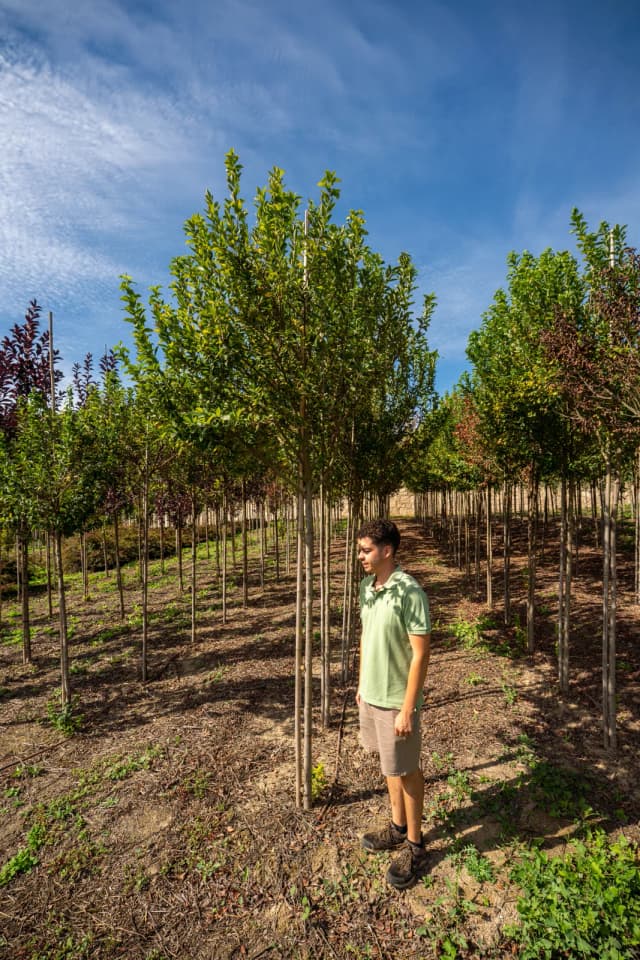
Amelanchier candensis 'Glenn Form' (=Rainbow Pillar)
A small deciduous tree or large shrub, it stands out for its narrow, upright, densely branched habit, significantly more contained than that of the common forms of Amelanchier canadensis. The white spring flowering is followed by dark fruits and by an intense autumn transformation in golden, orange and red tones.
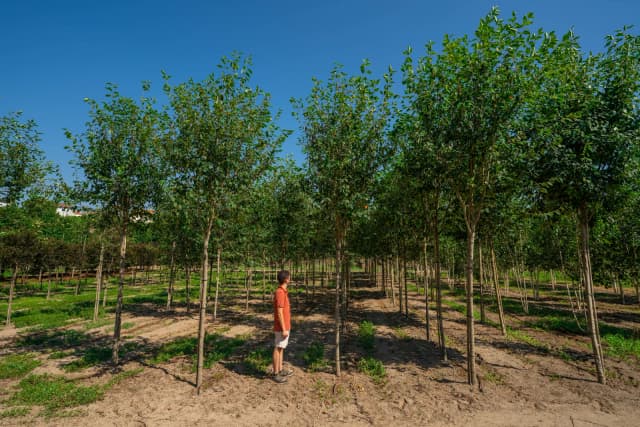
Amelanchier laevis 'Snowflakes'
A small tree of markedly upright habit, with a crown that is narrow at first, it reads as almost columnar, which sets it apart from the Amelanchier of more open growth. This architecture makes it possible to bring abundant white blossom to narrow streets, entrances and small gardens, where the available width limits the choice of tree.
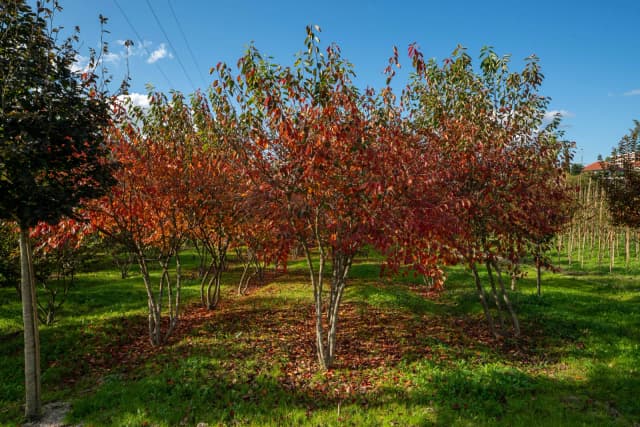
Amelanchier lamarckii
Juneberry
- SunFull sun, Partial shade
- Mature height5–10 m
- FoliageDeciduous
- Rate of growthMedium
- Maintenance levelEasy
A small tree often grown as a multi-stem, it stands out for its particularly complete succession of seasons. The white blossom coincides with the bronze new growth, followed by edible blue-black fruits, intense autumn colour and a delicate structure of grey branches during the winter.
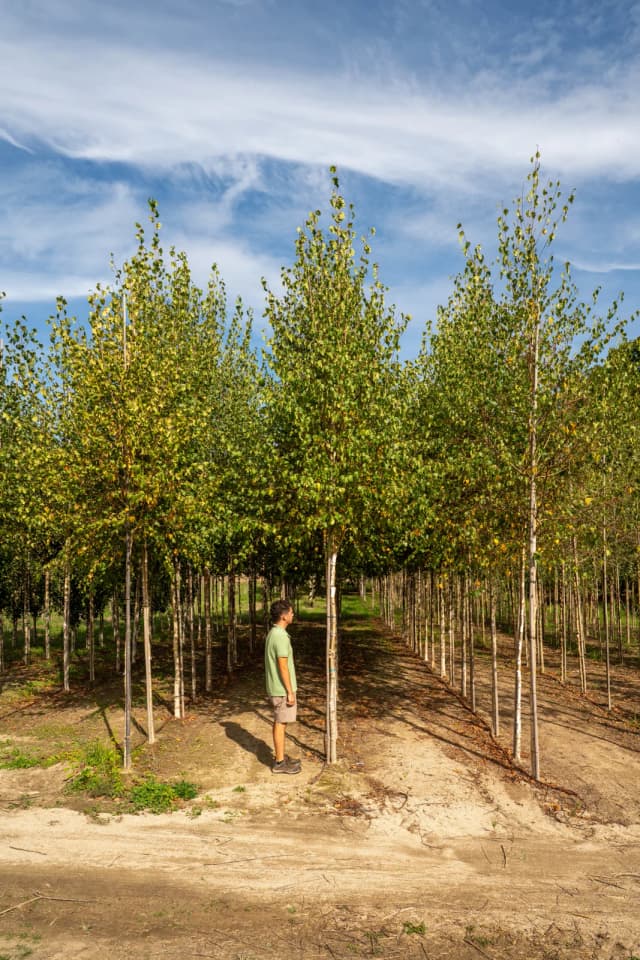
Betula pendula
Silver birch
- SunFull sun
- Mature height15–25 m
- FoliageDeciduous
- Rate of growthFast
- Maintenance levelEasy
The combination of white trunk, luminous crown and fine, clearly pendulous twigs gives Betula pendula an immediately recognisable silhouette. It is a fast-growing pioneer species, able to bring verticality without creating a heavy visual mass and to hold landscape interest all year round.
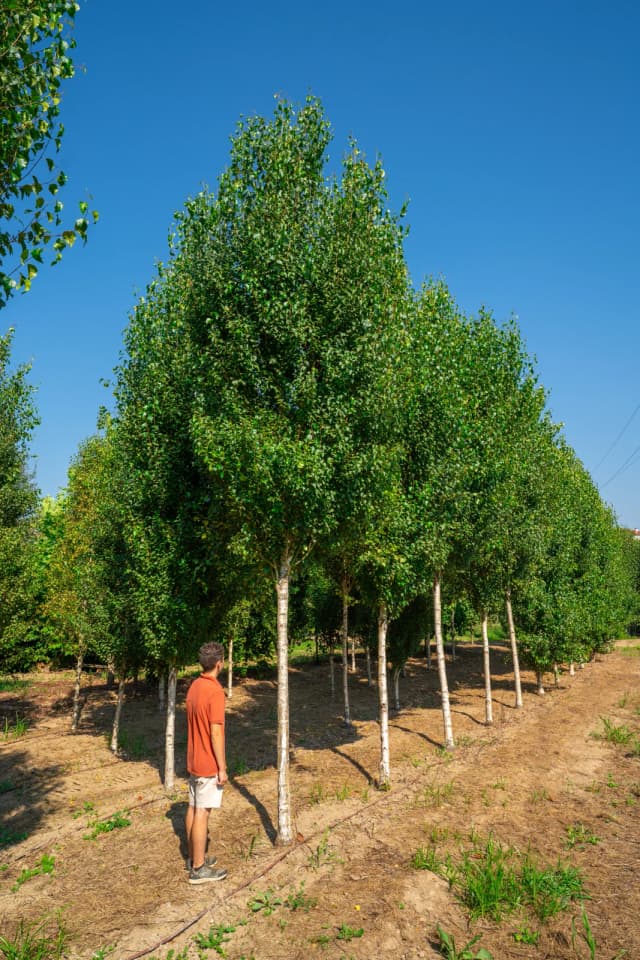
Betula pendula 'Fastigiata'
Silver birch
- SunFull sun
- Mature heightUp to 15 m
- FoliageDeciduous
- Rate of growthFast
A fastigiate cultivar of Betula pendula, suited to urban avenue planting with small tree pits, narrow dividing strips and courtyards where a vertical silhouette and white bark are wanted, performing most reliably north of the River Mondego.
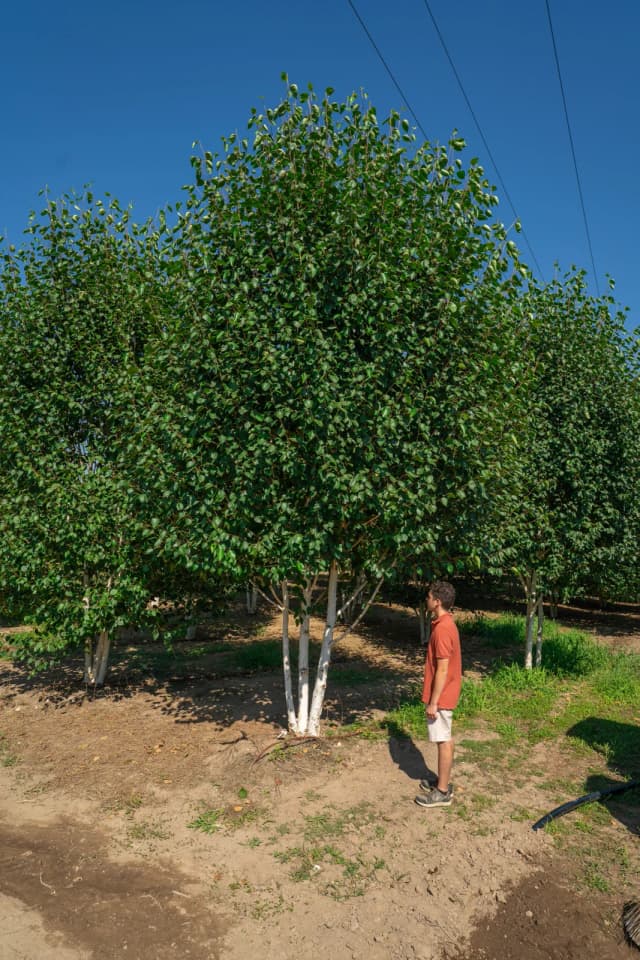
Betula utilis 'Jacquemontii'
Himalayan birch
- SunFull sun
- Mature heightUp to 15 m
- FoliageDeciduous
- Rate of growthFast
A birch with a light, regular crown, known for the intensely white bark that stands out all year round and comes to the fore in winter. As a single-stem or multi-stem tree, it creates a luminous, vertical composition, complemented by spring catkins and golden foliage in autumn.
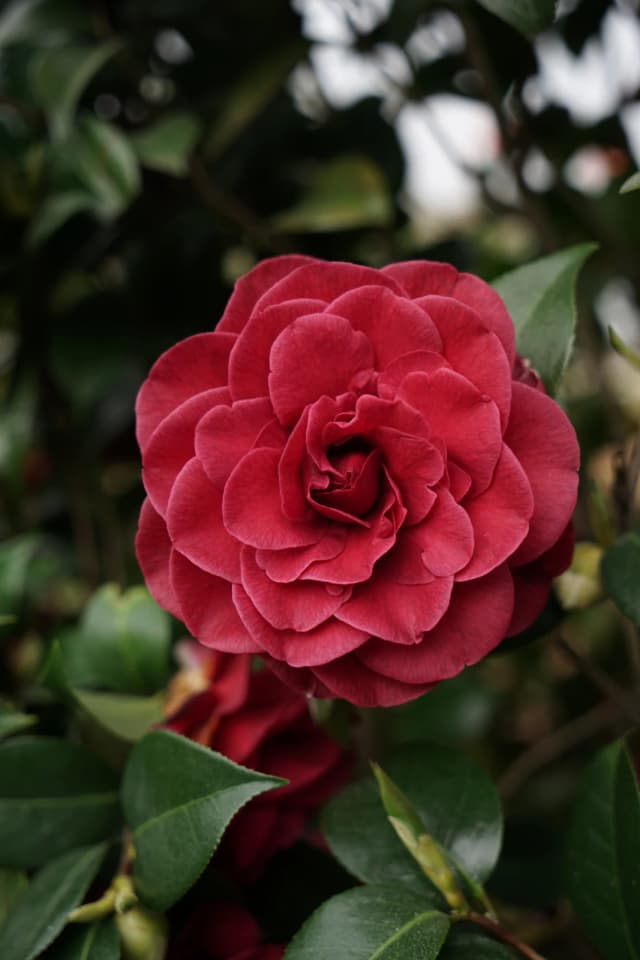
Camellia japonica
Camellia
- SunPartial shade, Full shade
- Mature height1.5–6 m
- FoliageEvergreen
- Rate of growthSlow
- Maintenance levelModerate
A structural hedge or small single specimen for shaded courtyards, for the understorey of trees of the beech family in historic gardens of the North and for walled settings that call for evergreen foliage and flowering between January and April.
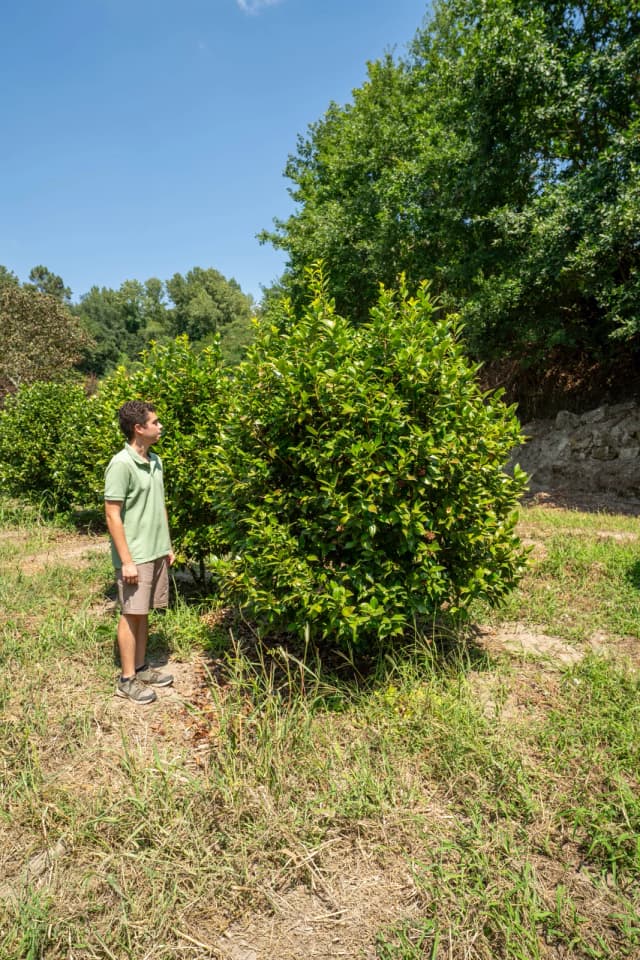
Camellia japonica 'Brushfield's Yellow'
Camellia
‘Brushfield’s Yellow’ approaches yellow through a very particular floral composition: creamy-white outer petals surround a dense centre of small primrose-yellow petaloids. This anemone form, set off against the dark green foliage, makes it one of the most recognisable pale camellias.
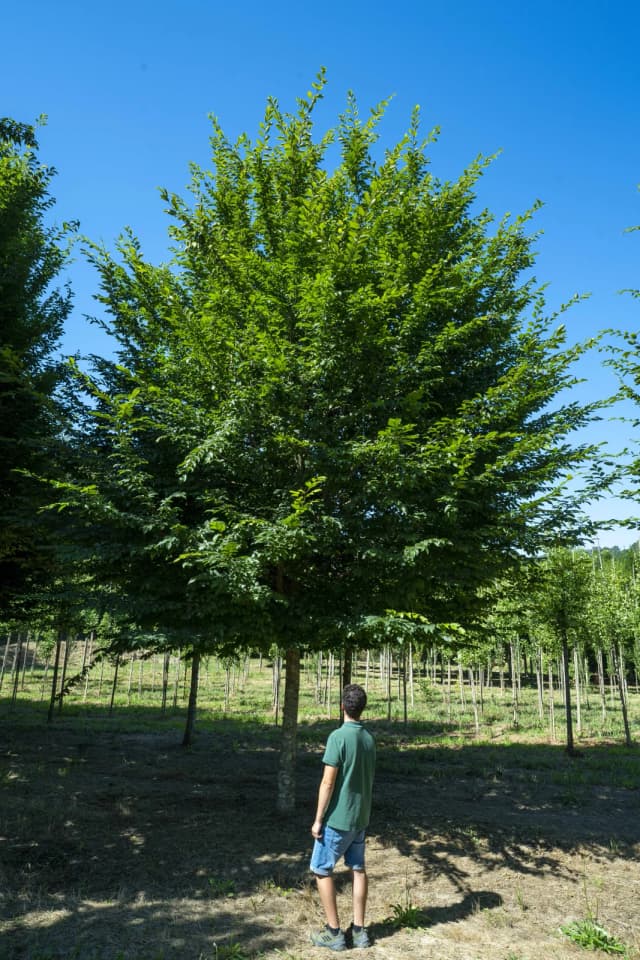
Carpinus betulus
Hornbeam
- SunFull sun, Partial shade
- Mature height15–25 m
- FoliageDeciduous
- Rate of growthMedium
- Maintenance levelEasy
A European tree with a dense crown and great longevity, recognised by its deeply fluted grey trunk and its strongly textured foliage. Its extraordinary response to pruning allows it to be used both in its natural form and in hedges, pleached screens, avenue plantings and rigorously trained plant structures.
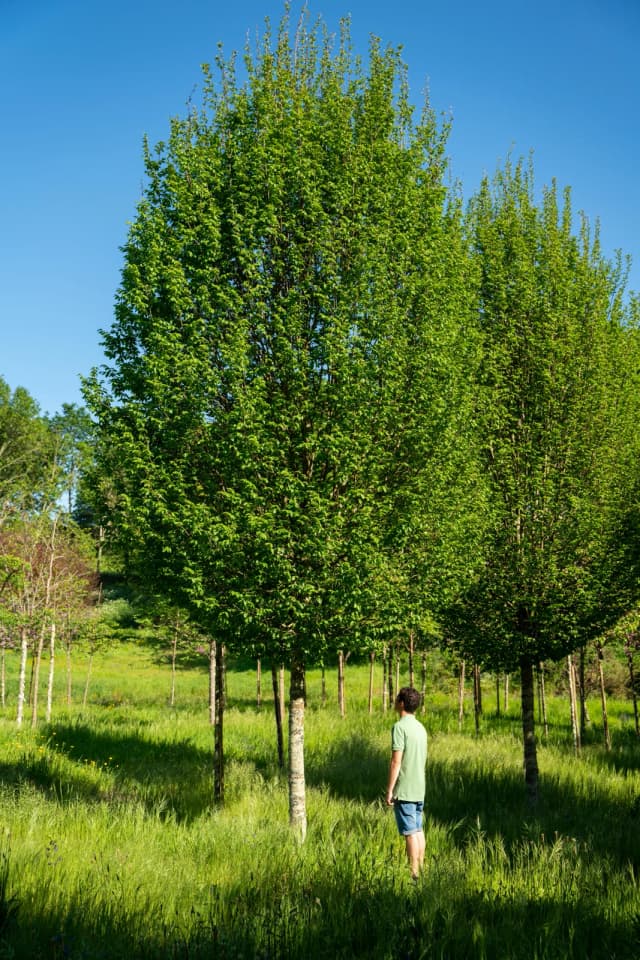
Carpinus betulus 'Fastigiata'
Hornbeam
- SunFull sun
- Mature heightUp to 15 m
- FoliageDeciduous
- Rate of growthMedium
A selection of hornbeam with a well-defined vertical axis and strongly ascending branching. The narrow, pyramidal crown of youth gradually turns into a broad oval structure, compact and densely leaved, creating a tree of strong formal presence for avenues, entrances and large avenue plantings.
Carpinus betulus 'Lucas'
Hornbeam
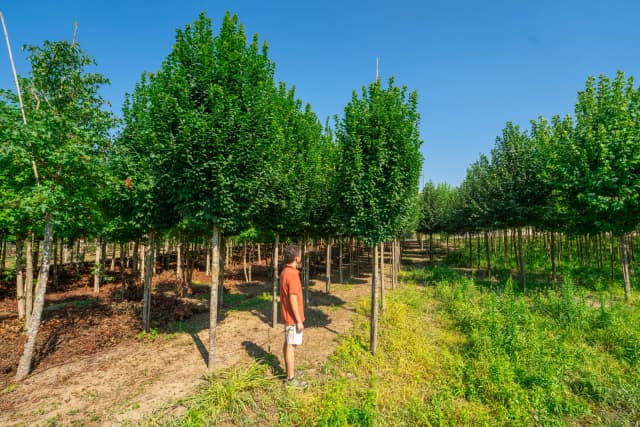
A hornbeam cultivar with a narrow, compact and densely branched crown, it keeps a more contained vertical silhouette than ‘Fastigiata’. The dark green foliage takes on golden tones in autumn and stays brown on the branches for much of the winter, prolonging the visual presence of the tree.
Carpinus betulus 'Monumentalis'
Hornbeam
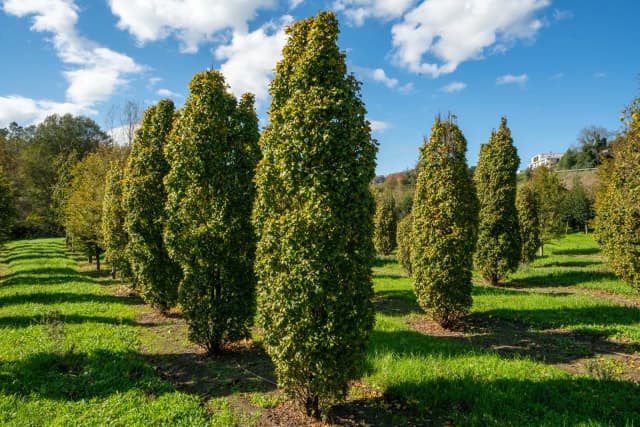
A very slow-growing cultivar, it naturally forms an extremely compact, dense and regular columnar crown, like a living obelisk. Its restrained size makes it possible to introduce a precise architectural presence in small gardens and urban spaces where other columnar trees would reach an excessive volume.
Cedrus atlantica
Atlas cedar
- SunFull sun
- Mature height20–40 m
- FoliageEvergreen
- Rate of growthMedium
- Maintenance levelEasy
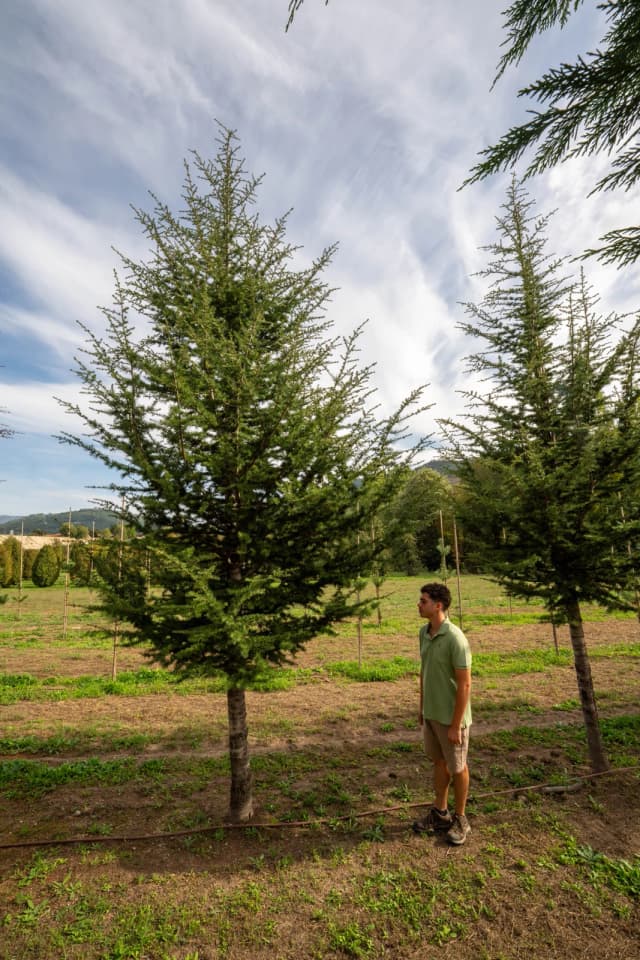
A large conifer of monumental presence, it develops a crown that is pyramidal at first and becomes progressively broader, more open and sculptural. The horizontal arrangement of its branches, its evergreen foliage, green to grey-green, and its longevity give it an exceptional architectural expression.
Cedrus atlantica 'Aurea'
Atlas cedar
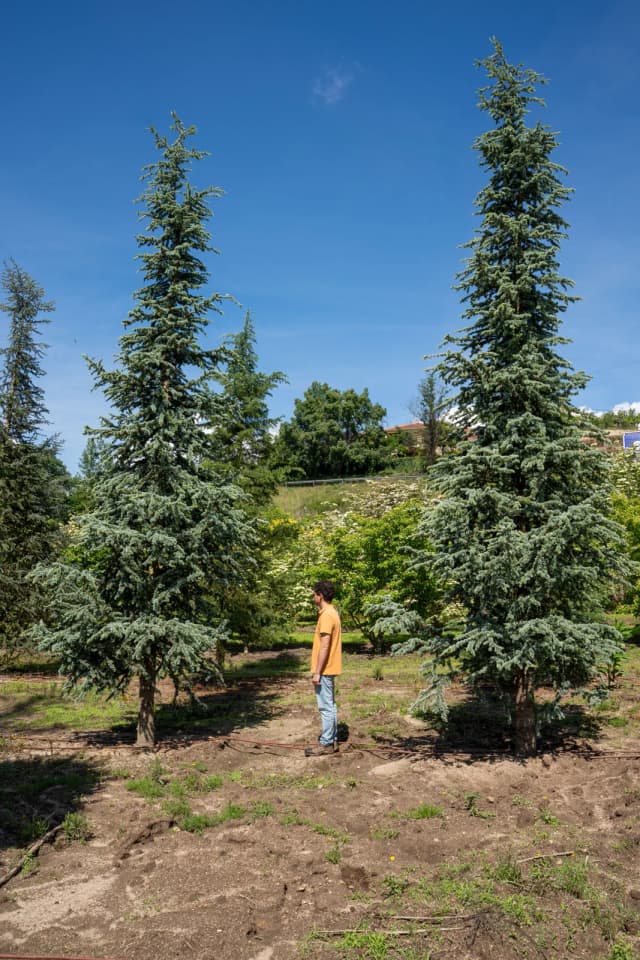
An evergreen conifer of relatively slow growth, it stands out for the golden-yellow foliage of its young shoots, which contrasts with the yellowish-green and bluish-green tones of the older needles. The crown, pyramidal at first, becomes progressively broad and layered, acquiring a luminous, monumental presence.
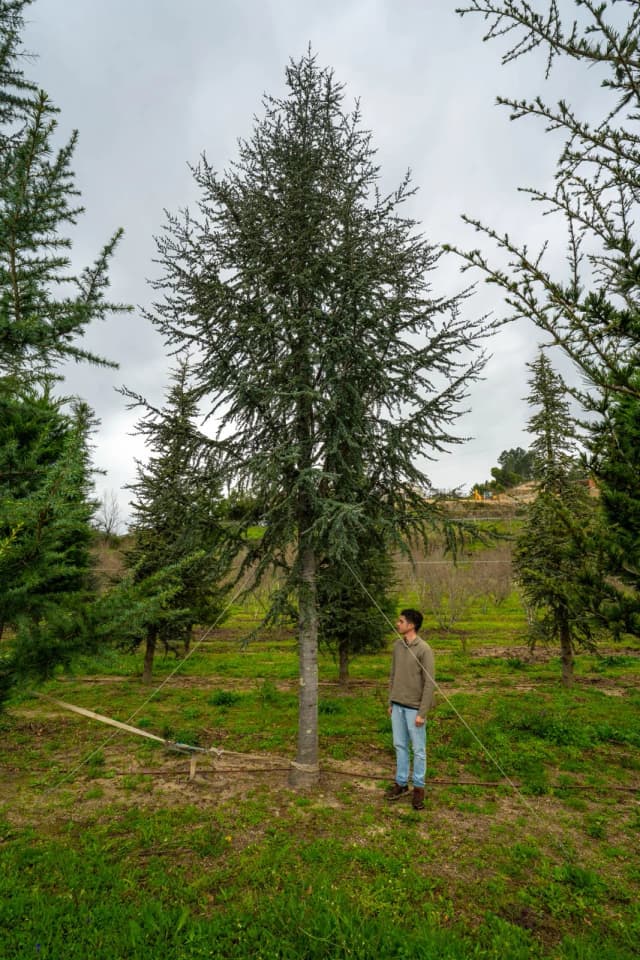
Cedrus atlantica 'Glauca'
Atlas cedar
- SunFull sun
- Mature height15–20 m
- FoliageEvergreen
- Rate of growthSlow
With the silvery-blue foliage that sets the cultivar apart from the botanical type, this conifer has established itself in historic Portuguese parks and avenues as an architectural feature with a broad crown and an unmistakable silhouette.
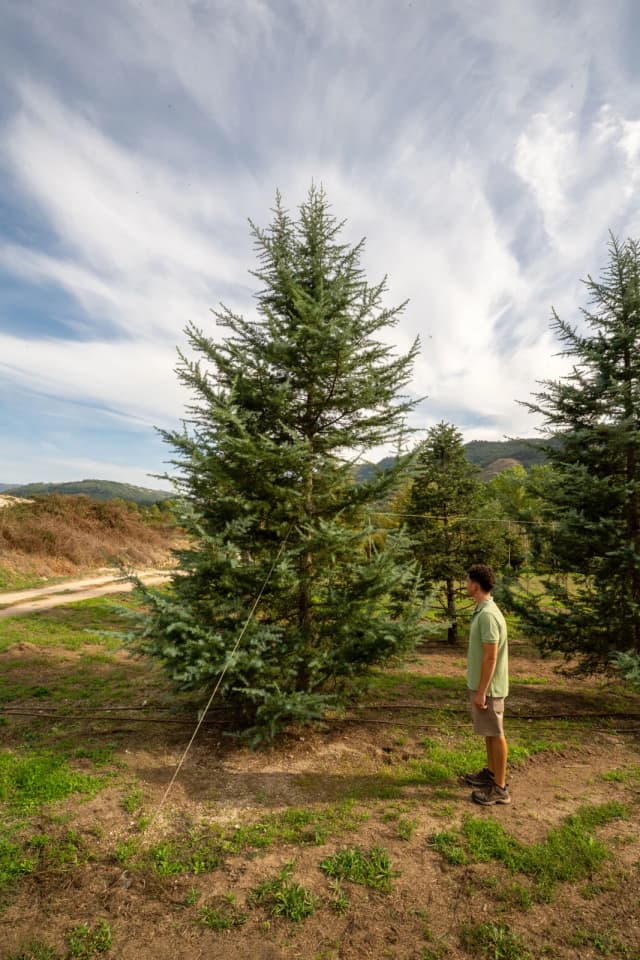
Cedrus deodara
Deodar cedar
- SunFull sun
- Mature height20–40 m
- FoliageEvergreen
- Rate of growthMedium
- Maintenance levelEasy
A large evergreen conifer, it stands out for its extraordinary grey-blue to silvery-blue foliage and for its progressively broad, layered architecture. The crown, pyramidal at first, becomes more open and sculptural with age, giving mature specimens a monumental presence.
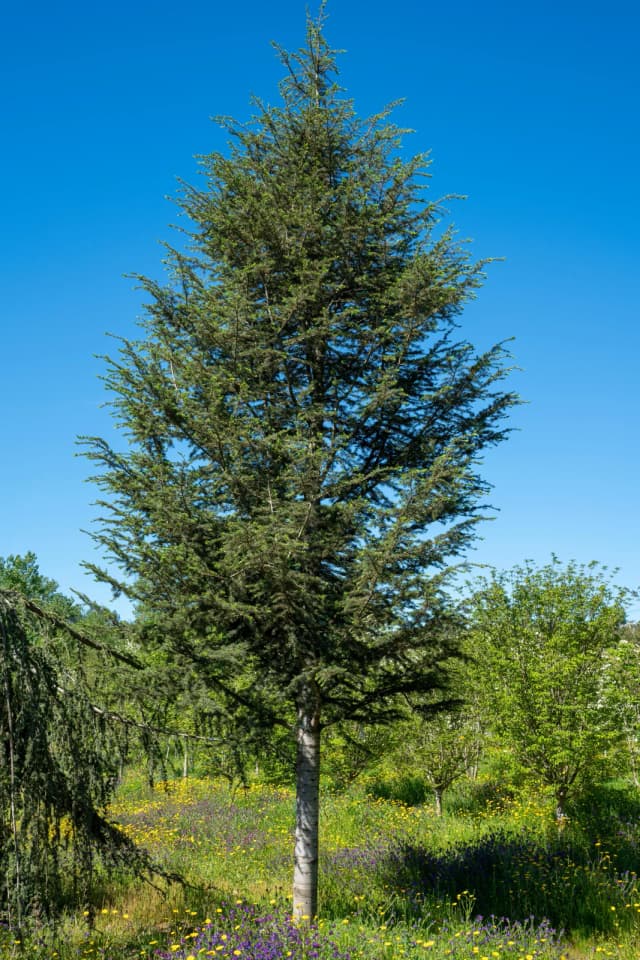
Cedrus libani
Cedar of Lebanon
- SunFull sun
- Mature height20–40 m
- FoliageEvergreen
- Rate of growthSlow
- Maintenance levelEasy
An evergreen conifer of extraordinary longevity and monumental presence, it develops a crown that is pyramidal at first and becomes, with age, a broad, tabular structure. The great horizontal branches form successive tiers, creating one of the most recognisable silhouettes among mature conifers.
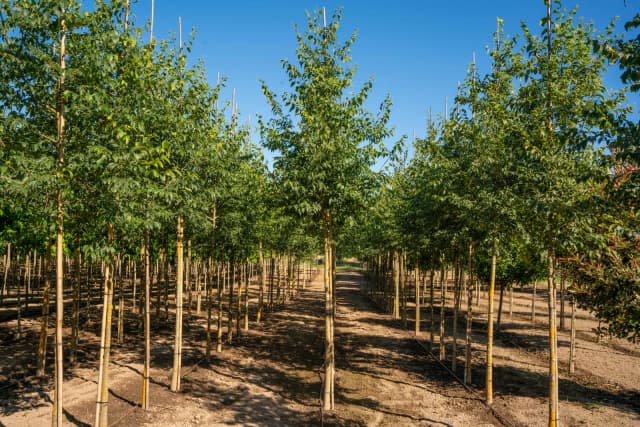
Celtis australis
Southern nettle tree
- SunFull sun
- Mature height15–25 m
- FoliageDeciduous
- Rate of growthMedium
- Maintenance levelEasy
A tree native to Portugal, it combines a light grey trunk of sculptural expression with a broad, luminous crown that is effective in creating shade. Its ability to stay vigorous in stony, chalky soils, under heat and drought, makes it especially relevant to the Portuguese landscape and to urban projects prepared for a more demanding climate.
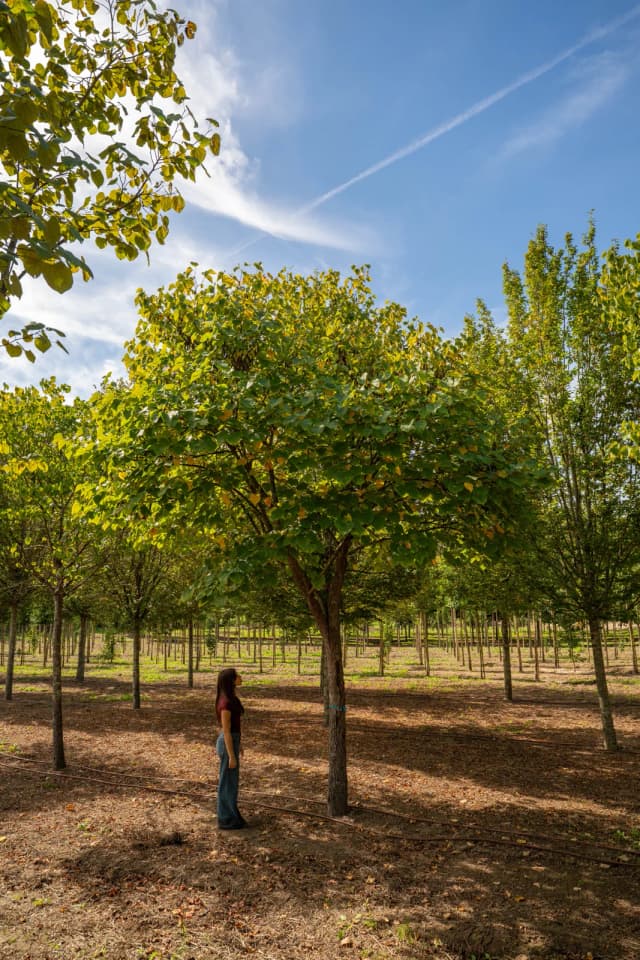
Cercis canadensis
Eastern redbud
A small deciduous tree of North American origin, with a rounded crown and often several stems. In early spring it covers its still bare branches with magenta-pink flowers, followed by broad heart-shaped leaves that turn yellow in autumn.
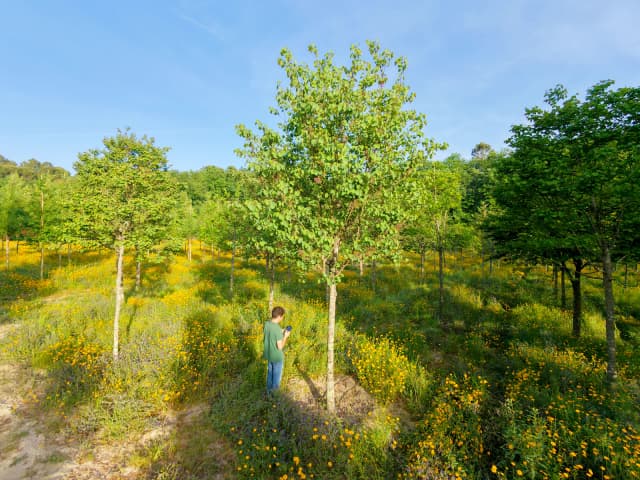
Cercis siliquastrum
Judas tree
- SunFull sun
- Mature height5–10 m
- FoliageDeciduous
- Rate of growthMedium
- Maintenance levelEasy
A small deciduous tree with a broad, irregular crown, it is transformed in early spring by an intense purple-pink flowering that appears directly on the mature branches and on the trunk itself. Heart-shaped leaves and long, flattened pods follow, extending the ornamental interest through the year.
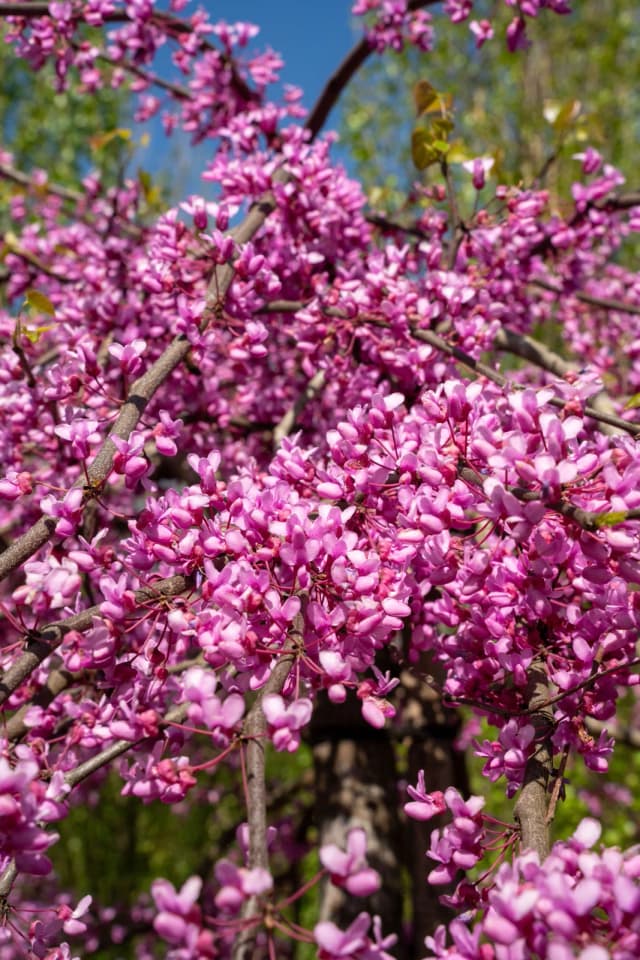
Cercis siliquastrum 'Pendula'
Judas tree
A small deciduous tree of weeping habit, it combines a cascading crown with the intense purple-pink flowering characteristic of the species. The flowers appear directly on the mature branches and the trunk, before the heart-shaped leaves, turning the whole structure of the tree into a spring event.
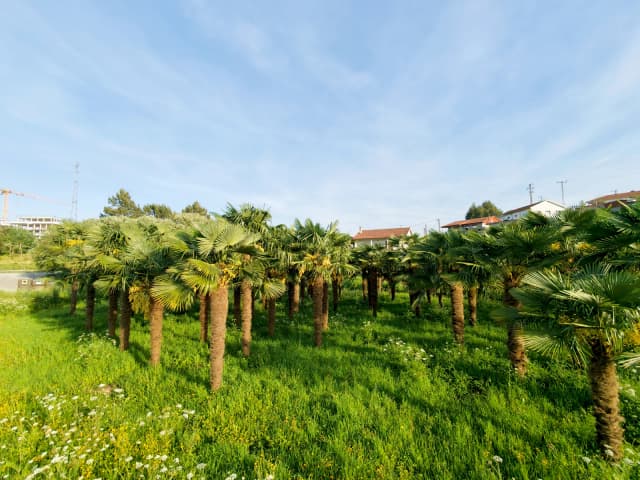
Chamaerops excelsa
Chusan palm
- SunFull sun, Partial shade
- Mature height6–12 m
- FoliageEvergreen
- Rate of growthSlow
- Maintenance levelEasy
A palm of upright habit, recognisable by its trunk clothed in brown fibres and its compact crown of large fan-shaped leaves. Its cold hardiness and small lateral footprint make it particularly versatile in urban gardens and projects of Mediterranean or tropical inspiration.
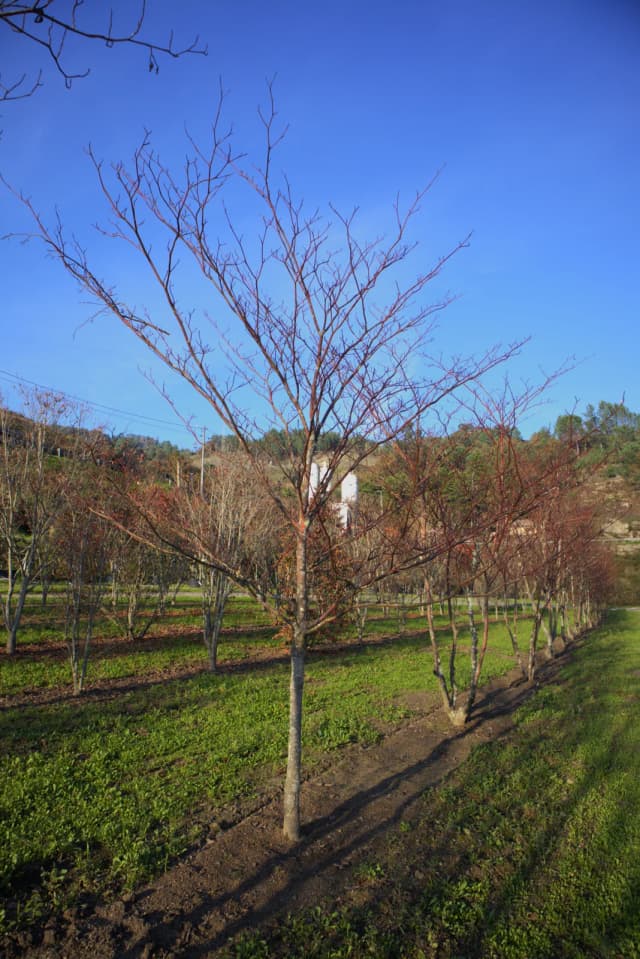
Cornus controversa
Wedding cake tree
The architecture of Cornus controversa is built from successive tiers of horizontal branches, forming a layered silhouette that remains recognisable even in winter. In early summer, each platform is covered in white flower heads, visually reinforcing the organisation of the crown.
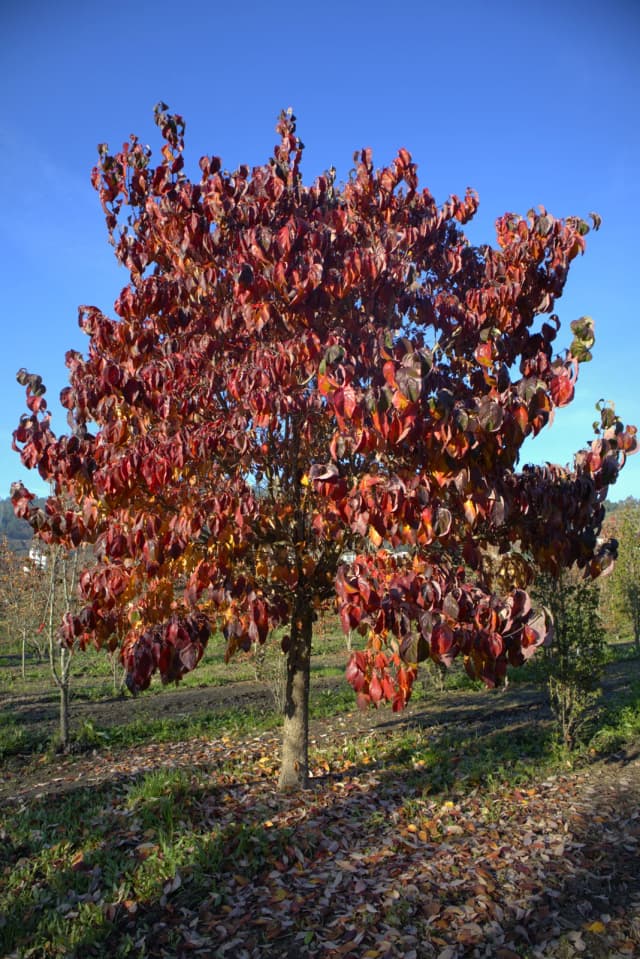
Cornus florida
Flowering dogwood
- SunPartial shade, Full sun
- Mature height5–10 m
- FoliageDeciduous
- Rate of growthSlow
- Maintenance levelModerate
Native to eastern North America, Cornus florida announces spring by covering its still sparsely leaved crown with four large white bracts, recognisable by their notched tip. Red fruits follow, then a scarlet to violet autumn colour and, in mature specimens, a finely chequered bark.
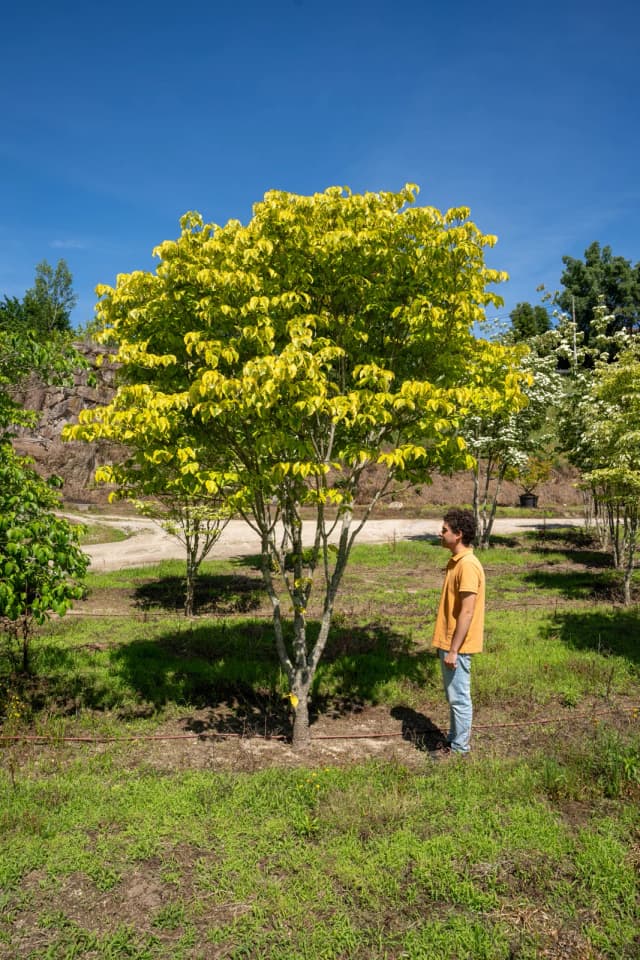
Cornus florida 'Rainbow'
Flowering dogwood
- SunPartial shade, Full sun
- Mature height4–6 m
- FoliageDeciduous
- Rate of growthSlow
A small deciduous tree with a compact, elegant crown, it is distinguished by green foliage edged with creamy yellow, by white flowering in spring and by an extraordinary change of colour in autumn. The succession of colours through the year makes it especially suited to small gardens and compositions that call for a luminous focal point.
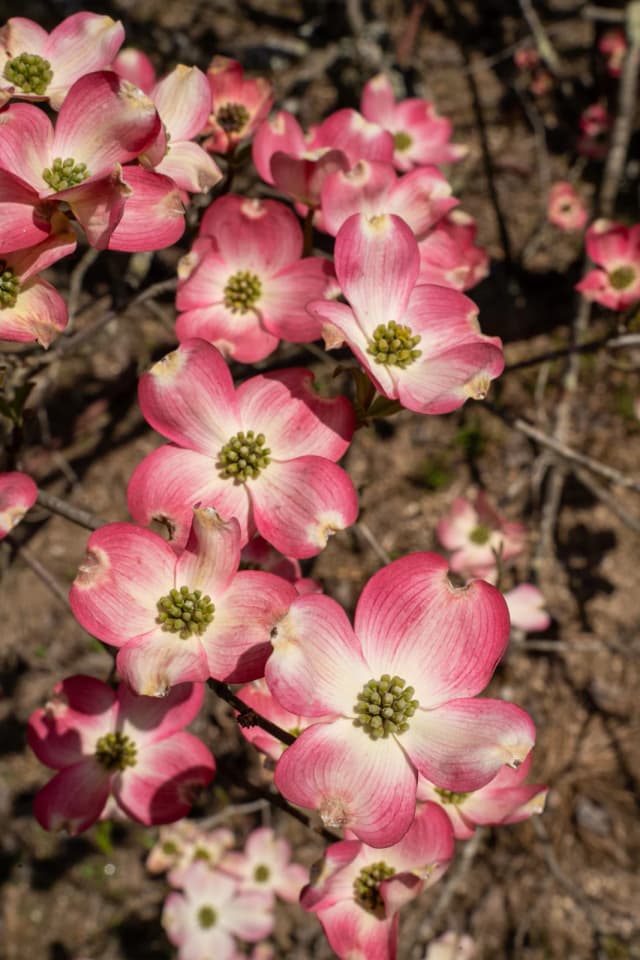
Cornus florida 'Rubra'
Flowering dogwood
- SunPartial shade, Full sun
- Mature height6–8 m
- FoliageDeciduous
- Rate of growthSlow
A small deciduous tree with a progressively broad crown, it stands out for the abundant pink flowering that covers the branches in spring. Red fruits and intense autumn colour follow, extending its interest over several seasons.
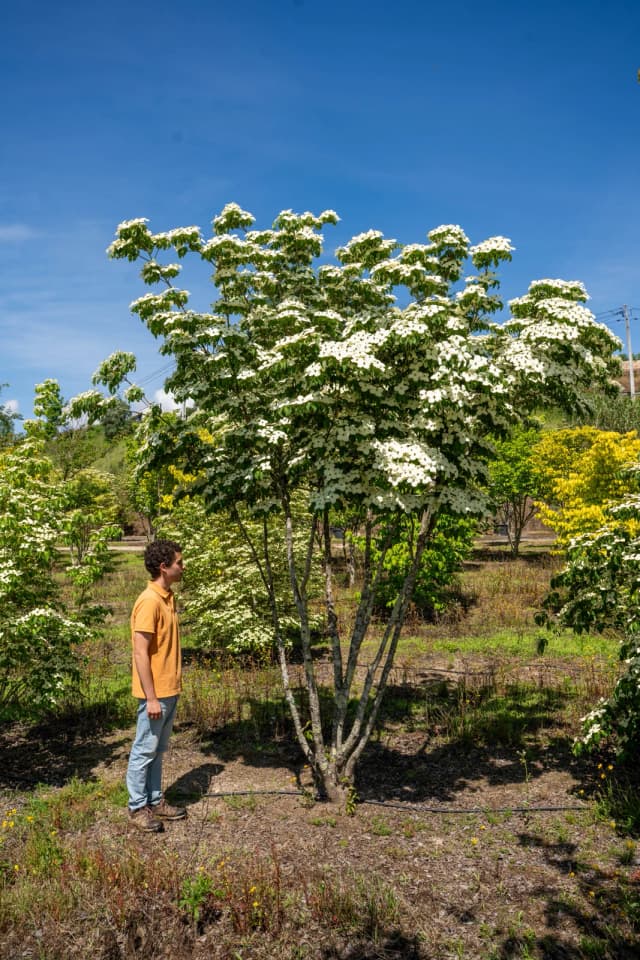
Cornus kousa 'Chinensis'
Kousa dogwood
- SunPartial shade, Full sun
- Mature height6–9 m
- FoliageDeciduous
- Rate of growthMedium
A small tree or medium-sized shrub, with a progressively broad, layered crown, it stands out for its abundant white flowering in early summer. Pinkish fruits and intense autumn colour follow, while the bark of mature specimens adds interest during the winter.
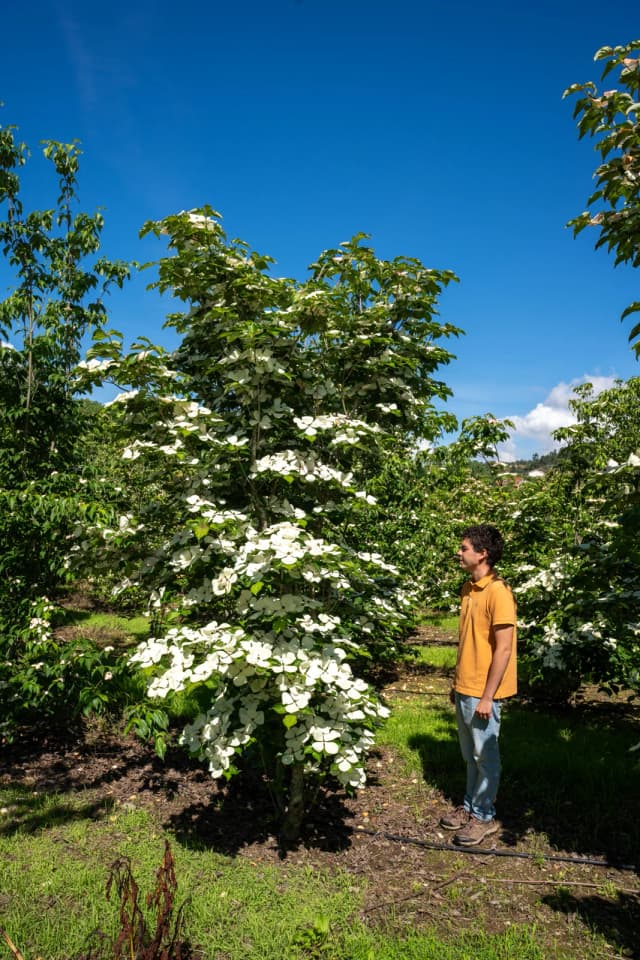
Cornus kousa 'Venus'
Kousa dogwood
- SunPartial shade, Full sun
- Mature height5–7 m
- Rate of growthSlow
A small deciduous tree of vigorous growth and dense crown, it stands out for its extraordinary creamy-white bracts, which can exceed 15 centimetres in diameter. The abundant flowering covers much of the crown in late spring and is complemented by red fruits and intense autumn colour.
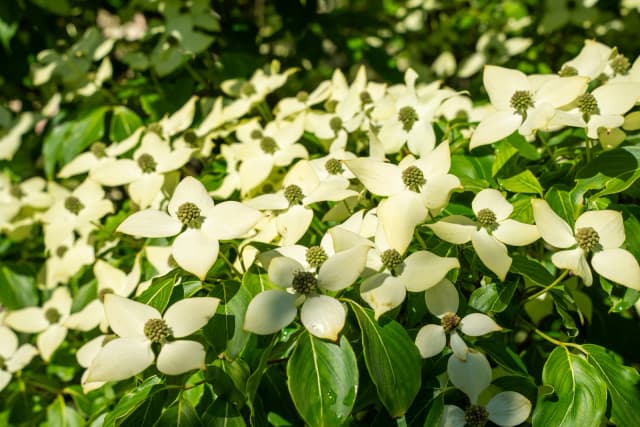
Cornus kousa chinensis 'China Girl'
Kousa dogwood
A small deciduous tree of vigorous growth with a broad, vase-shaped crown, it stands out for its white flowering, abundant from a relatively young age. The large creamy-white bracts are followed by numerous red fruits, while the foliage takes on intense tones in autumn.
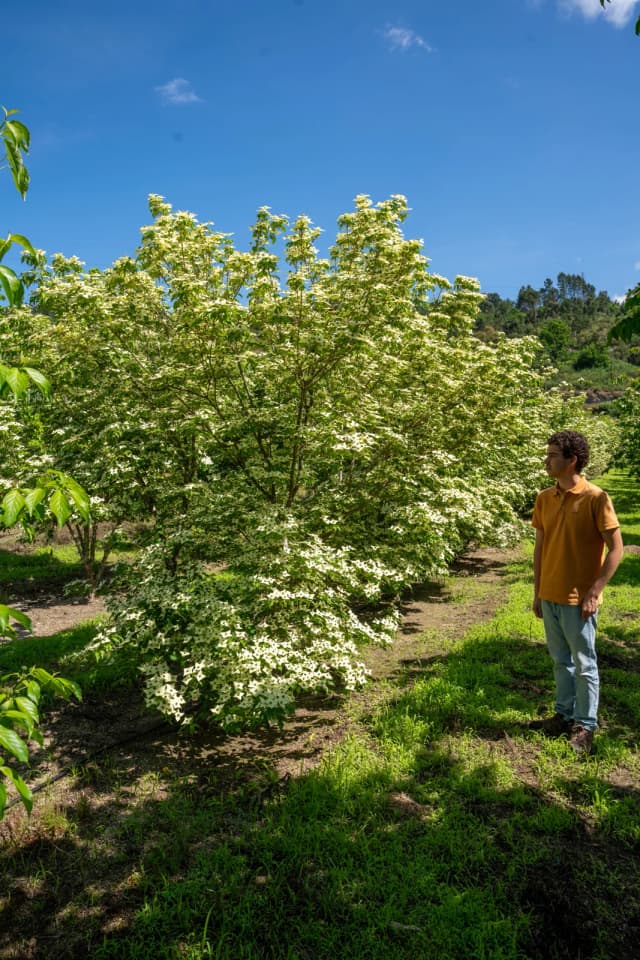
Cornus kousa chinensis 'Milky Way'
Kousa dogwood
A small deciduous tree with a broad crown and open branching, it stands out for the extraordinary quantity of creamy-white bracts that covers the foliage in early summer. The flowering is followed by numerous red fruits, while the foliage takes on intense tones of orange, red and purple in autumn.
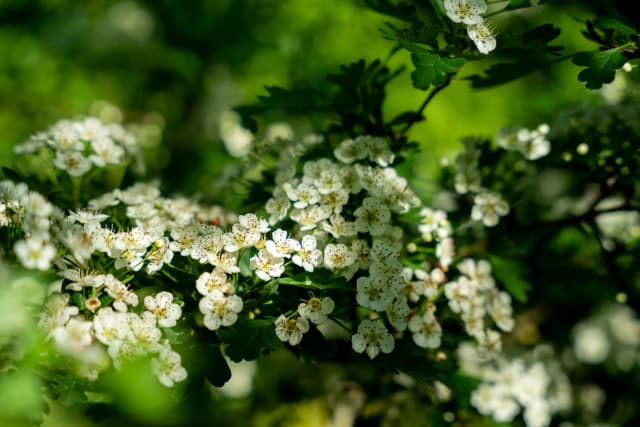
Crataegus monogyna
Common hawthorn
- SunFull sun, Partial shade
- Mature height5–10 m
- FoliageDeciduous
- Rate of growthMedium
- Maintenance levelEasy
A small native deciduous tree with a rounded crown and naturalistic character, it stands out for its abundant white spring blossom and the numerous red fruits that persist through the autumn. Its great hardiness and its value for biodiversity make it particularly suitable for gardens, parks and landscape integration projects.
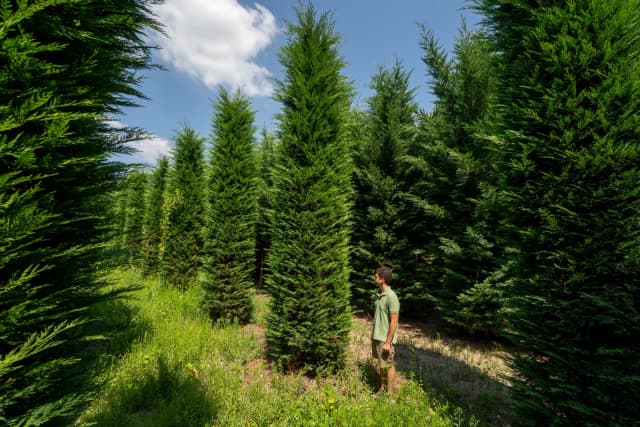
Cupressocyparis leylandii
Leyland cypress
- SunFull sun
- FoliageEvergreen
- Rate of growthFast
A very fast-growing evergreen conifer with a columnar to narrowly pyramidal habit, it forms a dense mass of vegetation from the base. Its evergreen foliage and strong response to pruning make it particularly effective for creating tall hedges, visual screens and windbreaks.
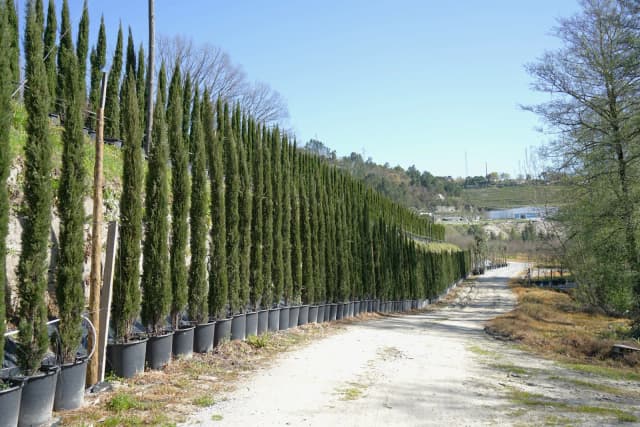
Cupressus sempervirens 'Stricta'
Italian cypress
- SunFull sun
- Mature heightUp to 15 m
- FoliageEvergreen
- Rate of growthSlow
An evergreen conifer with an extremely narrow, vertical silhouette, it stands out for its dense columnar crown and dark green foliage. Its small lateral footprint makes it possible to bring height, rhythm and structure to limited spaces, making it one of the most characteristic elements of Mediterranean gardens.
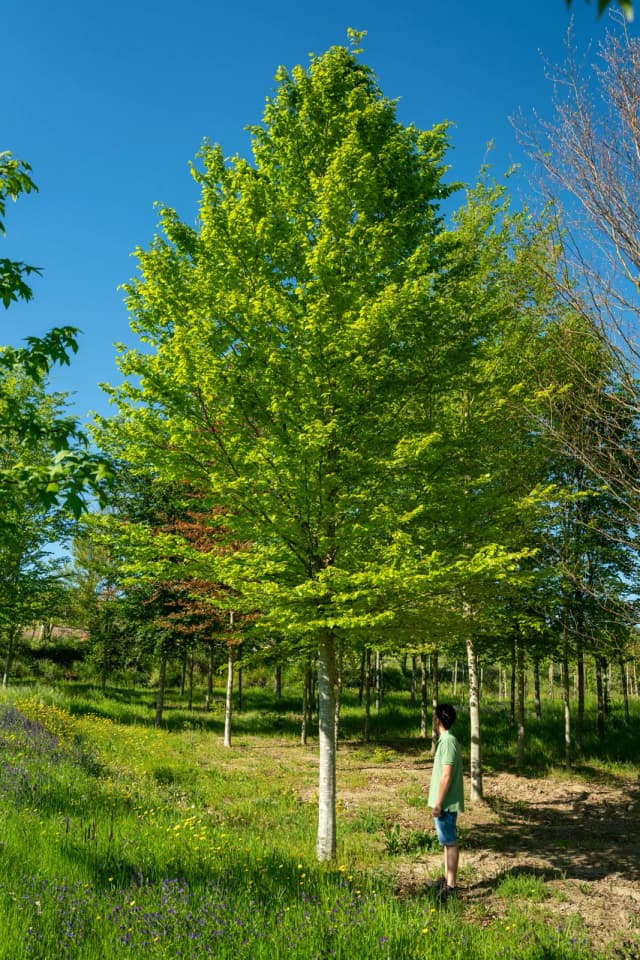
Fagus sylvatica
European beech
- SunFull sun, Partial shade
- Mature height20–35 m
- FoliageDeciduous
- Rate of growthMedium
- Maintenance levelEasy
A large deciduous tree with a broad, majestic crown, it combines luminous foliage with grey, smooth and instantly recognisable bark. The transformation of the leaves, from the light green of spring to the golden and coppery tones of autumn, reinforces its presence through the seasons.
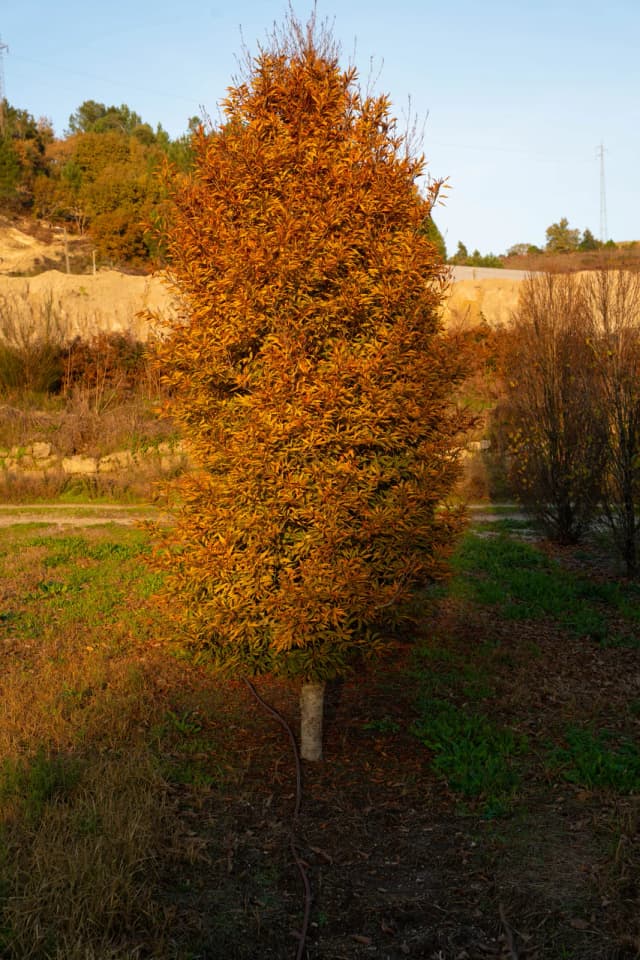
Fagus sylvatica 'Aspleniifolia'
European beech
A deciduous tree with a broad, rounded crown, it is distinguished by its deeply cut foliage, which gives the beech an unusually light and delicate texture. It keeps the elegance and architectural presence of the species, adding lacier foliage and luminous autumn colour.
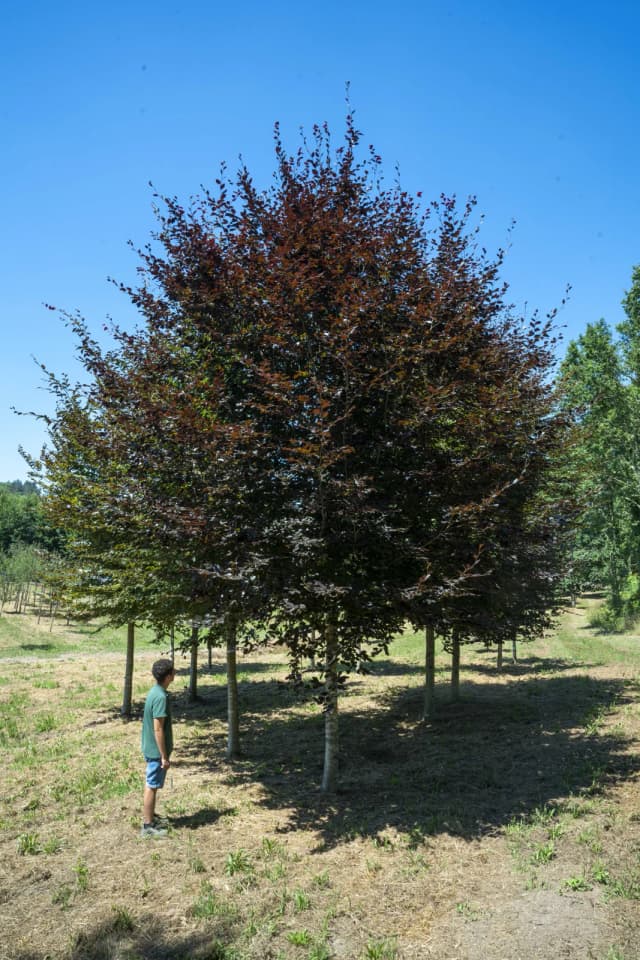
Fagus sylvatica 'Atropurpureum'
European beech
The European beech in its dark-leaved version: intense purple in spring, deep all summer, copper and scarlet in autumn. A broad, dense crown on a smooth grey trunk, for a specimen tree in large gardens, parks and estates in the North and the cool interior.
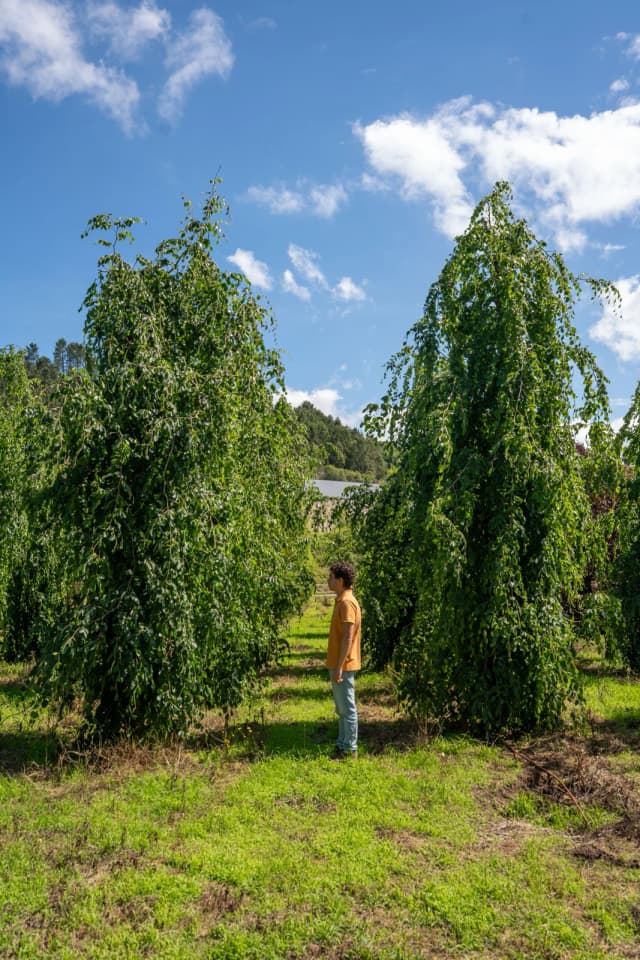
Fagus sylvatica 'Pendula'
European beech
- SunPartial shade, Full sun
- Mature heightUp to 15 m
- FoliageDeciduous
- Rate of growthSlow
A weeping cultivar of the European beech intended for an urban park, historic garden or large green space in the north and centre of the country: it is used as a free-standing specimen, serving as a structuring focal point with an unmistakable silhouette on the location plan.
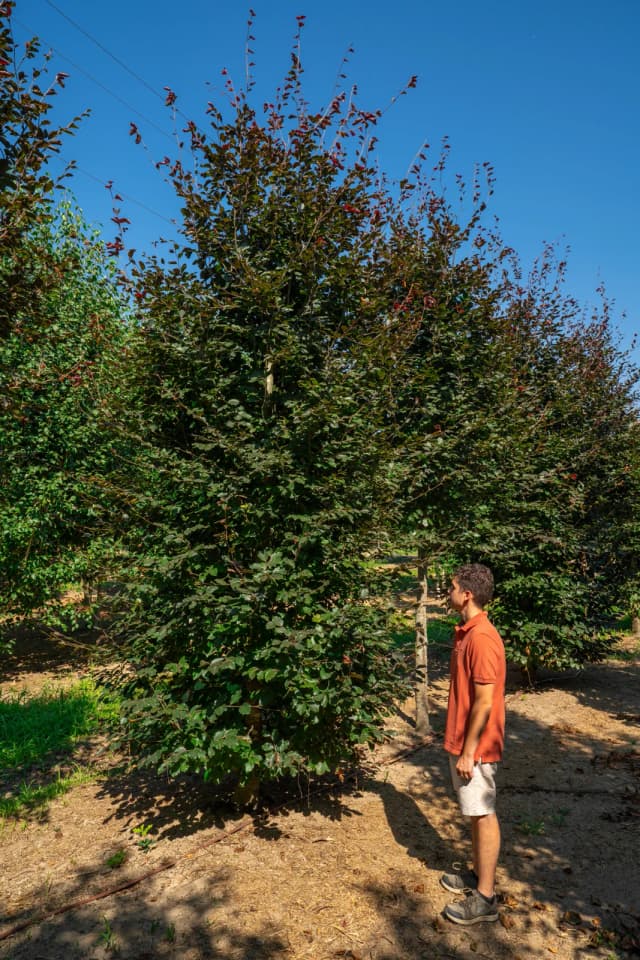
Fagus sylvatica 'Riversii'
European beech
A selection of purple beech with large leaves and the darkest, most stable purple in the genus, which holds its colour all summer and turns copper in autumn. A broad, dense crown on a smooth grey trunk. A tree for parks and large gardens, to be seen from afar.
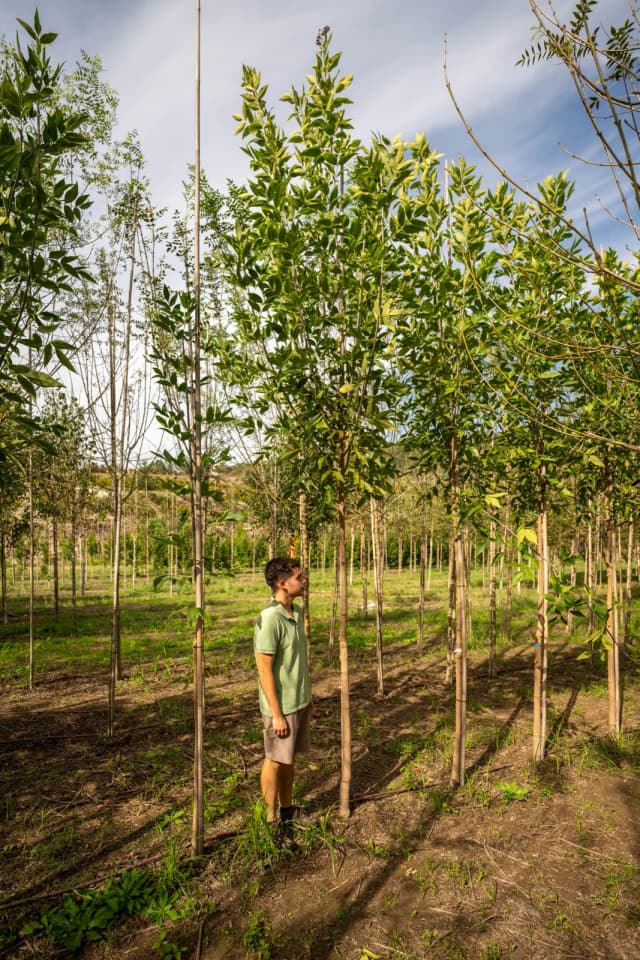
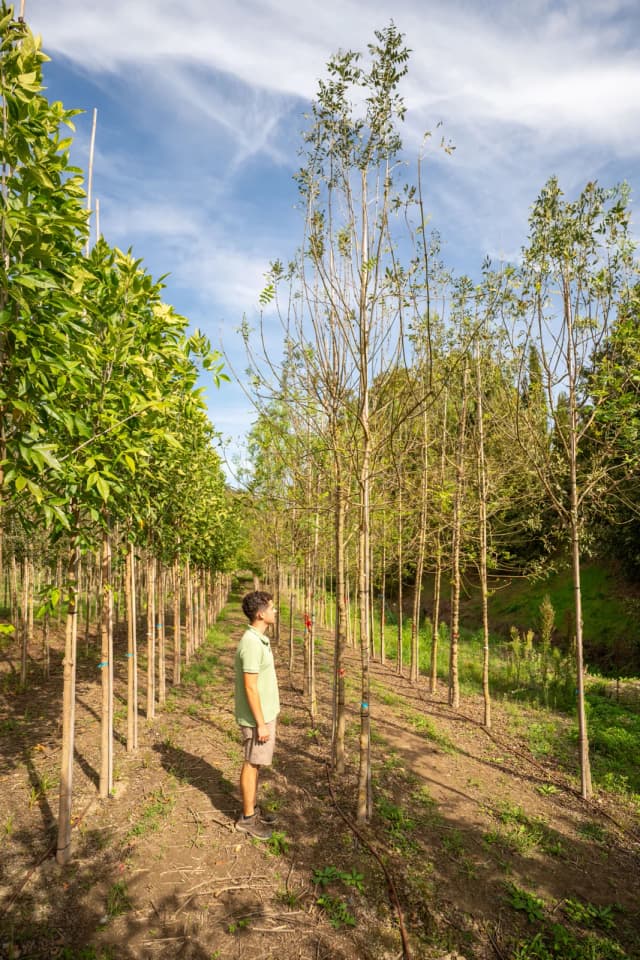
Fraxinus angustifolia
Narrow-leaved ash
- SunFull sun
- Mature height15–25 m
- FoliageDeciduous
- Rate of growthFast
- Maintenance levelEasy
A native tree with a strong riverside identity, it stands out for its broad and relatively transparent crown, made up of compound leaves with particularly narrow leaflets. It combines adaptation to deep, periodically moist soils with a Mediterranean resilience that lets it come through dry periods once well established.
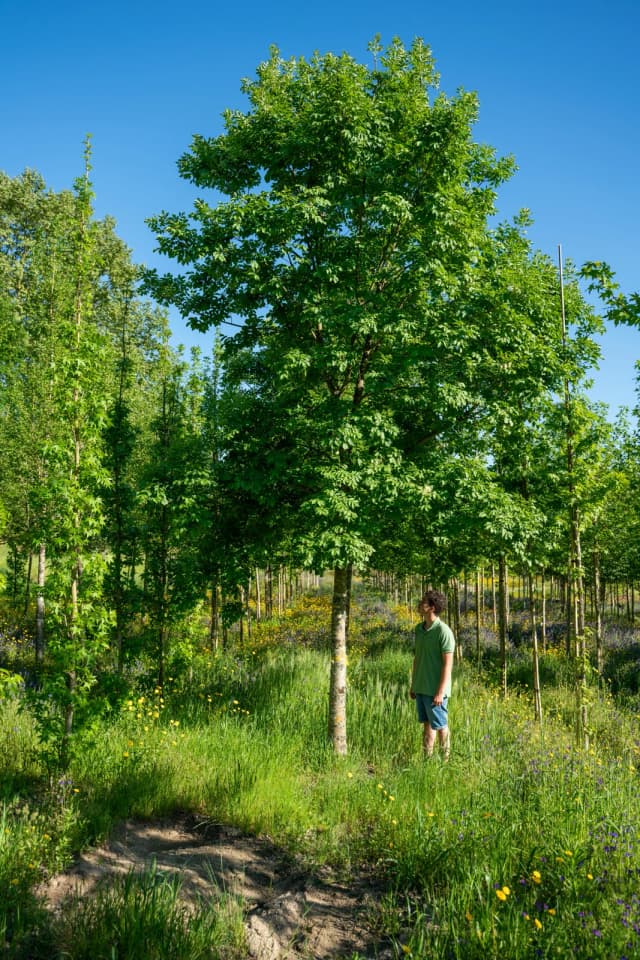
Fraxinus ornus
Manna ash
- SunFull sun
- Mature height8–15 m
- FoliageDeciduous
- Rate of growthMedium
- Maintenance levelEasy
An ash that differs from other ashes in the abundant, scented white flowering that covers the crown in late spring. Its light, Mediterranean character combines the ornamental value of a flowering tree with the robustness needed for urban spaces and gardens exposed to heat.
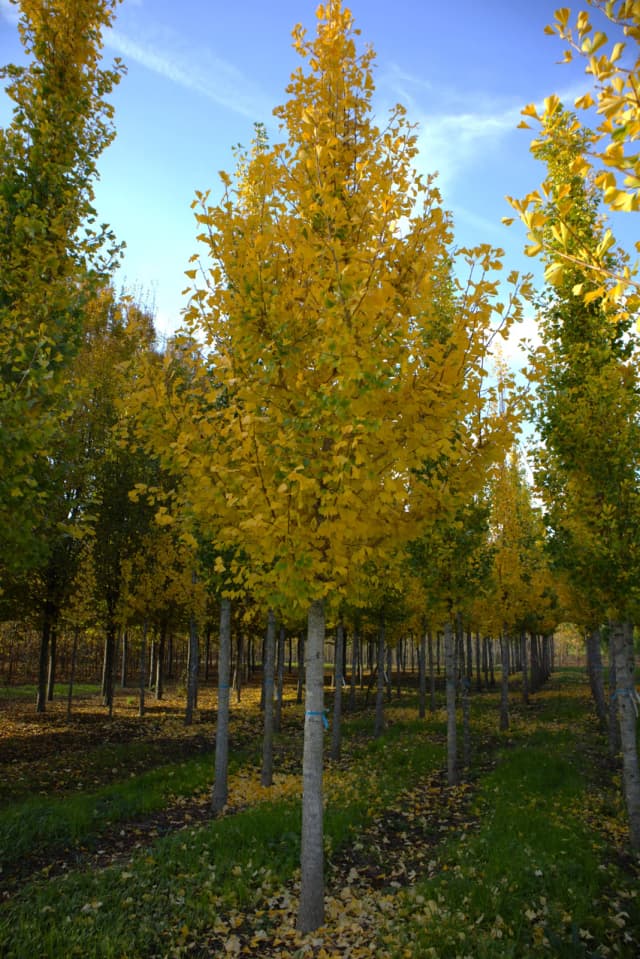
Ginkgo biloba
Ginkgo
- SunFull sun
- Mature height15–25 m
- FoliageDeciduous
- Rate of growthSlow
- Maintenance levelEasy
A species with a conical to pyramidal crown for urban avenue planting and single specimens in squares, chosen when the aim is a structured habit, reliable autumn colour and freedom from the plant-health pressures that now constrain plane and ash.
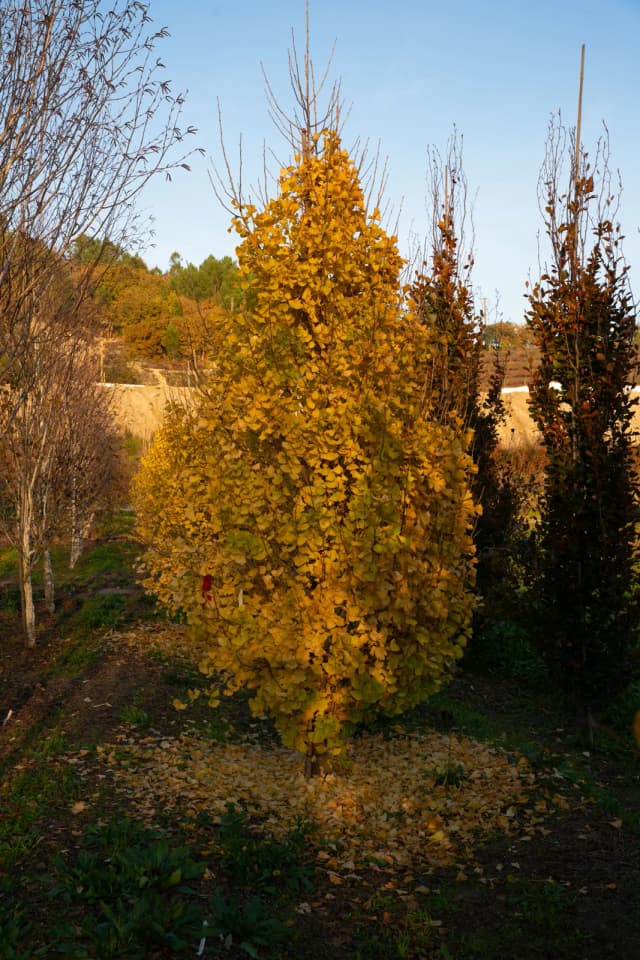
Ginkgo biloba 'Blagon'
Ginkgo
- SunFull sun
- Mature heightUp to 12 m
- FoliageDeciduous
- Rate of growthSlow
A French selection of columnar habit, it concentrates the ancestral identity of the Ginkgo in a narrow, strongly vertical silhouette. In autumn, the foliage turns the whole crown into a golden-yellow column, particularly effective in avenue planting and urban spaces where width is limited.
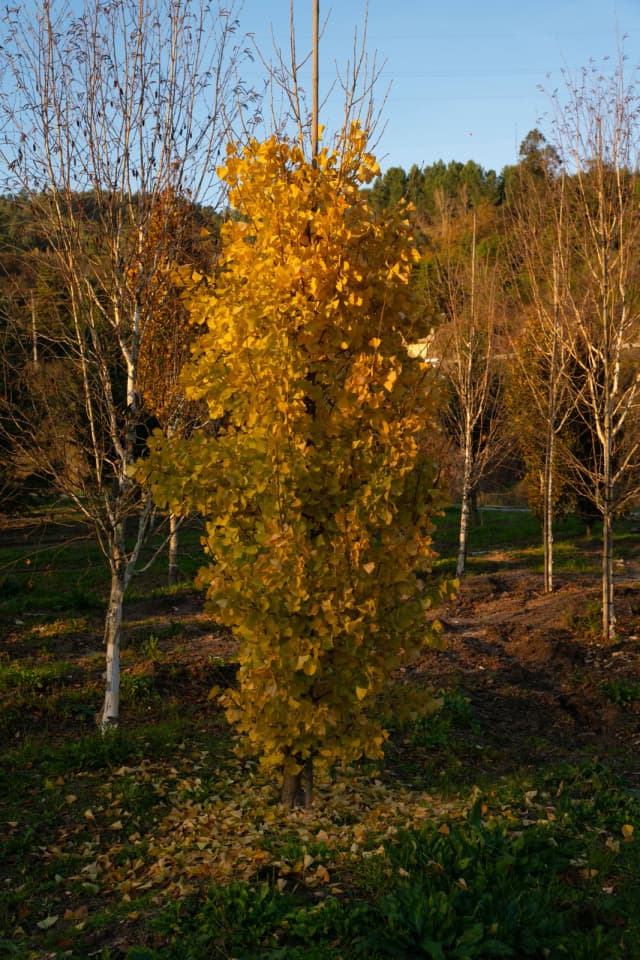
Ginkgo biloba 'Fastigiata'
Ginkgo
A male selection of Ginkgo biloba with a very straight central leader and ascending lateral branches, more fastigiate than the cultivar 'Blagon'. It forms a tall, architectural columnar crown, crowned in autumn by an intense golden-yellow transformation.
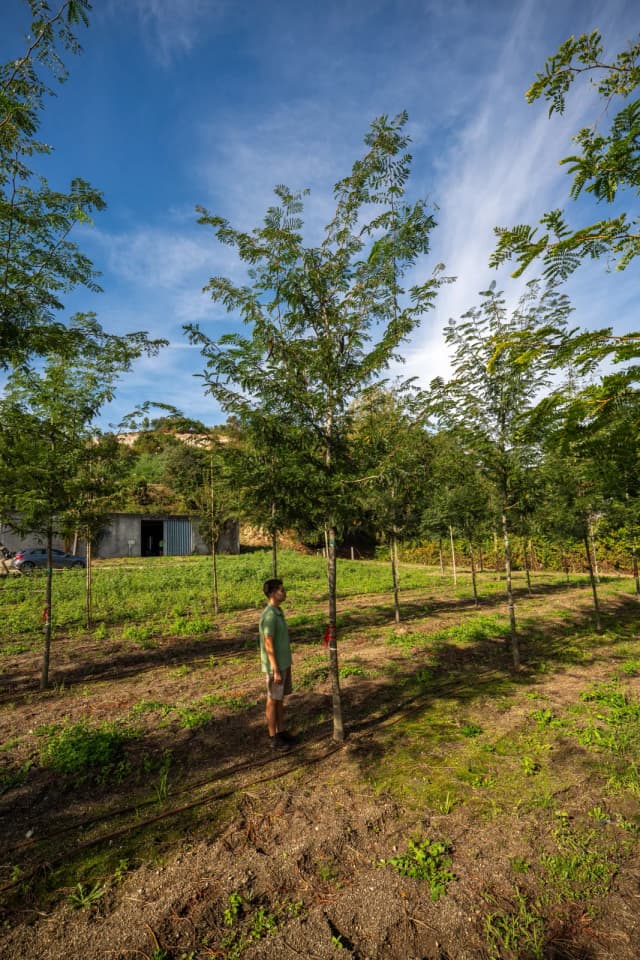
Gleditsia triacanthos 'Inermis'
Honey locust
- SunFull sun
- Mature height12–18 m
- FoliageDeciduous
- Rate of growthFast
A thornless cultivar of Gleditsia triacanthos, selected for urban tree planting where the straight species is ruled out by its thorns; in street planting and squares it takes the place of a plane or an ash, with proven tolerance of drought and pollution.
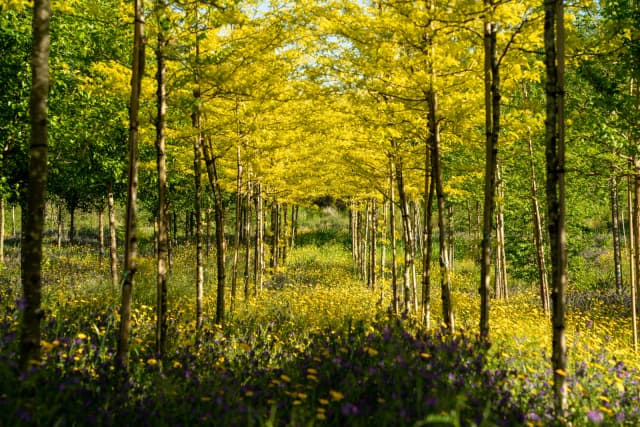
Gleditsia triacanthos 'Sunburst'
Honey locust
- SunFull sun
- Mature height10–15 m
- FoliageDeciduous
- Rate of growthFast
For projects that call for shade without darkness, this golden cultivar of honey locust combines a rounded, airy crown, a complete absence of thorns and pods, and compound foliage that filters the light, allowing lawn or massed planting beneath.
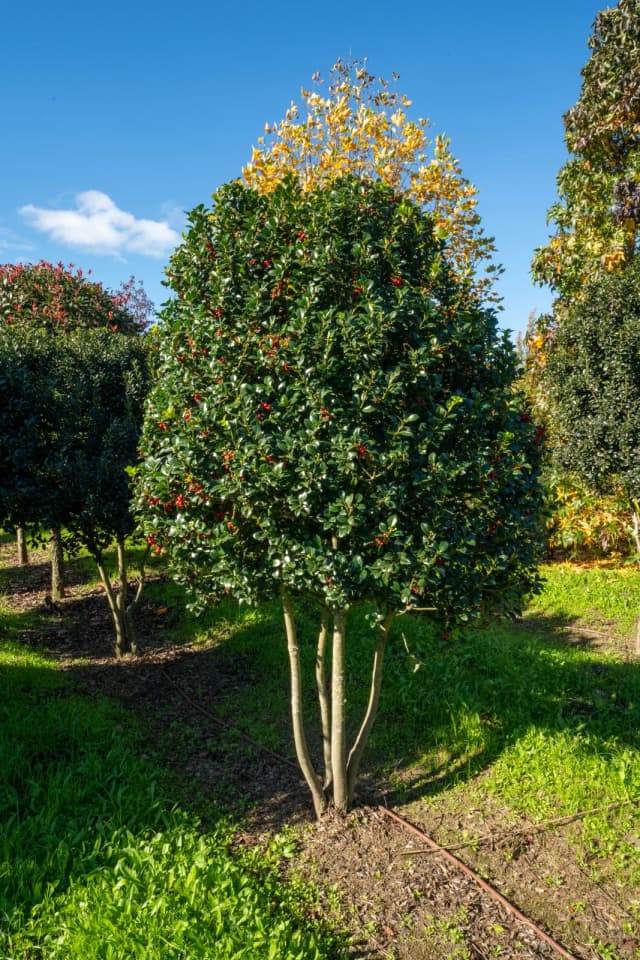
Ilex meserveae 'Heckenfee'
Blue holly 'Heckenfee'
A female cultivar of blue holly, with glossy dark green leaves with a bluish sheen and a compact habit, selected for evergreen hedges of 2 to 3 metres. With a male plant nearby, such as 'Heckenstar', it is covered in red berries in autumn and winter.
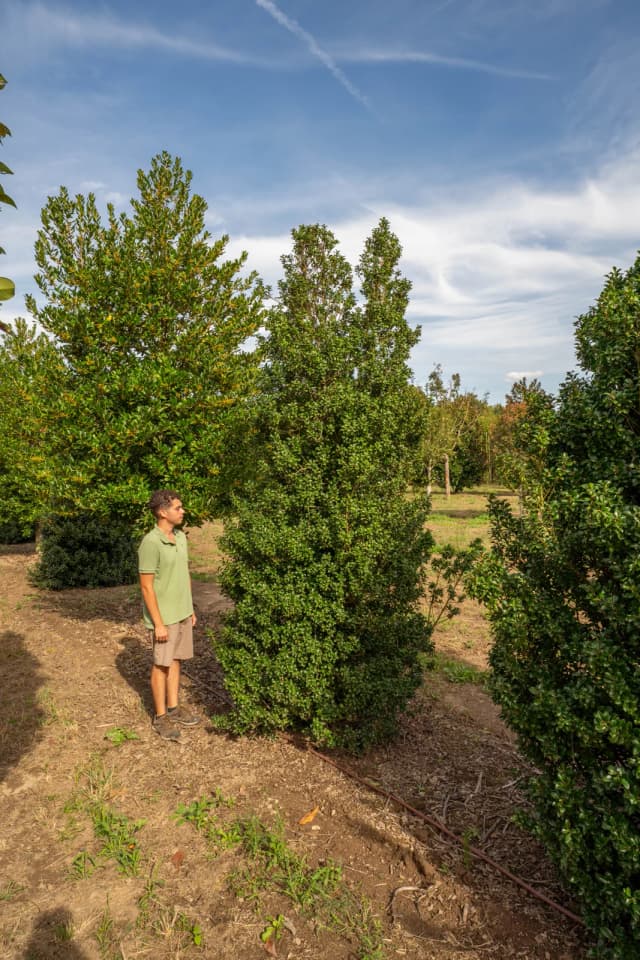
Ilex meserveae 'Heckenstar'
Blue holly 'Heckenstar'
A male cultivar of blue holly, with a compact, pyramidal habit and glossy dark green leaves with bluish glints, selected for evergreen hedges and to pollinate 'Heckenfee', which bears no fruit without it. Resistant to cold and wind, it keeps its foliage immaculate all year round.
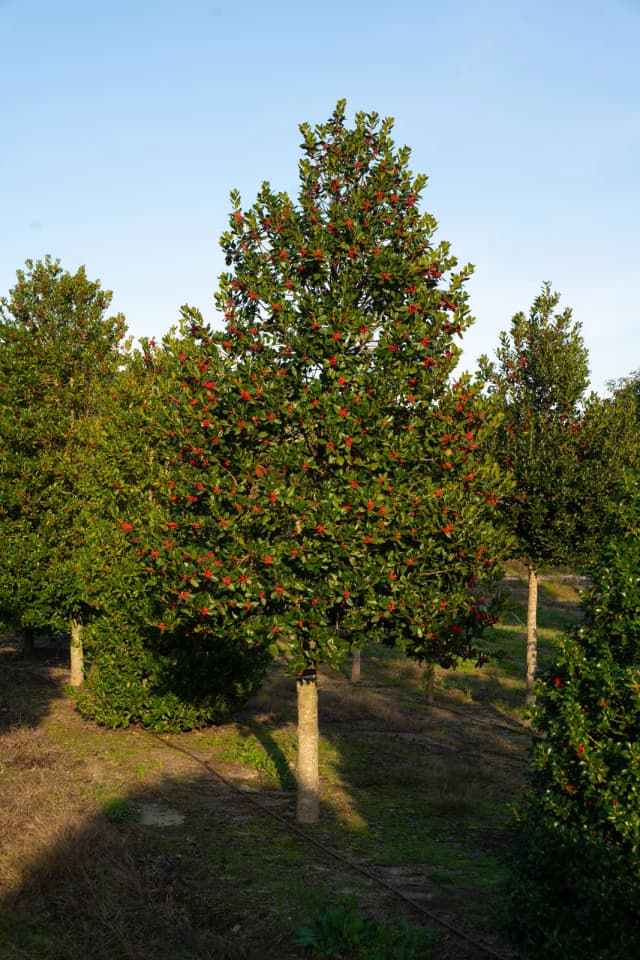
Ilex mutchagara 'Nellie R. Stevens'
Holly
- SunPartial shade, Full sun
- Mature height4–6 m
- Rate of growthSlow
A hybrid holly cultivar with a dense pyramidal habit, dark green spiny foliage and abundant red fruiting. Suited to tall hedges, visual screens and evergreen framing in urban or peri-urban projects.
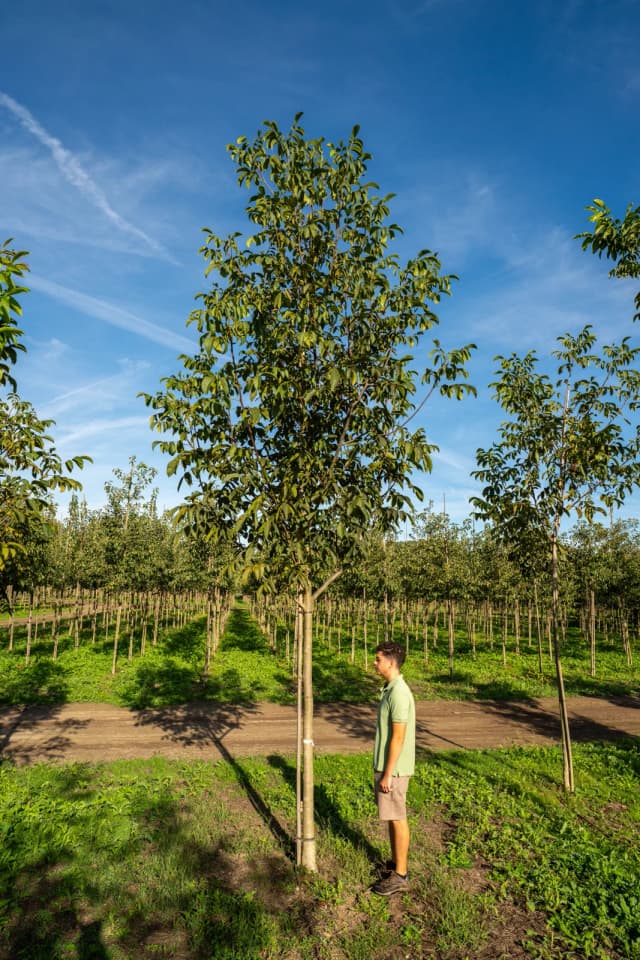
Juglans regia
Walnut
- SunFull sun
- Mature height15–25 m
- FoliageDeciduous
- Rate of growthMedium
- Maintenance levelEasy
A large deciduous tree, cultivated for centuries for its timber and its nuts. Over time it forms a broad, rounded crown that gives cool shade in summer, and it asks for a place with space around it, on country estates, in parks and in large gardens.
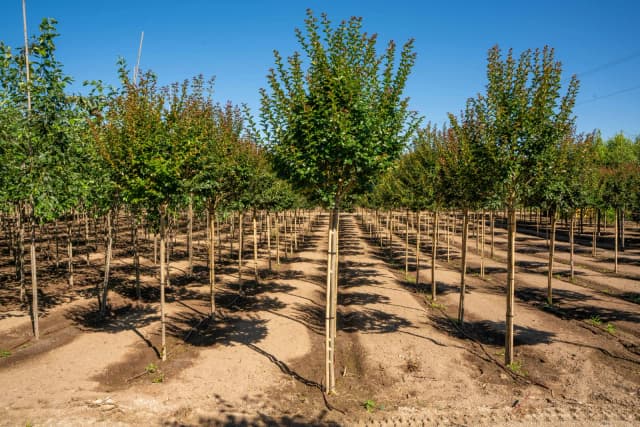
Lagerstroemia indica 'Coccinea'
Crape myrtle
A small deciduous tree that flowers when almost everything else has finished: from July to September it is covered in bright red panicles, above a trunk with smooth bark that peels in patches. In autumn the leaves turn orange and red. Made for sun and heat.
Lagerstroemia indica 'Nivea'
Crape myrtle
A small deciduous tree with abundant white flowering between July and September, when few trees are in flower. The smooth trunk, which peels in patches of grey and light brown, and the foliage that turns orange in autumn make it a four-season feature for courtyards, entrances and sunny gardens.
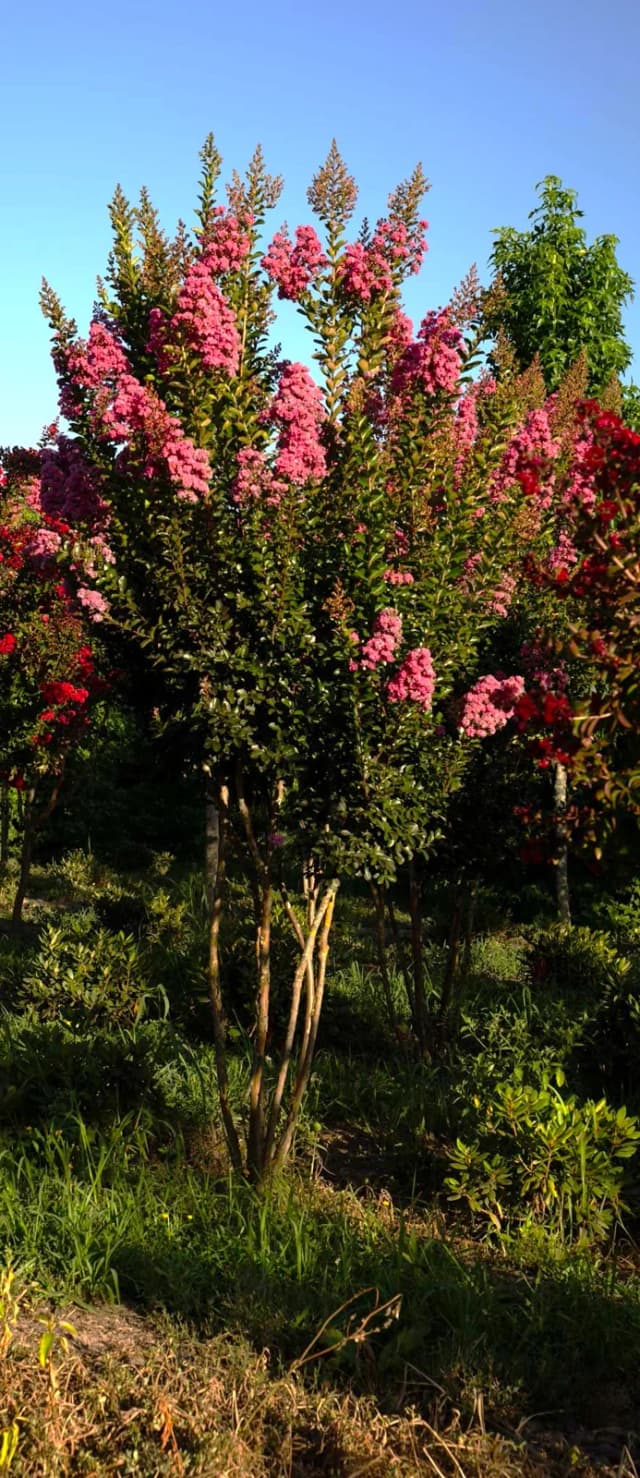
Lagerstroemia indica 'Rosea'
Crape myrtle
A small deciduous tree that flowers pale pink from July to September, above a trunk with smooth bark that peels in patches. It copes with heat, drought and the tight space of a courtyard or a street tree pit, and ends the year with orange and red foliage.
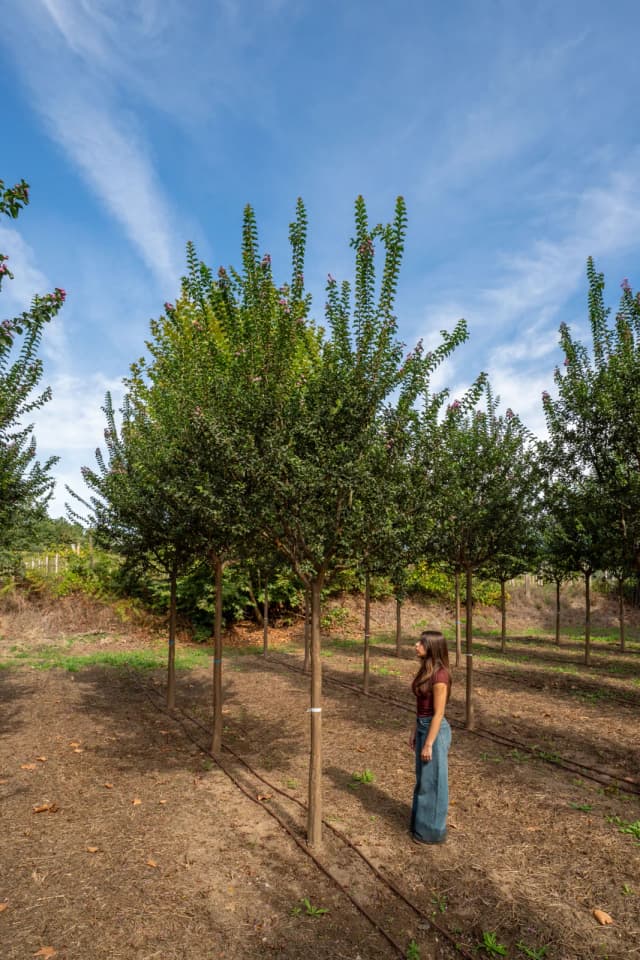
Lagerstroemia indica 'Violacea'
Crape myrtle
- SunFull sun
- Mature height4–6 m
- FoliageDeciduous
- Rate of growthSlow
A cultivar with intense purple flowering from July to September and a balanced size of 4 to 6 metres, suited to short avenue plantings, urban tree pits and ornamental groups where prolonged summer interest is wanted without aggressive roots.
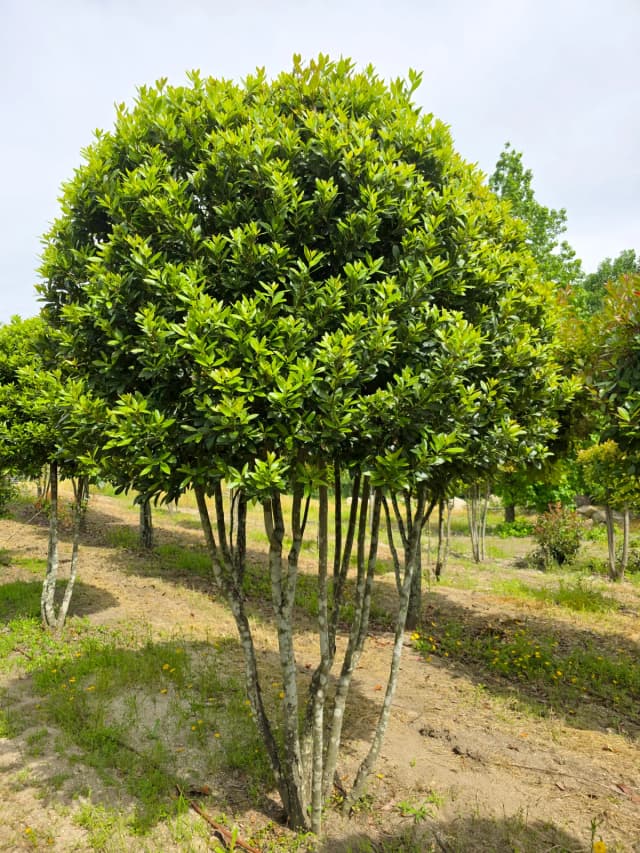
Laurus nobilis
Bay tree
- SunFull sun, Partial shade
- Mature height5–12 m
- FoliageEvergreen
- Rate of growthMedium
- Maintenance levelEasy
A species to specify when the project calls for a dense evergreen mass that can be clipped and tolerates partial shade, with reliable establishment and vigorous rooting in deep, well-drained soils.
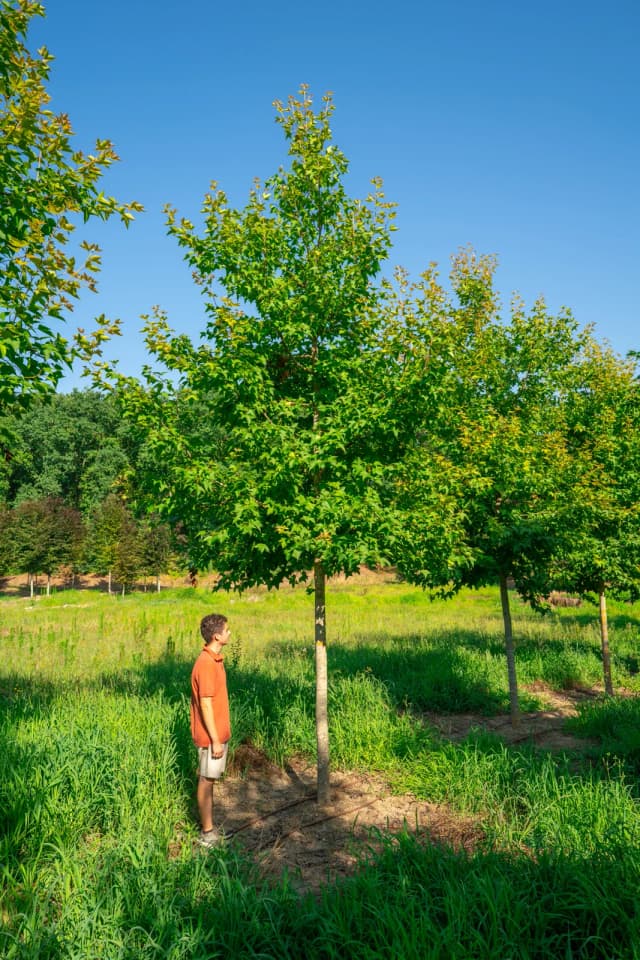
Liquidambar formosana 'Ellen'
Formosan sweetgum
An Asian sweetgum with three-lobed leaves, rarer in European gardens than its American cousin, with purple new growth in spring and autumn colour in red, orange and purple. A grafted selection to guarantee a uniform crown and reliable colour, for a single specimen or a wide avenue planting.
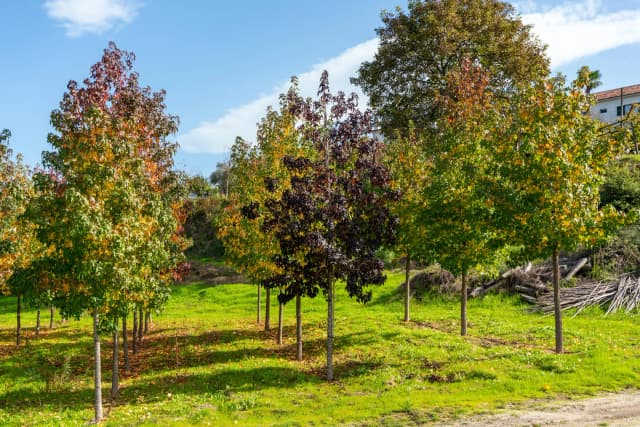
Liquidambar styraciflua
Sweetgum
- SunFull sun
- Mature height15–25 m
- FoliageDeciduous
- Rate of growthMedium
- Maintenance levelEasy
A conical-crowned species for projects that require stable autumn colour in avenue planting or as a structural group, particularly where the soil is acidic to neutral and well drained and the mature size can be accommodated at generous spacing.
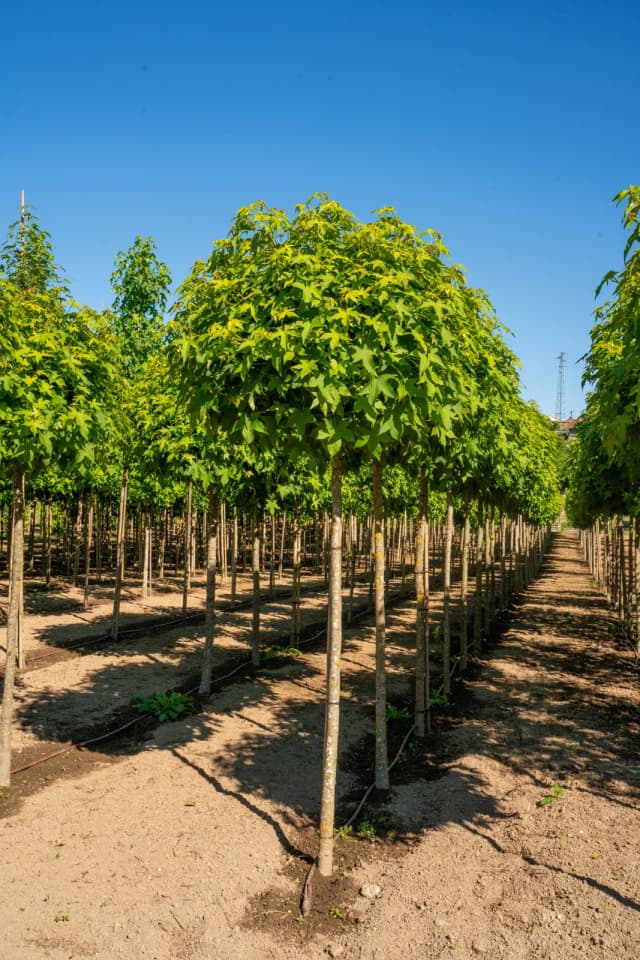
Liquidambar styraciflua 'Globosum'
Sweetgum
A compact form of sweetgum, with a spherical crown that shapes itself and stays at 3 to 5 metres for decades. The same palmate leaf and the same autumn in layers of yellow, orange, red and purple, on a scale that fits narrow streets, courtyards and beds beside the house.
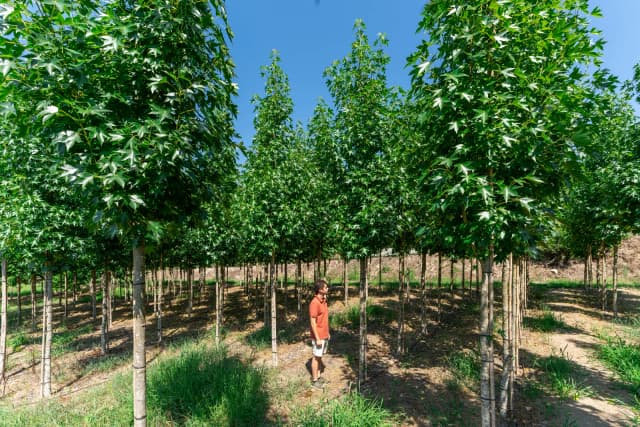
Liquidambar styraciflua 'Paarl'
Sweetgum
- SunFull sun
- FoliageDeciduous
- Rate of growthFast
A sweetgum cultivar selected for the uniformity of its autumn colour and for a crown more restrained than that of the straight species, which makes it particularly suitable for urban avenue planting, central reservations and parks where formal consistency between specimens is required.
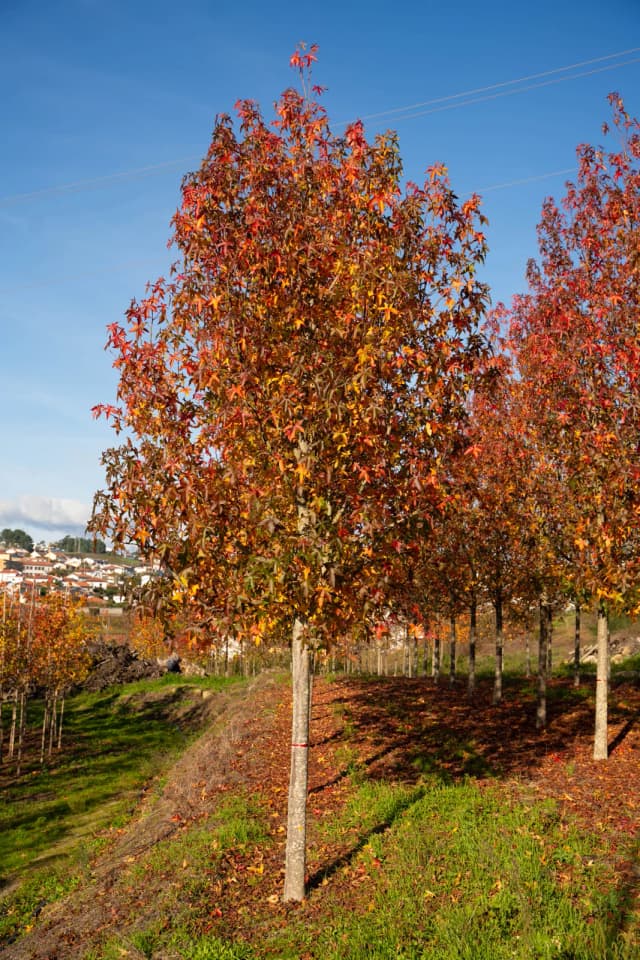
Liquidambar styraciflua 'Palo Alto'
Sweetgum
A Californian selection of sweetgum chosen for the regularity of its conical, symmetrical crown and for its reliable autumn colour, in uniform orange and red, even in mild climates where seed-raised plants colour poorly. For avenue planting, tree-lined walks and single specimens.
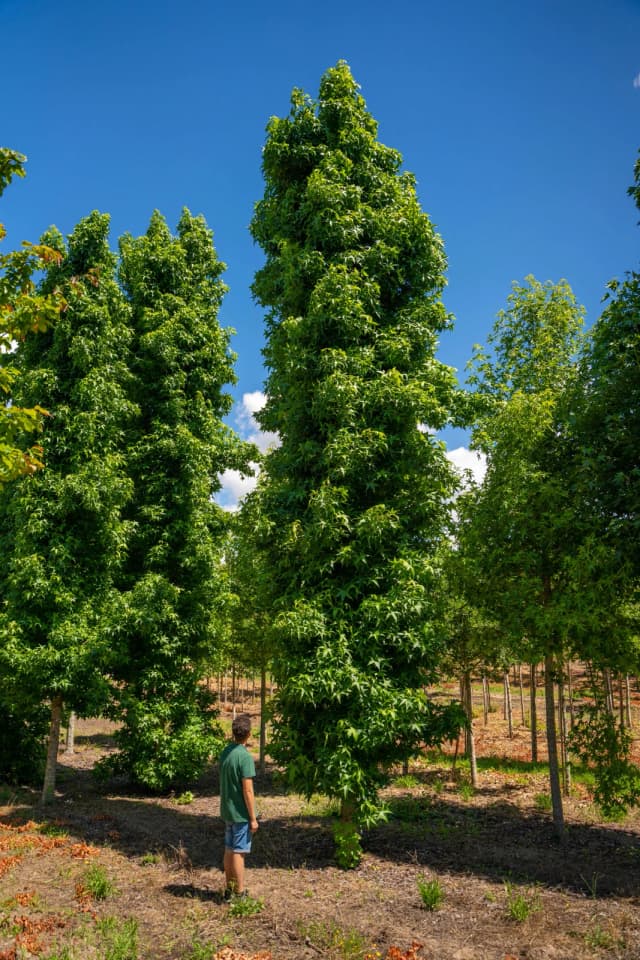
Liquidambar styraciflua 'Slender Silhouette'
Sweetgum
- SunFull sun
- Mature height12–18 m
- FoliageDeciduous
- Rate of growthMedium
A fastigiate cultivar of the sweetgum, with a columnar habit of 12 to 18 m by only 1.5 to 2 m in spread. Suited to avenue planting along narrow streets, central reservations and urban courtyards where the crown of the straight species does not fit.
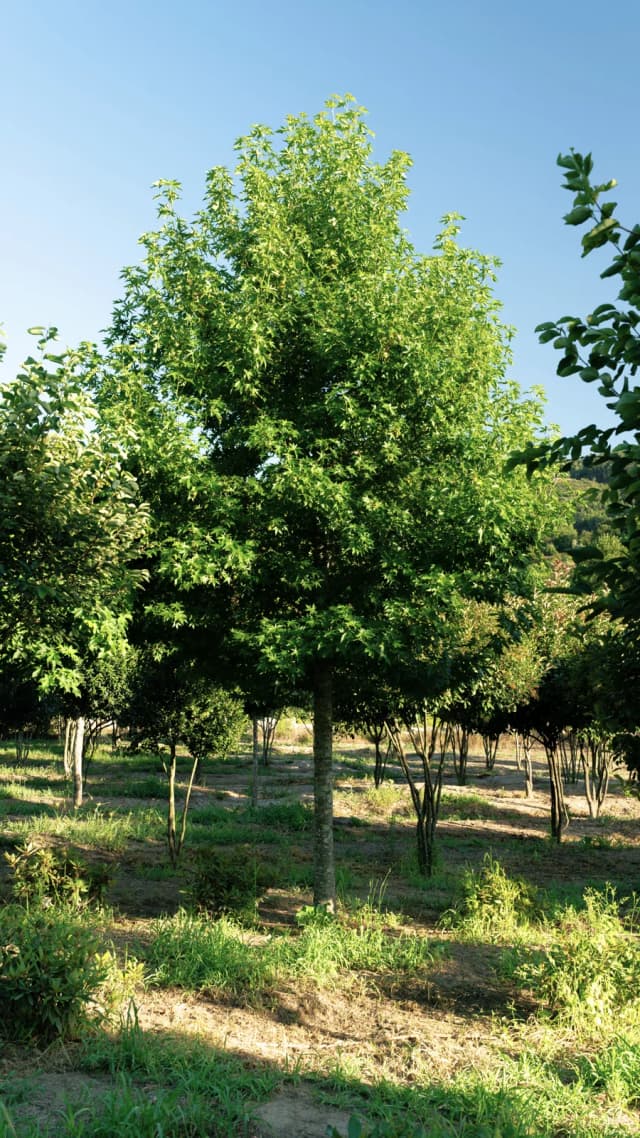
Liquidambar styraciflua 'Worplesdon'
Sweetgum
- SunFull sun
- Mature height15–20 m
- FoliageDeciduous
- Rate of growthMedium
A cultivar of Liquidambar styraciflua chosen for street planting and avenues that call for a narrow pyramidal silhouette, an ascending crown and reliable autumn colour, without the lateral spread that limits the straight species in a tree pit.
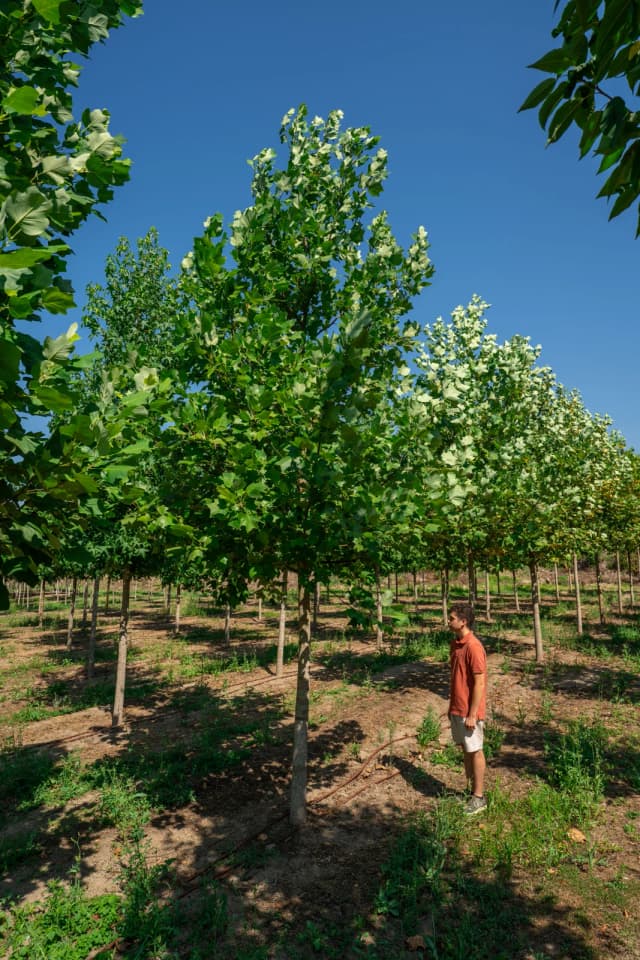
Liriodendron tulipifera
Tulip tree
- SunFull sun
- Mature height20–35 m
- FoliageDeciduous
- Rate of growthFast
- Maintenance levelEasy
A fast-growing species of columnar habit that takes the place of a plane or a lime in parks and avenues, with a more upright silhouette, ornamental flowering and an intense autumn turn, requiring moist, deep, well-drained soil.
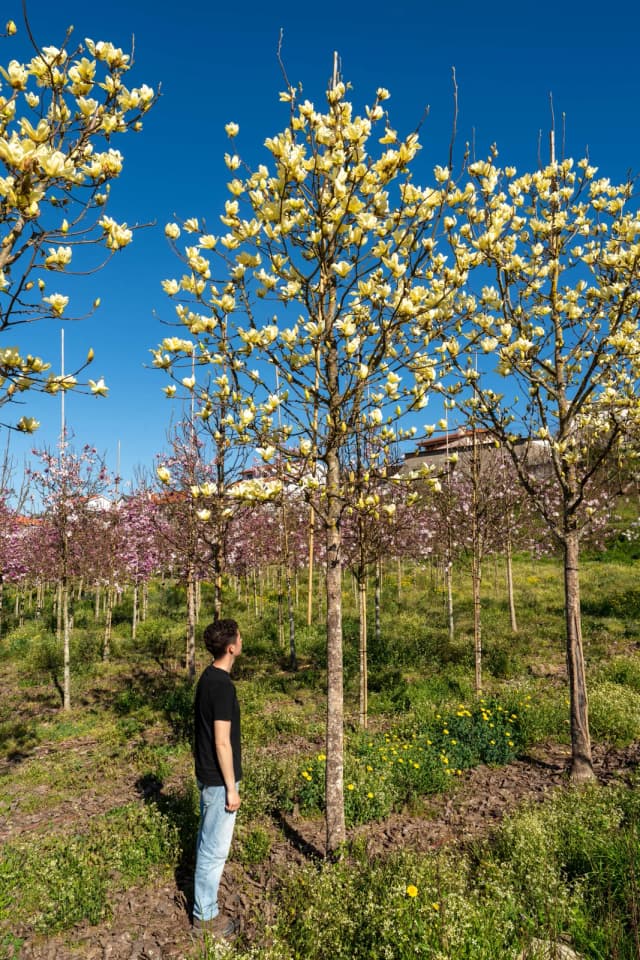
Magnolia denudata 'Yellow River'
Yulan magnolia
- SunPartial shade, Full sun
- Mature height6–8 m
- FoliageDeciduous
- Rate of growthSlow
Selected for its creamy-yellow flowering, rare in the genus, which appears before the leaves emerge. Its contained size and rounded crown make this cultivar a focal specimen in spaces where large-growing magnolias do not fit.
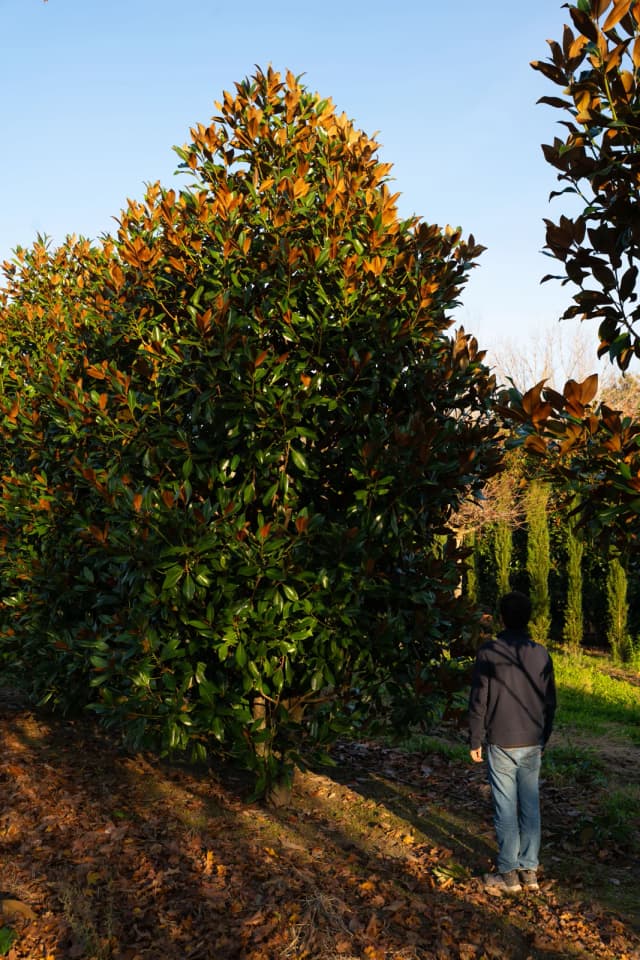
Magnolia grandiflora 'Gallisoniensis'
Bull bay
- SunFull sun
- Mature height15–20 m
- FoliageEvergreen
- Rate of growthMedium
A benchmark cultivar for projects that require evergreen mass and summer flowering. The dense pyramidal crown provides green structure all year round, with added interest from the scented flowering from June to September.
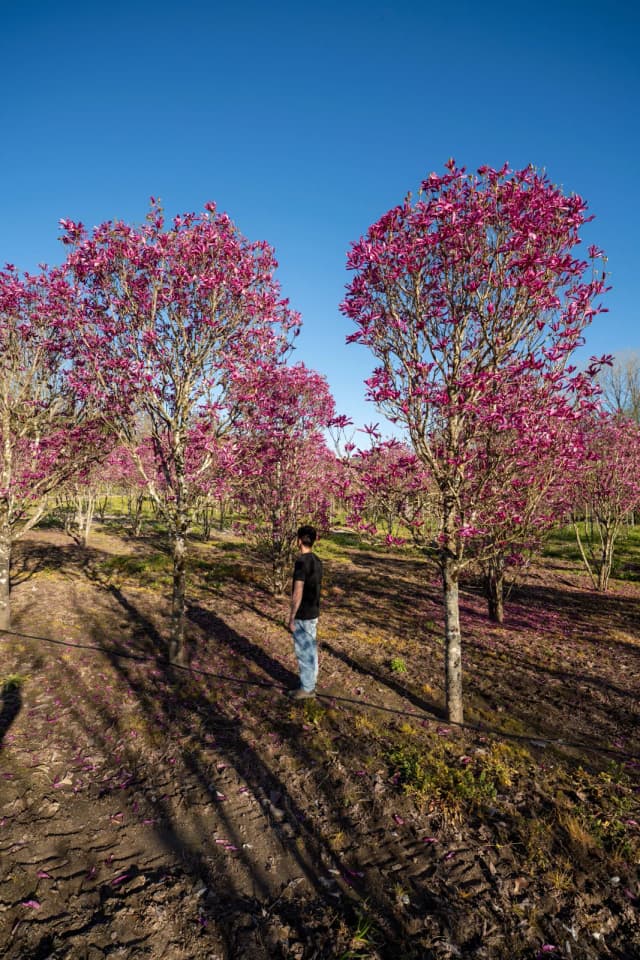
Magnolia susan
Magnolia 'Susan'
- SunFull sun, Partial shade
- Mature height3–5 m
- FoliageDeciduous
- Rate of growthSlow
- Maintenance levelEasy
A large shrub or small tree of contained size, Magnolia 'Susan' answers design situations that call for spring floral impact in a limited space, without the problems of scale and sensitivity to late frost that constrain M. x soulangeana.
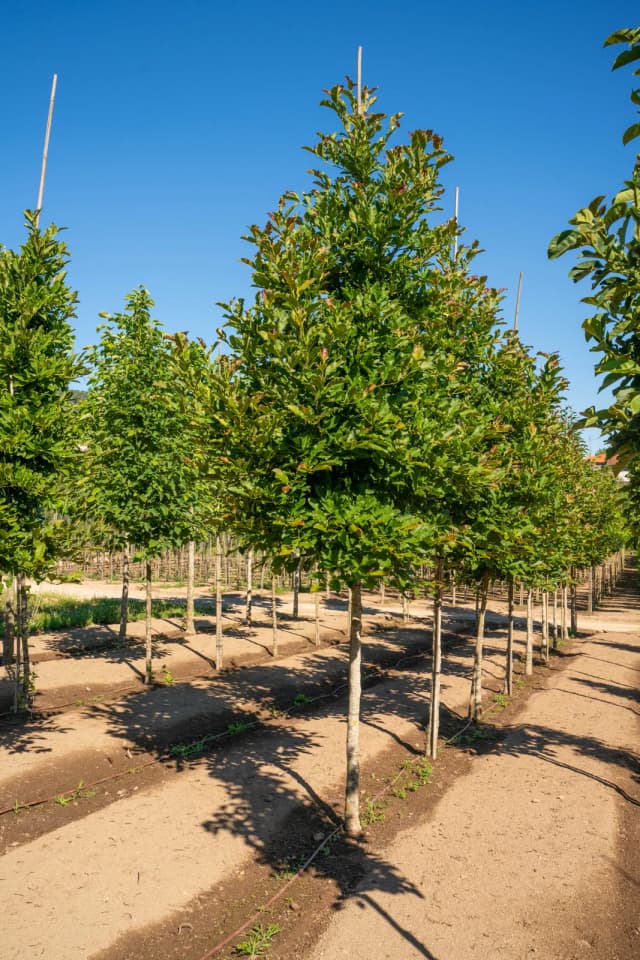
Magnolia x loebneri 'Leonard Messel'
Loebner magnolia 'Leonard Messel'
A deciduous magnolia of rounded habit that is covered in March and April with starry lilac-pink flowers, paler inside, before the leaves open. The flowers stand up to late frosts better than those of most magnolias, and the plant flowers early in life and every year.
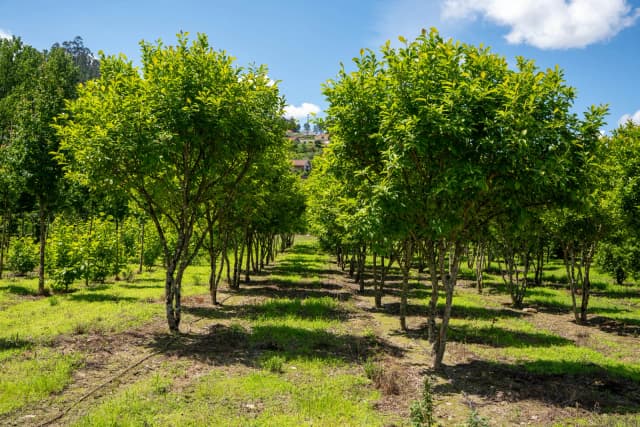
Magnolia x soulangeana
Saucer magnolia
- SunFull sun, Partial shade
- Mature height5–8 m
- FoliageDeciduous
- Rate of growthMedium
- Maintenance levelModerate
Where a project calls for a specimen with a broad crown and flowering before the leaves, it takes the central place in a lawn or courtyard, with a branched architecture that opens out horizontally as it gains size.
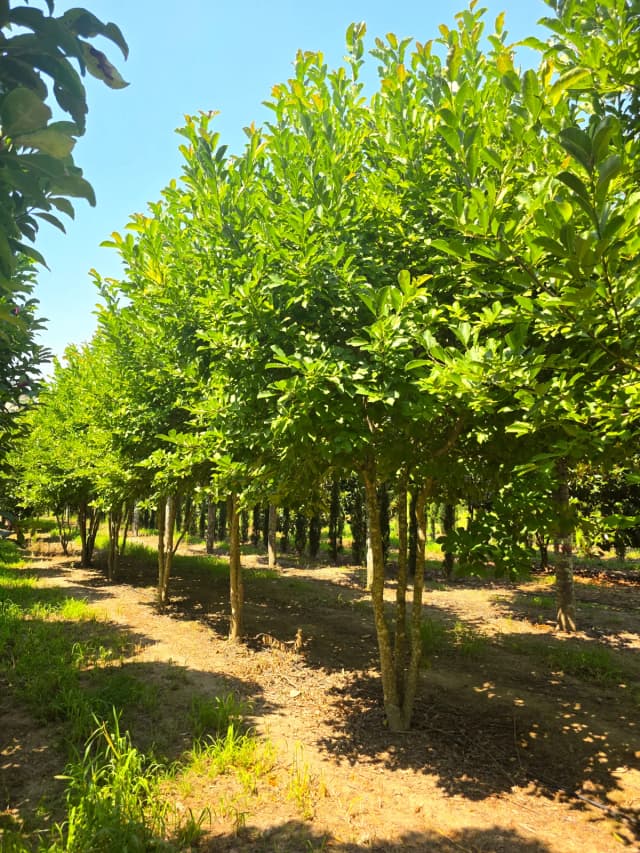
Magnolia × loebneri 'Merrill'
Loebner magnolia 'Merrill'
A deciduous magnolia of rounded habit that is covered in semi-double white flowers in March and April, before the leaves open. It flowers early in life and in great abundance, which makes it one of the most reliable magnolias as a spring specimen in medium-sized gardens.
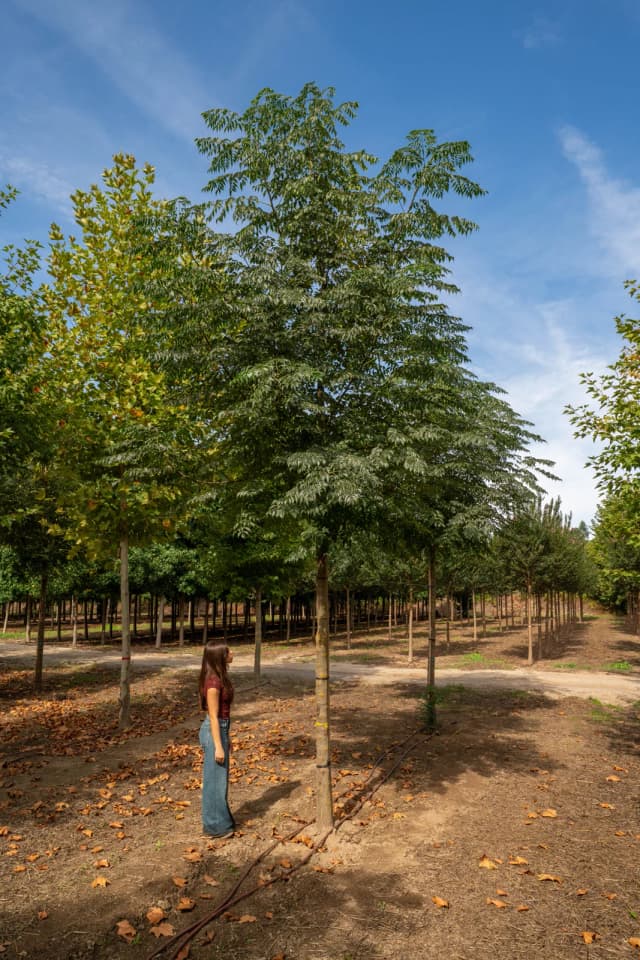
Melia azedarach
Bead tree
- SunFull sun
- Mature height8–15 m
- FoliageDeciduous
- Rate of growthFast
- Maintenance levelEasy
A fast-growing deciduous tree with a rounded crown, the bead tree takes the place of a shade plane in street planting or a central reservation where crown cover is wanted in under five years, with lower water demand and no susceptibility to canker stain.
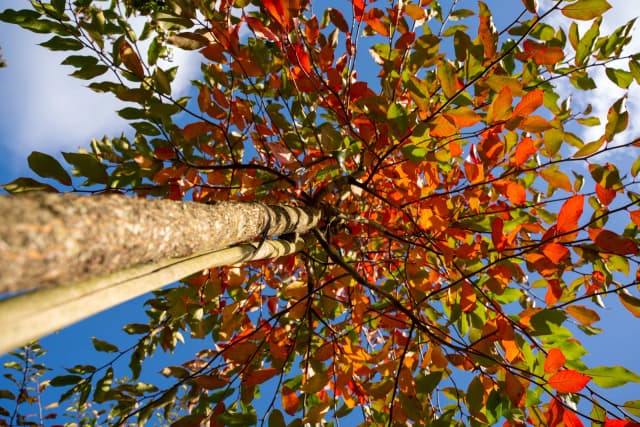
Nyssa sylvatica
Tupelo
- SunFull sun, Partial shade
- Mature height10–20 m
- FoliageDeciduous
- Rate of growthSlow
- Maintenance levelEasy
A slow-growing North American species with deciduous foliage and an autumn colour change among the most intense in the catalogue, positioned for projects on acidic soils that seek an alternative to Liquidambar styraciflua with less aggressive roots and greater tolerance of seasonal waterlogging.
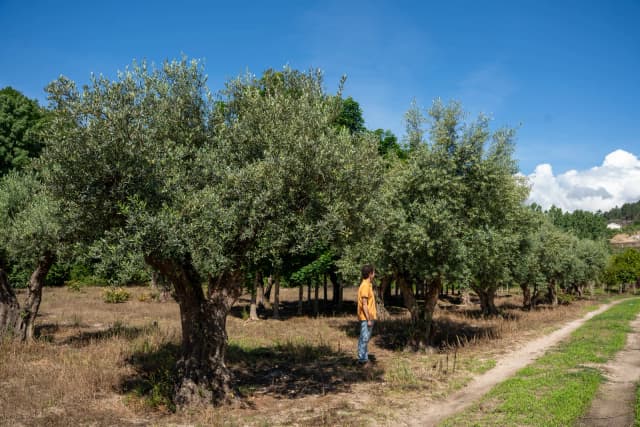
Olea europaea
Olive
- SunFull sun
- Mature height5–12 m
- FoliageEvergreen
- Rate of growthSlow
- Maintenance levelEasy
The mature olive, transplanted at a large girth size, meets both the quota of native species required by many PDM (municipal master plans) and the need for an evergreen specimen with immediate character in a square, on a roundabout or in an institutional setting.
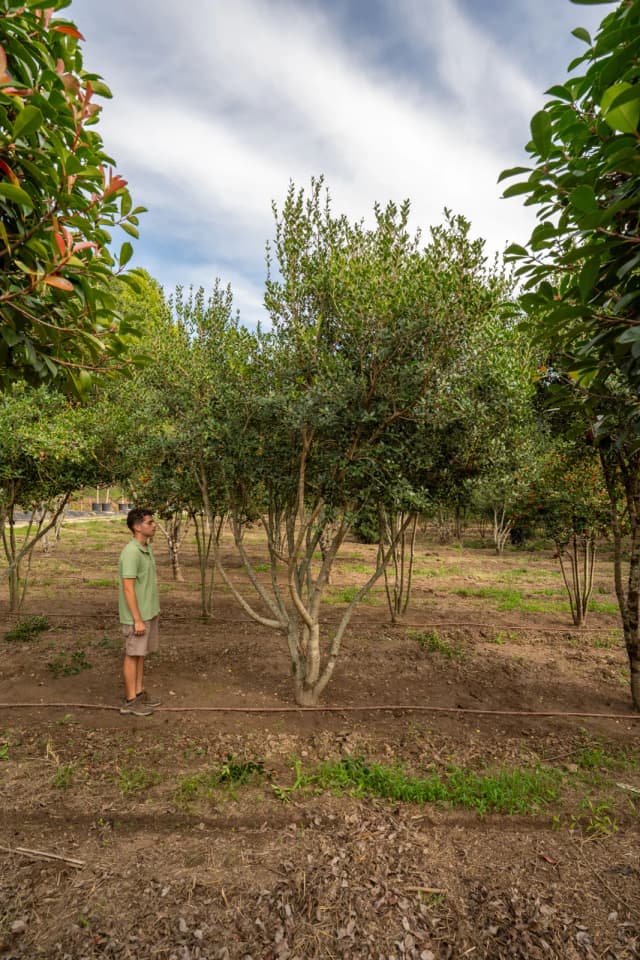
Osmanthus heterophyllus
Osmanthus
- SunFull sun, Partial shade
- Mature height3–6 m
- FoliageEvergreen
- Rate of growthSlow
- Maintenance levelEasy
Close to holly in a project, with one decisive morphological difference: the leaf arrangement is opposite, not alternate. A slow-growing evergreen shrub with a dense crown, it adapts to compacted urban soils and tolerates the city climate.
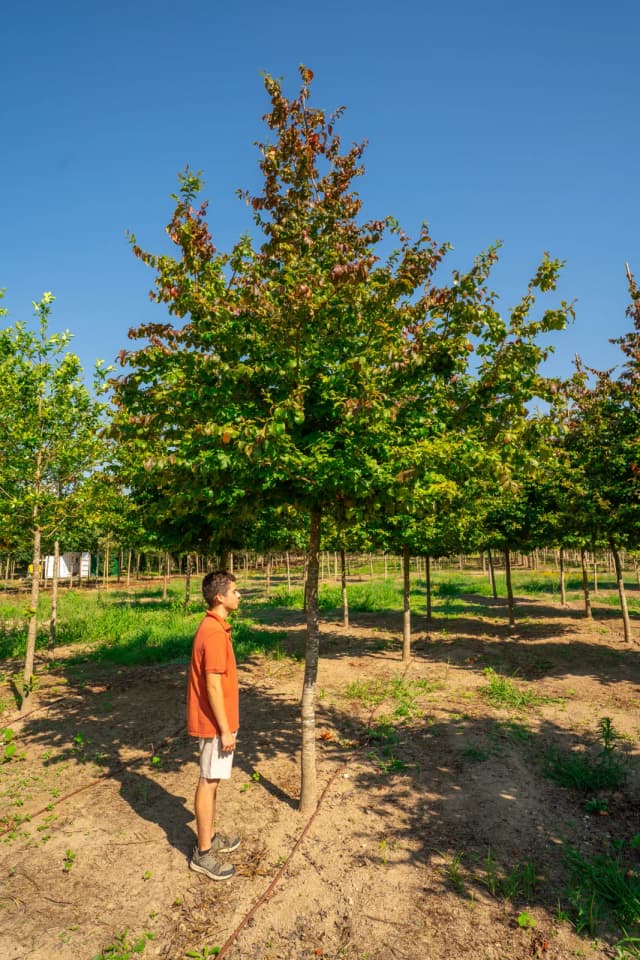
Parrotia persica
Persian ironwood
- SunFull sun, Partial shade
- Mature height6–12 m
- FoliageDeciduous
- Rate of growthSlow
- Maintenance levelEasy
A species seldom specified in the Portuguese market but with proven performance in Atlantic and temperate Mediterranean climates. In a tree pit it takes the place of a Liquidambar or an Acer, with lower water demand, proven plant-health resistance and ornamental interest spread across the whole year.
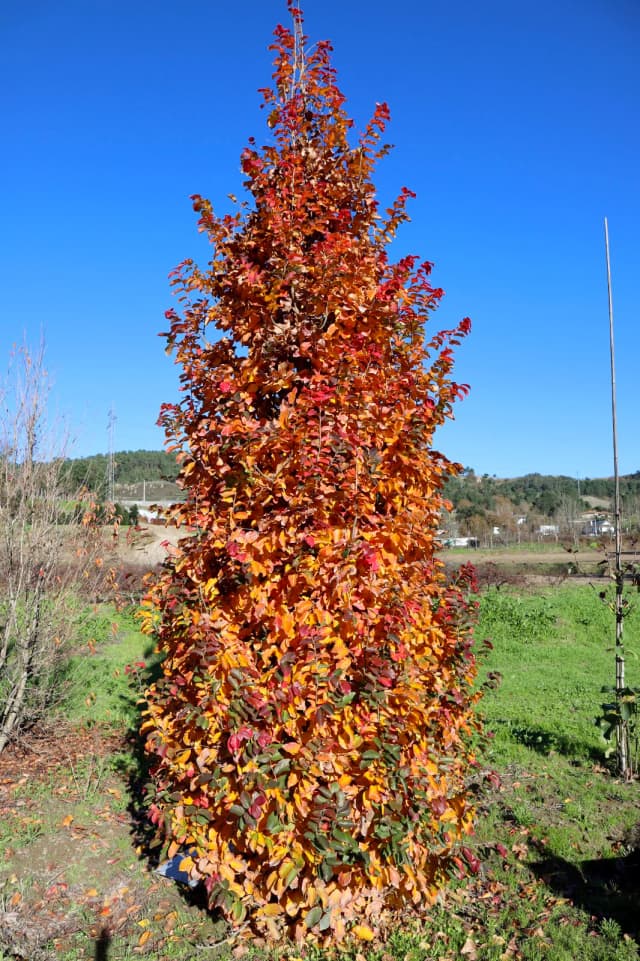
Parrotia persica 'Vanessa'
Persian ironwood
- SunFull sun
- Mature height8–10 m
- FoliageDeciduous
- Rate of growthMedium
A columnar cultivar of the Persian ironwood, suited to urban avenue plantings where the specification requires an upright habit and a contained crown, while retaining the autumn colour and the winter interest of the flaking bark.
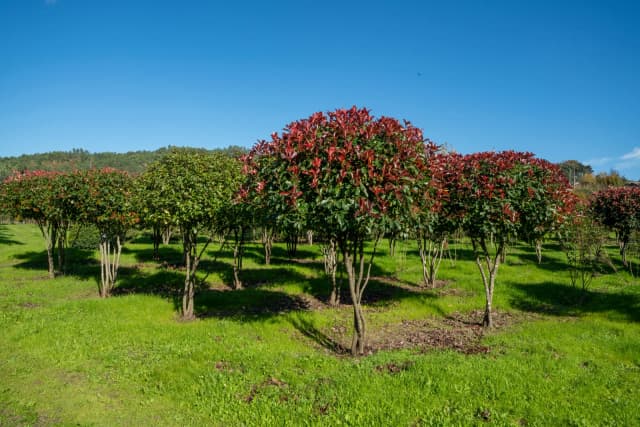
Photinia x fraseri 'Red Robin'
Photinia 'Red Robin'
- Mature height2.5–3.5 m
An evergreen cultivar with a dense, rounded crown, specified for a structured hedge or a single specimen: the cherry-red new shoots contrast with the glossy green mature foliage at every pruning, with a contained size of 3 to 4 metres.
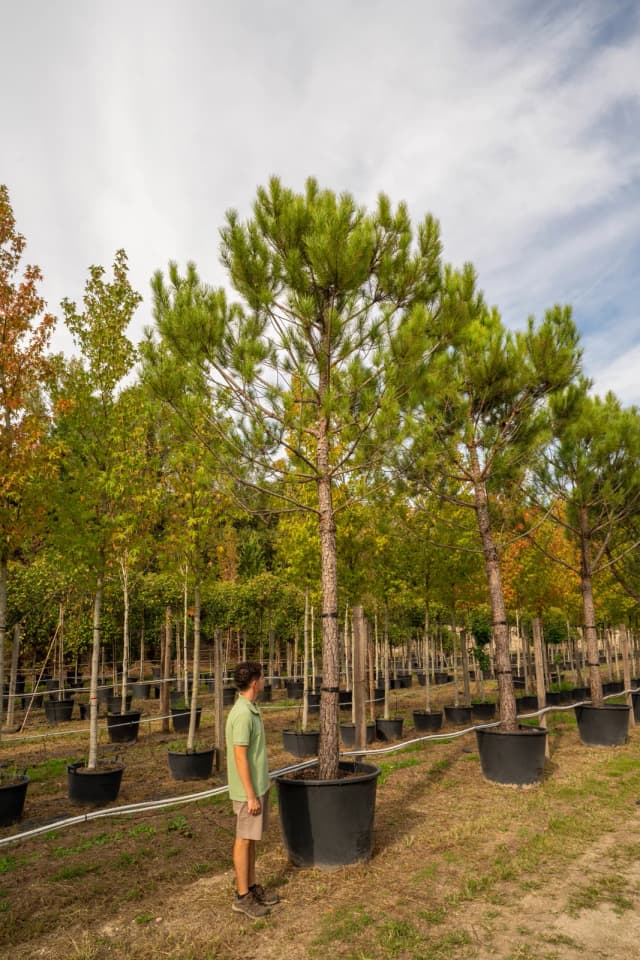
Pinus pinea
Stone pine
- SunFull sun
- Mature height12–20 m
- FoliageEvergreen
- Rate of growthMedium
- Maintenance levelEasy
A species native to the western Mediterranean, the stone pine is specified in Portugal for large-scale settings that combine ornamental standards with tolerance of prolonged summer drought, coastal salinity and poor sandy soil.
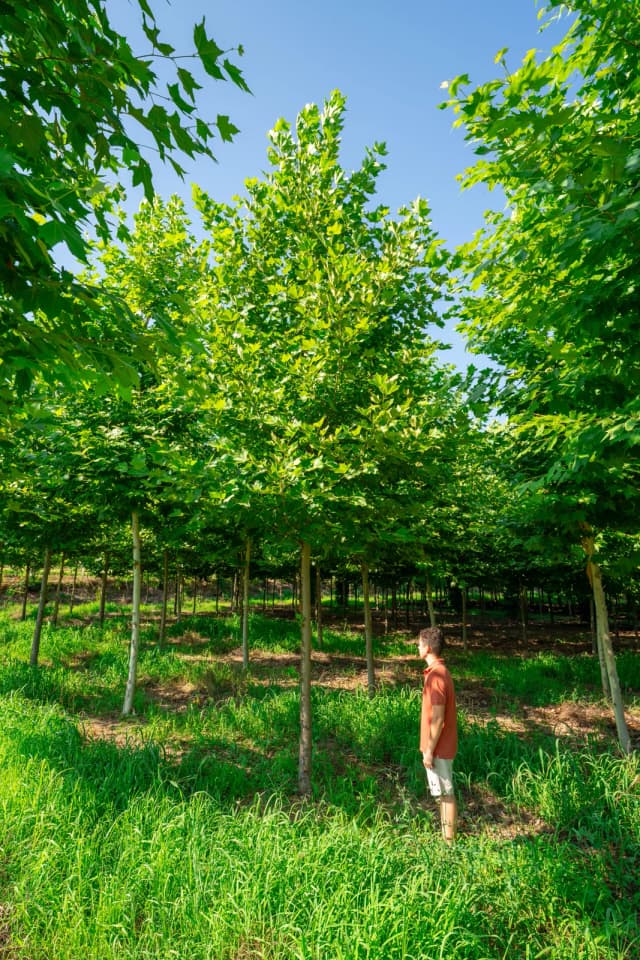
Platanus × hispanica
London plane
- SunFull sun
- Mature height20–35 m
- FoliageDeciduous
- Rate of growthFast
- Maintenance levelEasy
One of the most emblematic urban trees in Europe, it combines a monumental shade crown with the extraordinary mosaic bark that makes the trunk recognisable in any season. Its ability to stay vigorous in hard-surfaced environments and to respond to different forms of training explains its centuries-long presence in avenues, squares and parks.
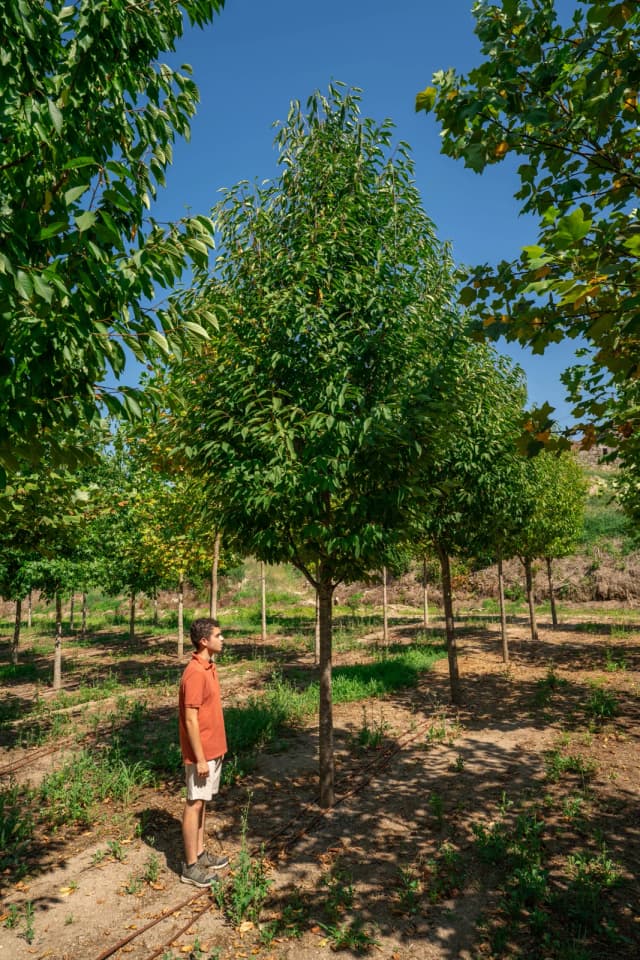
Prunus avium 'Plena'
Double-flowered wild cherry
The double-flowered form of the European wild cherry, which is covered in late April with white pompom flowers hanging in clusters, and bears no fruit. A broad, regular crown, smooth bark with horizontal rings and orange and red foliage in autumn.
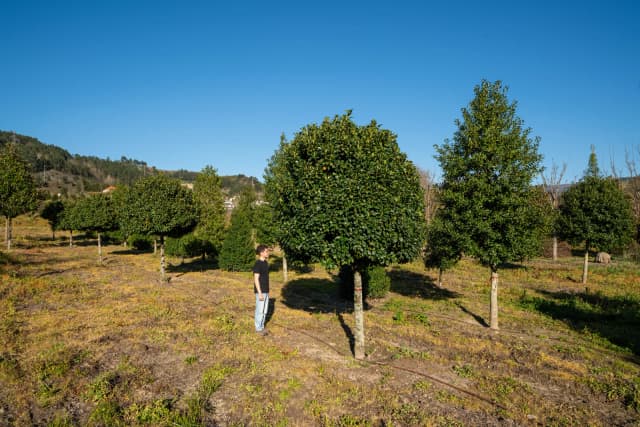
Prunus laurocerasus 'Etna'
Cherry laurel
A compact cultivar of cherry laurel, with broad, glossy leaves and coppery new growth in spring, specified for hedges of 2 to 3 metres that need to thicken quickly and withstand cold and wind. Evergreen and shade-tolerant.
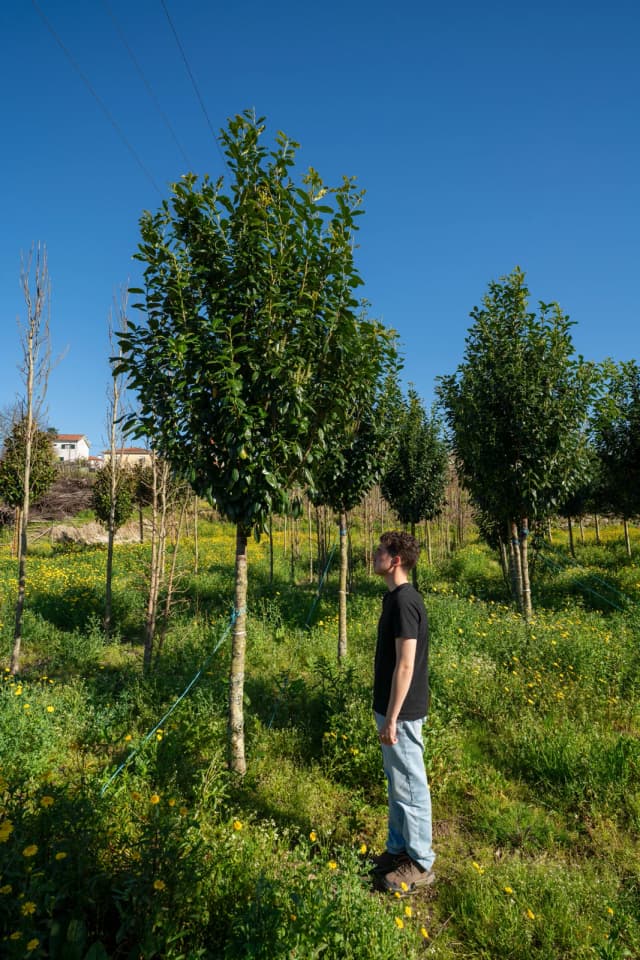
Prunus laurocerasus 'Novita'
Cherry laurel
A vigorous cherry laurel cultivar with large, bright green, glossy leaves, selected for its resistance to cold and to the leaf diseases that weaken other laurels. It makes tall, dense hedges in a few years, in sun or shade.
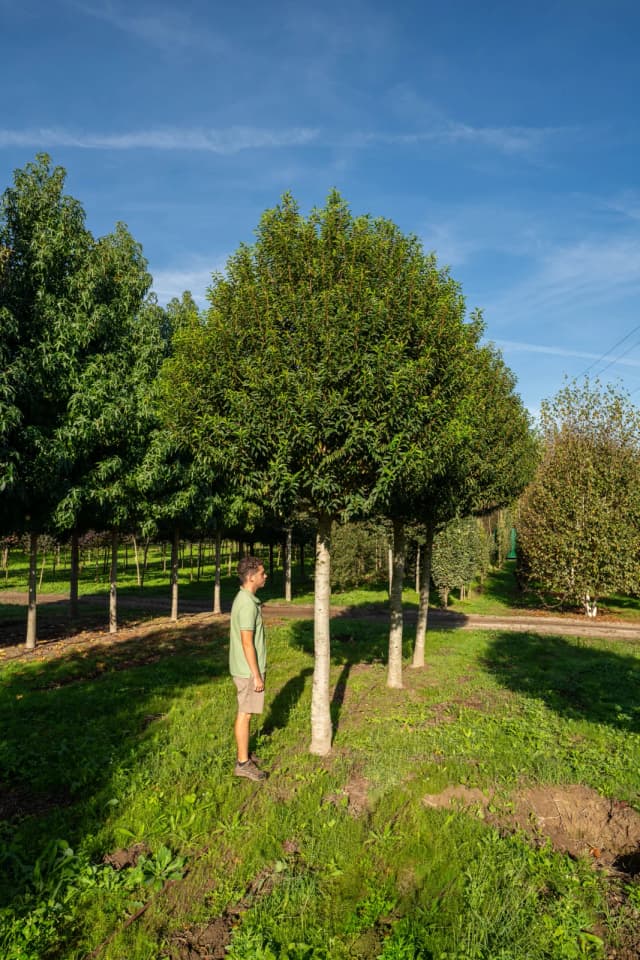
Prunus lusitanica 'Angustifolia'
Portugal laurel
- SunPartial shade, Full sun
- Mature height4–6 m
- FoliageEvergreen
- Rate of growthMedium
Where a project calls for a dense, well-structured evergreen mass, this form of Portugal laurel offers an upright, contained crown with a narrow leaf, suited to formal hedges, tall borders and framing plantings that require constant green volume throughout the year.
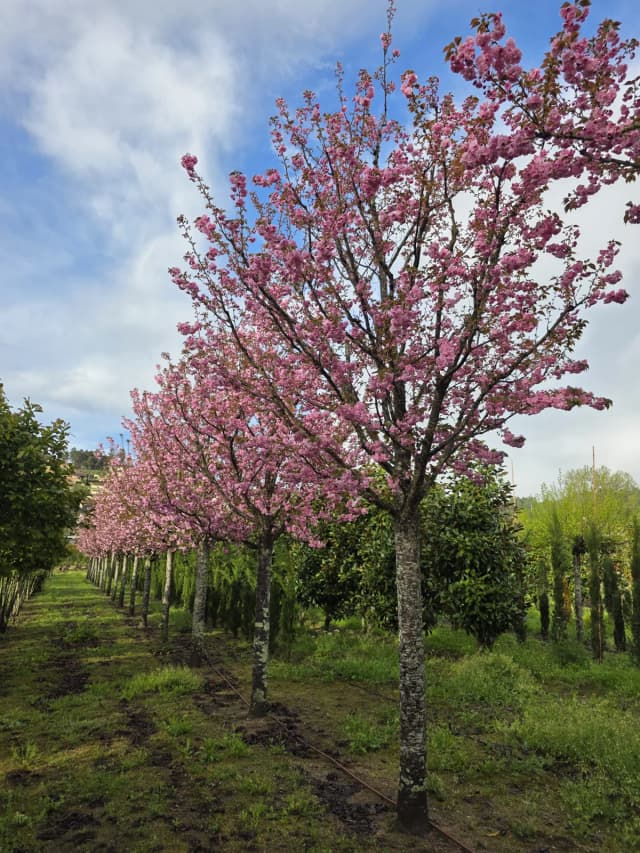
Prunus serrulata 'Kanzan'
Japanese flowering cherry
- SunFull sun
- Mature height6–10 m
- FoliageDeciduous
- Rate of growthMedium
One of the most emblematic Japanese cherries, ‘Kanzan’ turns its whole crown into an intensely pink composition in late spring. The double flowers, the contrast with the bronze new growth and the vase-shaped architecture give it a presence that is at once exuberant and formal.
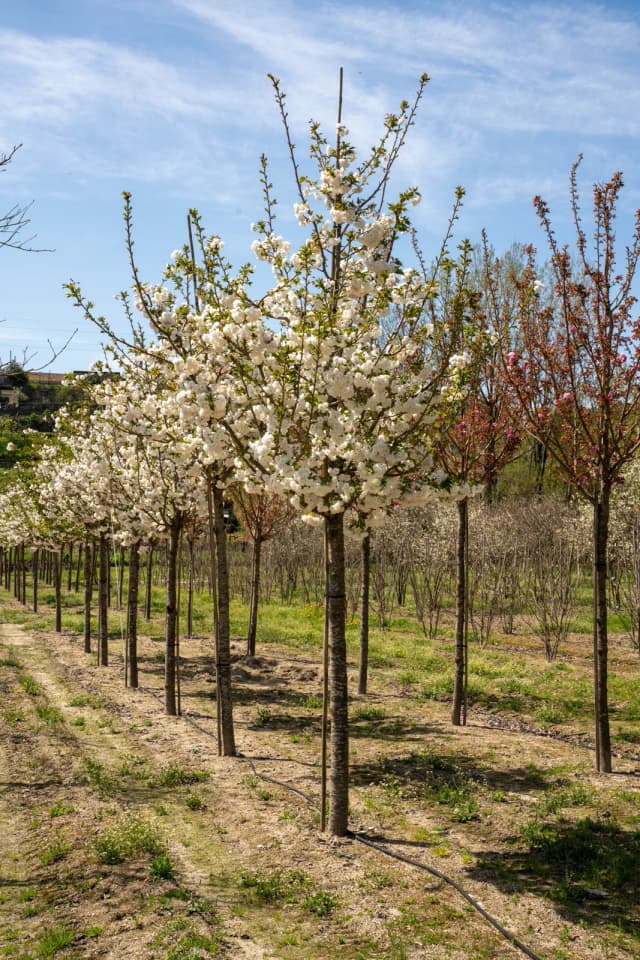
Prunus serrulata 'Shirotae'
Japanese flowering cherry
- SunFull sun
- FoliageDeciduous
- Rate of growthSlow
For projects that call for a spring-flowering specimen with an open, contained habit, this cultivar of Japanese flowering cherry stands out for its horizontal crown and semi-double white flower, distinct from the upright, vase-shaped habit of the more common 'Kanzan'.
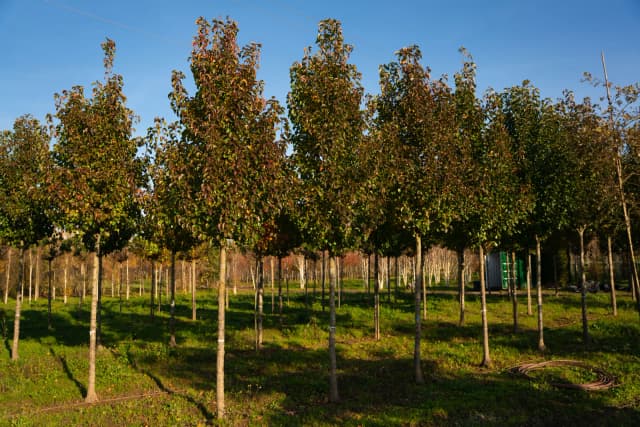
Pyrus calleryana 'Chanticleer'
Callery pear
- SunFull sun
- FoliageDeciduous
- Rate of growthMedium
Where an urban avenue planting calls for vertical shade without encroaching on the circulation zone, the narrow crown and columnar habit offer contained aerial volume in a tree pit, with spring flowering and a reliable autumn colour change.
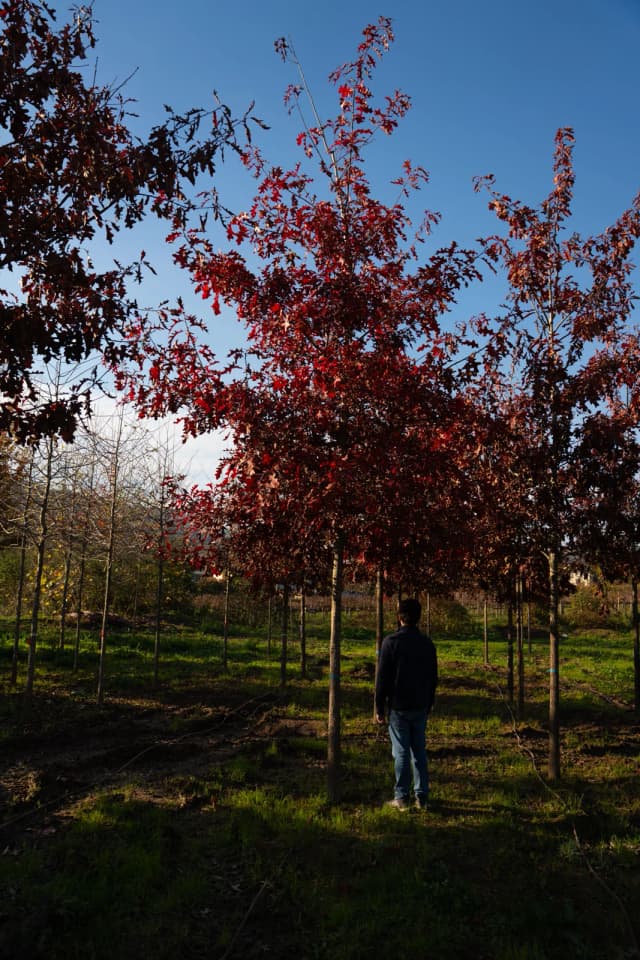
Quercus coccinea
Scarlet oak
- SunFull sun
- Mature height15–25 m
- FoliageDeciduous
- Rate of growthMedium
- Maintenance levelEasy
It is sought after for the most intense autumn colour in the red oak section: a rounded, open crown, light shade that allows underplanting, and good performance in acidic, free-draining soils where the plane or the lime offer no seasonal interest.
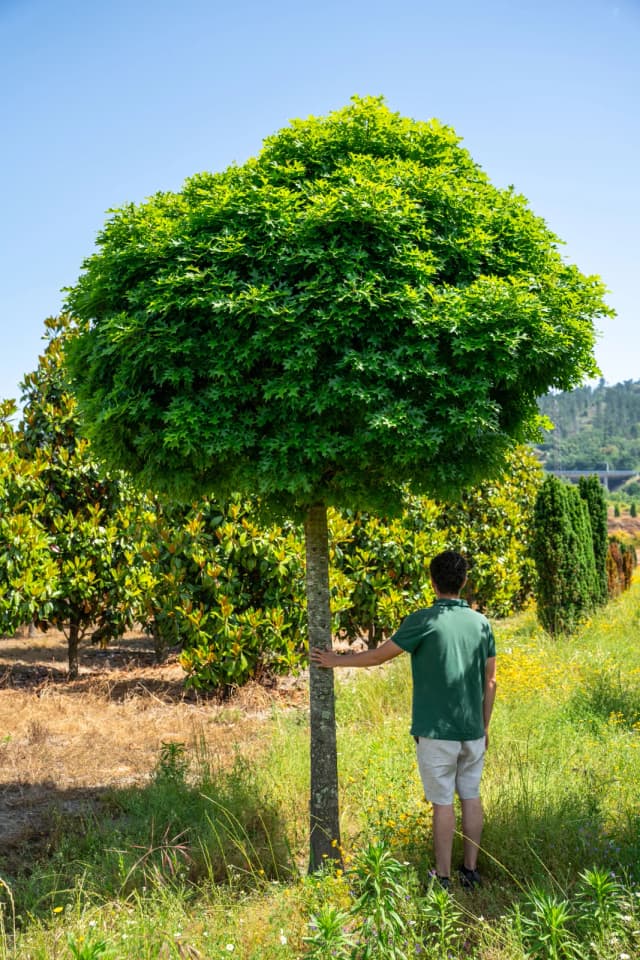
Quercus palustris 'Green Dwarf'
Dwarf pin oak
A dwarf form of pin oak, grafted on a tall stem, which develops a dense, regular globe-shaped crown without ever reaching the scale of the species. A deeply cut, glossy leaf that turns orange-red in autumn. The right choice where there are overhead wires, façades or narrow pavements.
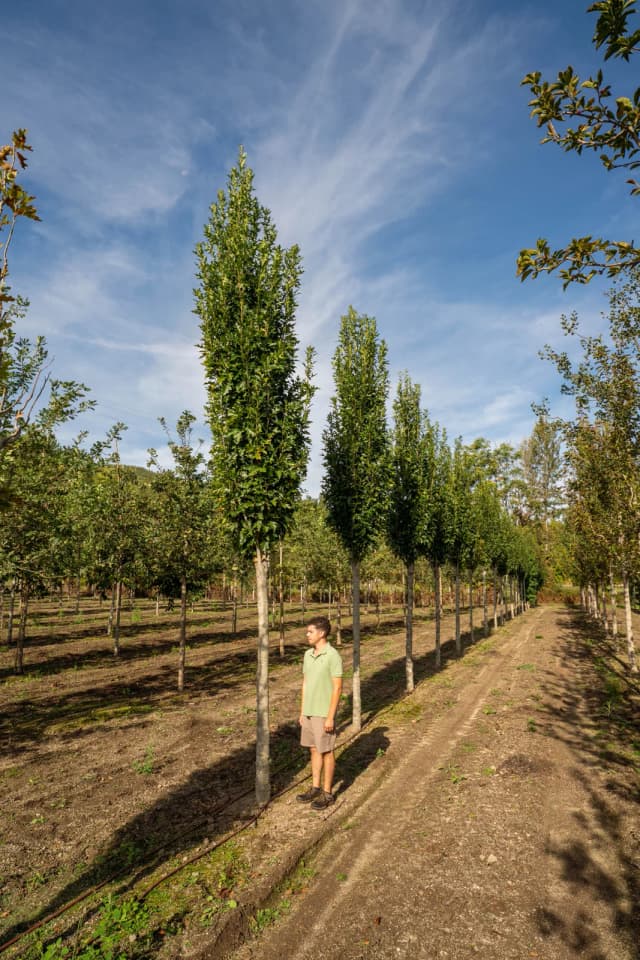
Quercus palustris 'Green Pillar'
Columnar pin oak
A columnar form of the pin oak, with a straight trunk and short, ascending branches, giving the height of an oak in a spread of 3 to 4 metres. Deeply cut, glossy leaves, red in autumn, and the urban toughness of the species.
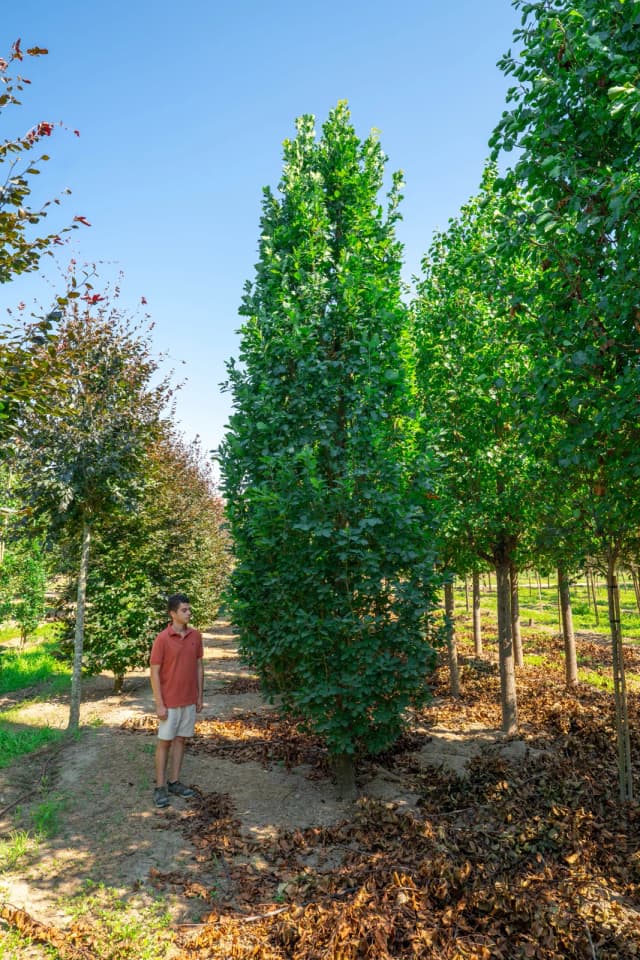
Quercus robur 'Fastigiata Koster'
English oak
- SunFull sun
- FoliageDeciduous
- Rate of growthMedium
With a narrow, strongly vertical silhouette, it occupies the air space without imposing it on the ground: the columnar form that a confined street or a central reservation calls for when the stature of the oak is wanted without the broad crown.
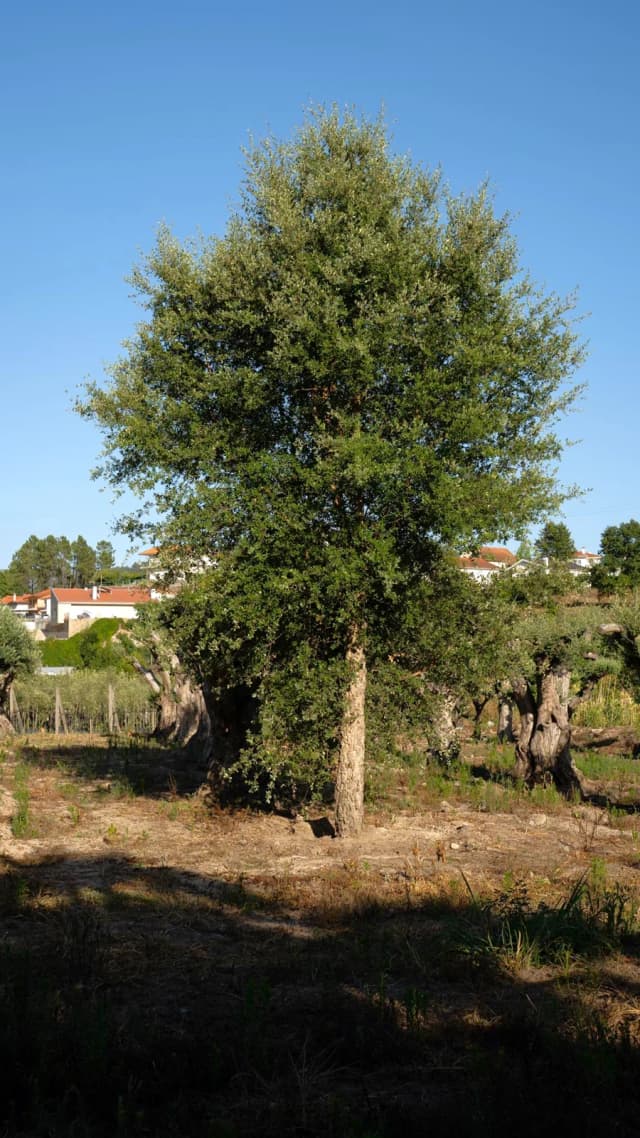
Quercus suber
Cork oak
- SunFull sun
- Mature height10–20 m
- FoliageEvergreen
- Rate of growthSlow
- Maintenance levelEasy
A Mediterranean specimen with a low, broad crown and immediate sculptural presence. Proven tolerance of drought, heat and poor acidic soils, with no regular watering after the establishment period. The cork bark offers permanent texture and a strong visual statement in projects of Iberian character.
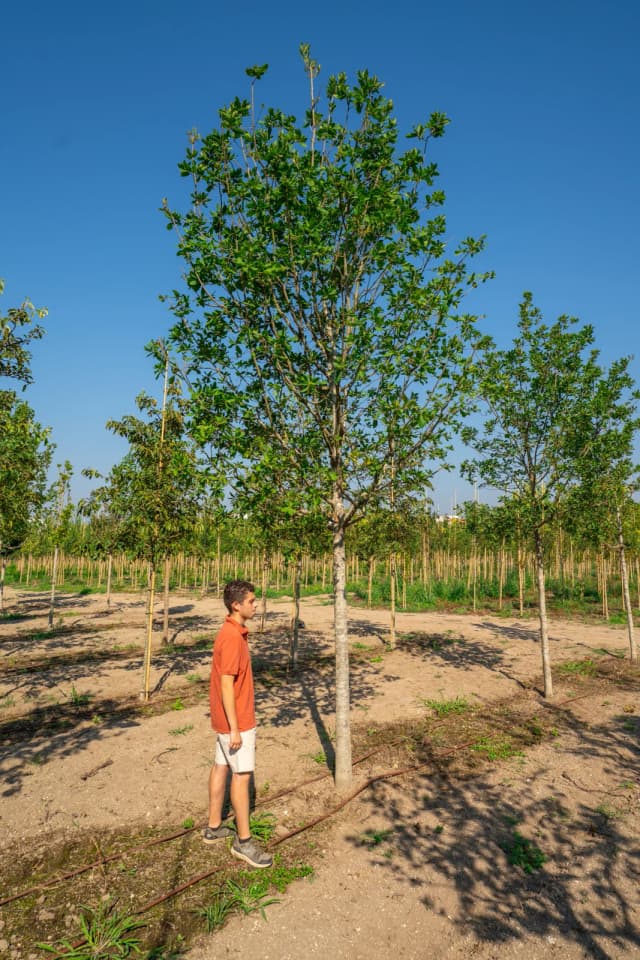
Quercus × turneri 'Pseudoturneri'
Turner’s oak
A hybrid between the holm oak and the pedunculate oak that keeps its dark green leaves for almost the whole winter and only sheds them in spring, as the new growth emerges. A broad, rounded crown, tolerance of lime and wind, and the look of an old oak within a few decades.
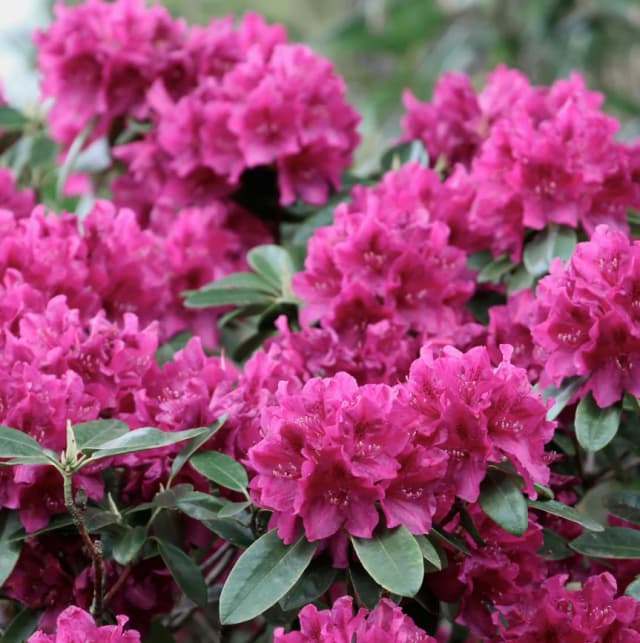
Rhododendron hybridum
Hybrid rhododendron
An evergreen shrub with broad, leathery leaves that is covered in April and May with large trusses of cup-shaped flowers, in the colours of the chosen variety. It is the structural plant of woodland gardens and of massed planting in shade on moist, acidic soils.
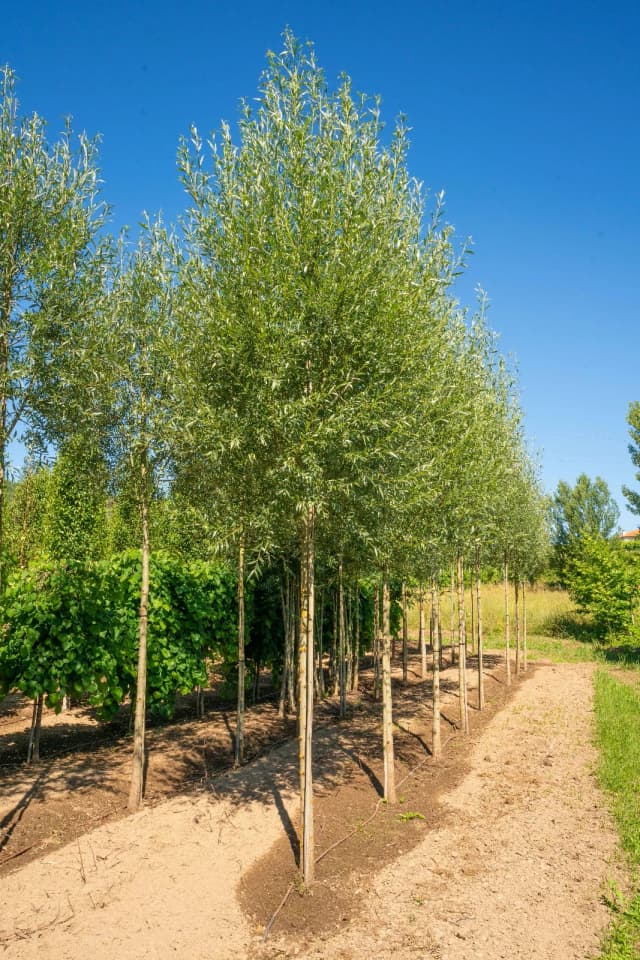
Salix alba
White willow
- SunFull sun
- Mature height15–25 m
- FoliageDeciduous
- Rate of growthFast
- Maintenance levelModerate
A native riparian species for the restoration of watercourses, riverside gallery woodland and waterlogged slopes, where its wide-spreading root system stabilises unstable banks and its rapid growth closes the tree canopy in a few growing seasons.
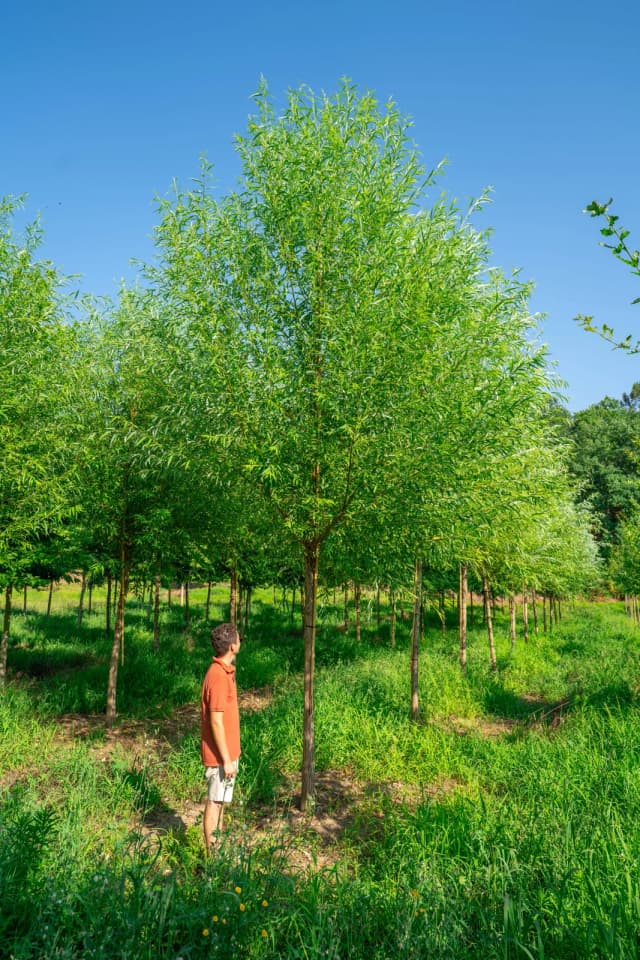
Salix fragilis
Crack willow
A fast-growing deciduous willow with a broad, irregular crown, native to the banks of European rivers. Narrow, glossy leaves, yellowish catkins in spring and a vigorous root system that holds slopes and banks. A tree for renaturalisation, for wetlands and for parks with water.
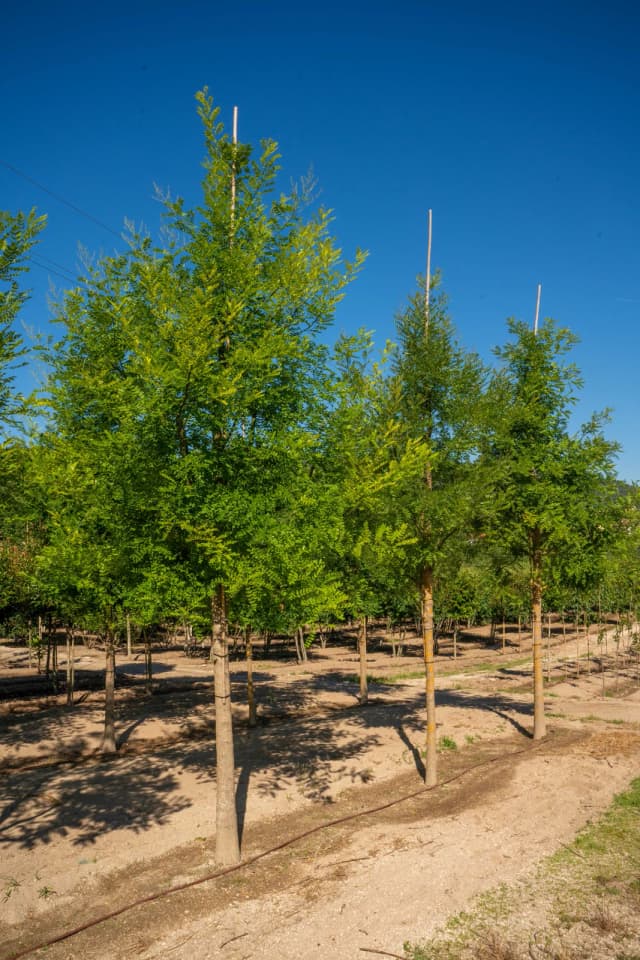
Sophora japonica
Japanese pagoda tree
A street selection with a regular, ascending oval crown, for street planting and avenue planting where uniformity, rapid establishment and tolerance of summer heat and compaction are required, without the plant-health pressure that today constrains ash and plane.
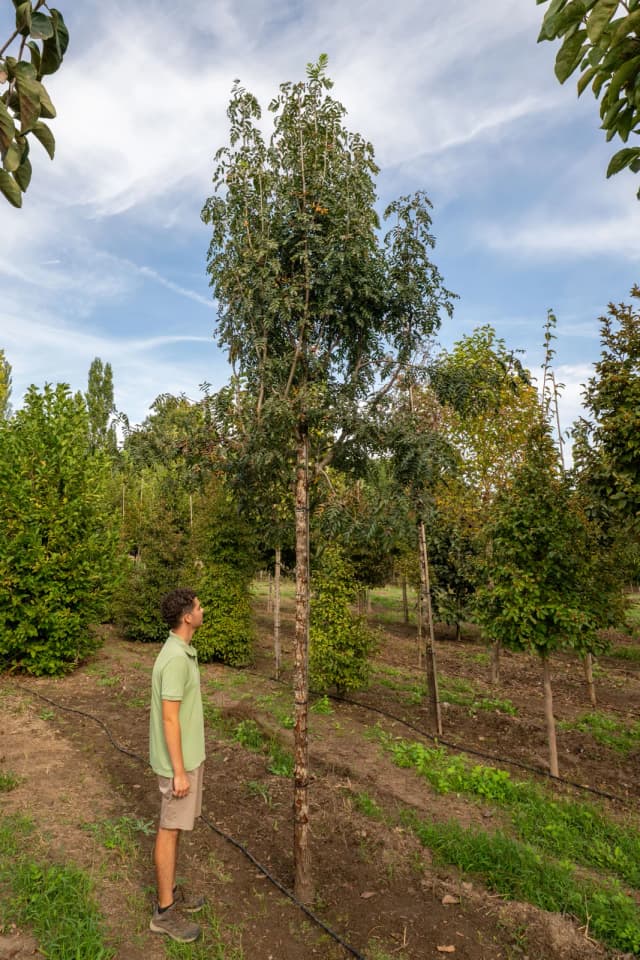
Sorbus aucuparia
Rowan
- SunFull sun, Partial shade
- Mature height8–15 m
- FoliageDeciduous
- Rate of growthMedium
- Maintenance levelEasy
A small deciduous tree with a light crown and pinnate leaves, with white flowers in May and clusters of orange-red berries in late summer that feed the birds. Native to the mountains of the North, it thrives in cool, high-altitude sites where many ornamental species struggle.
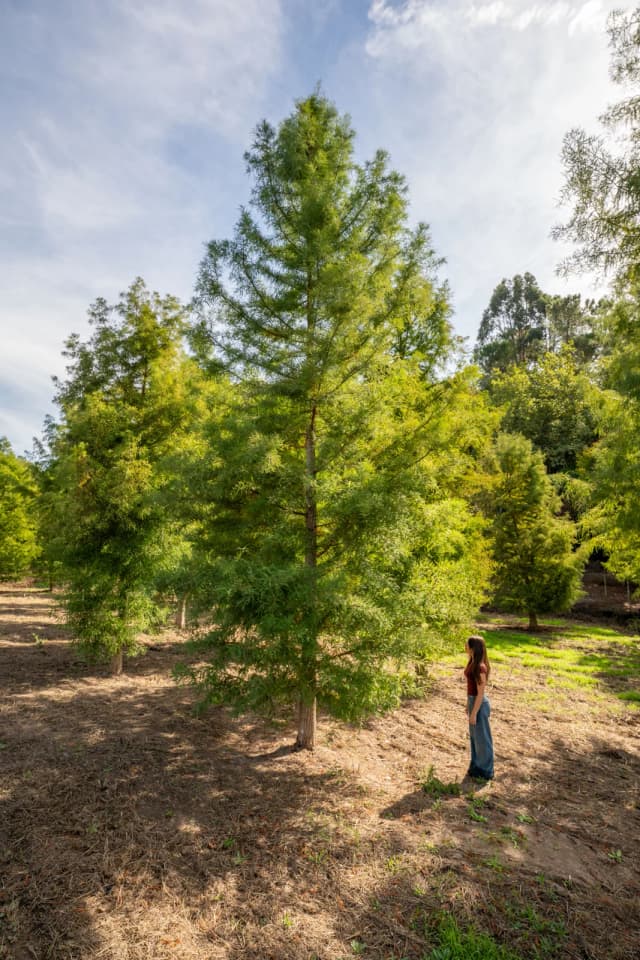
Taxodium distichum
Swamp cypress
A deciduous conifer of conical habit with feathery light green foliage, which turns copper and rust in autumn before falling. It is one of the few large trees that thrive with their feet in water, and so the natural choice for lake margins, flooded areas and heavy soils that other species cannot cope with.
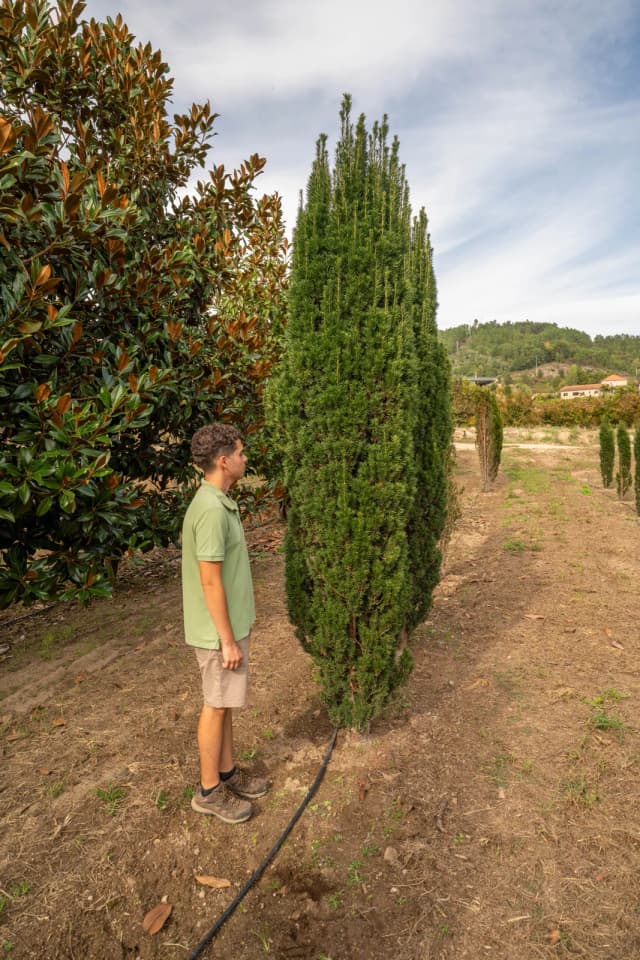
Taxus baccata 'Fastigiata Robusta'
Yew
- SunPartial shade
- Rate of growthSlow
Where a formal scheme calls for an evergreen vertical axis with a firm presence, this fastigiate selection of yew offers a tighter, more upright column than the usual 'Fastigiata', keeping architectural scale without widening the crown.
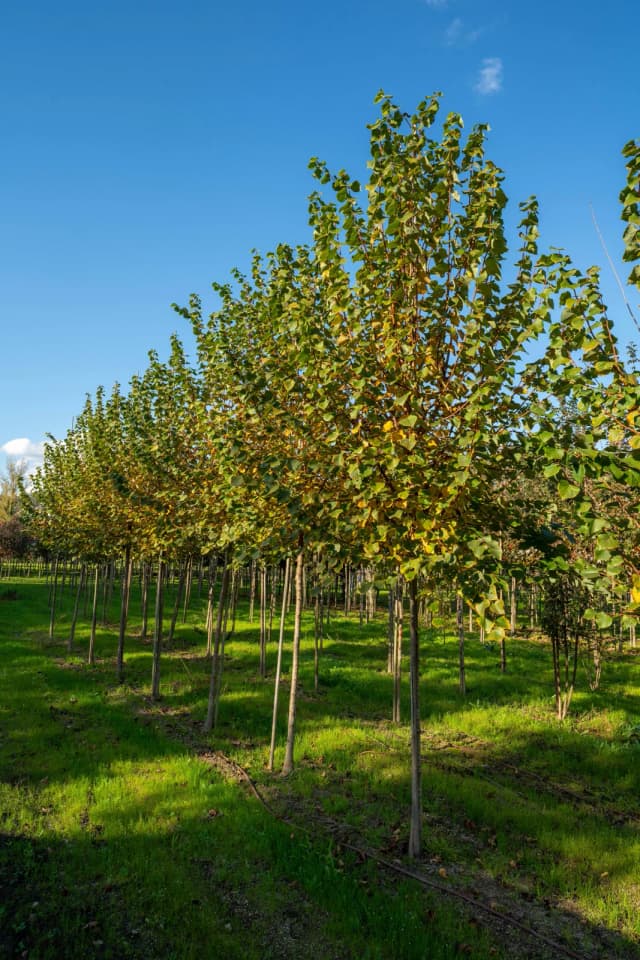
Tilia cordata
Small-leaved lime
- SunFull sun, Partial shade
- Mature height15–25 m
- FoliageDeciduous
- Rate of growthMedium
- Maintenance levelEasy
A deciduous tree with a dense, regular crown, heart-shaped leaves and scented cream flowers in June and July, which has filled the squares and avenues of Europe for centuries. It tolerates pruning, clay soil and urban conditions, and gives a cool, even shade.
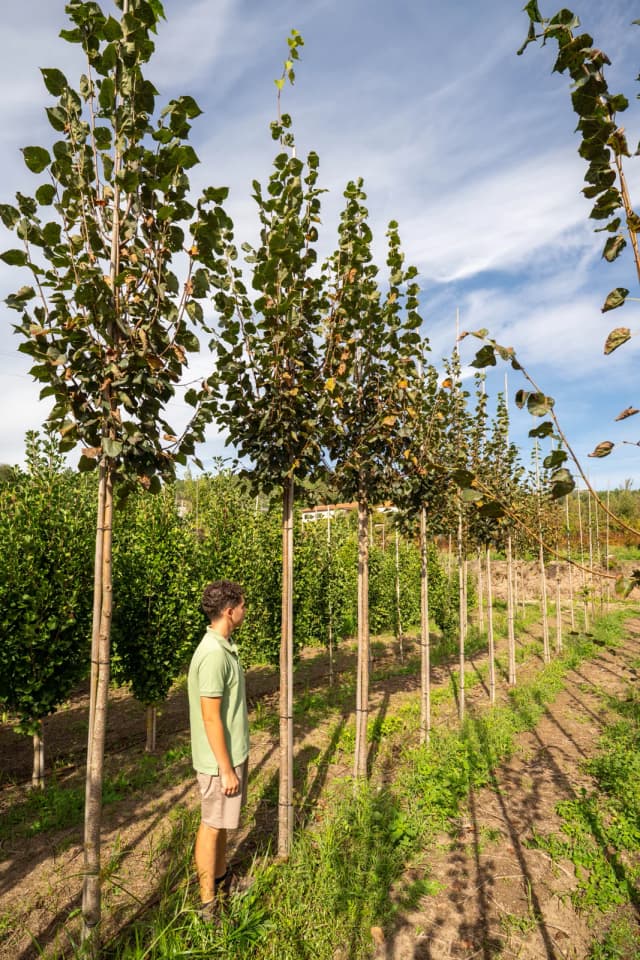
Tilia cordata 'Greenspire'
Small-leaved lime
A selection of particularly uniform growth, it forms a dense, symmetrical pyramidal crown, supported by a straight central leader and ascending branches. In early summer, the dark green foliage surrounds numerous clusters of yellowish-cream flowers whose scent and abundance of nectar turn the whole tree into an important centre of activity for pollinators.
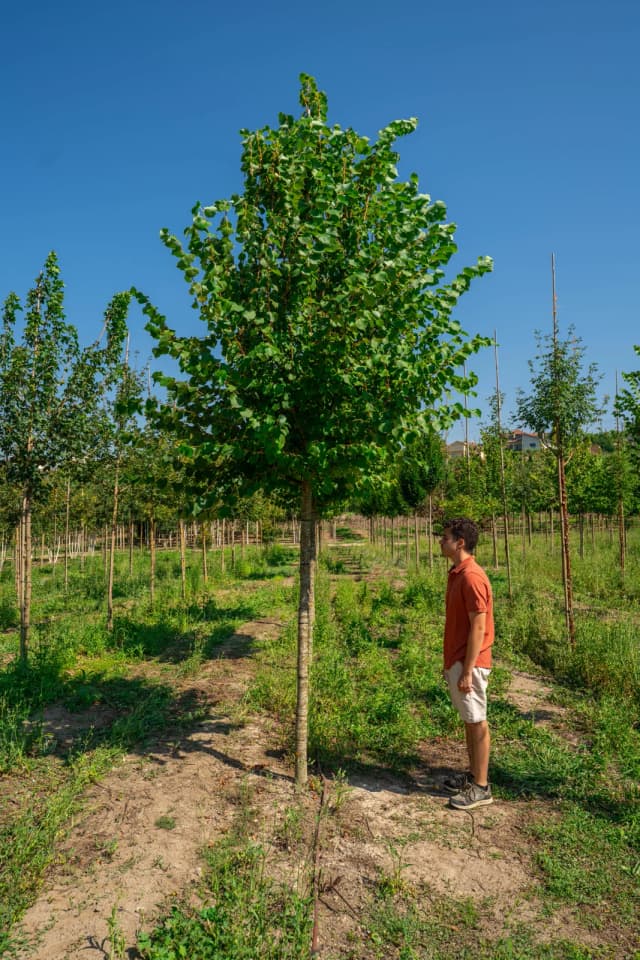
Tilia cordata 'Winter Orange'
Small-leaved lime
A selection of small-leaved lime chosen for the colour of its young shoots, which turn bright orange with the cold and keep the tree luminous from November to March. In summer it is a lime: oval crown, heart-shaped leaf and scented cream flowers in July.
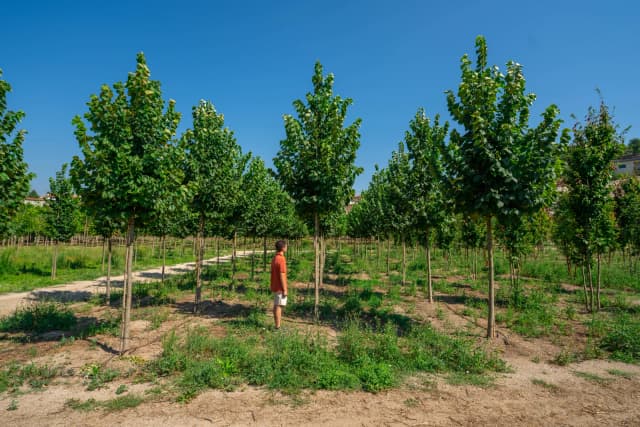
Tilia tomentosa
Silver lime
- SunFull sun
- Mature height15–25 m
- FoliageDeciduous
- Rate of growthMedium
- Maintenance levelEasy
Where avenue planting of lime is complicated by aphid honeydew on pavements and vehicles, this species solves the problem from the outset: the silvery foliage repels colonisation and keeps the paving clean beneath a dense crown.
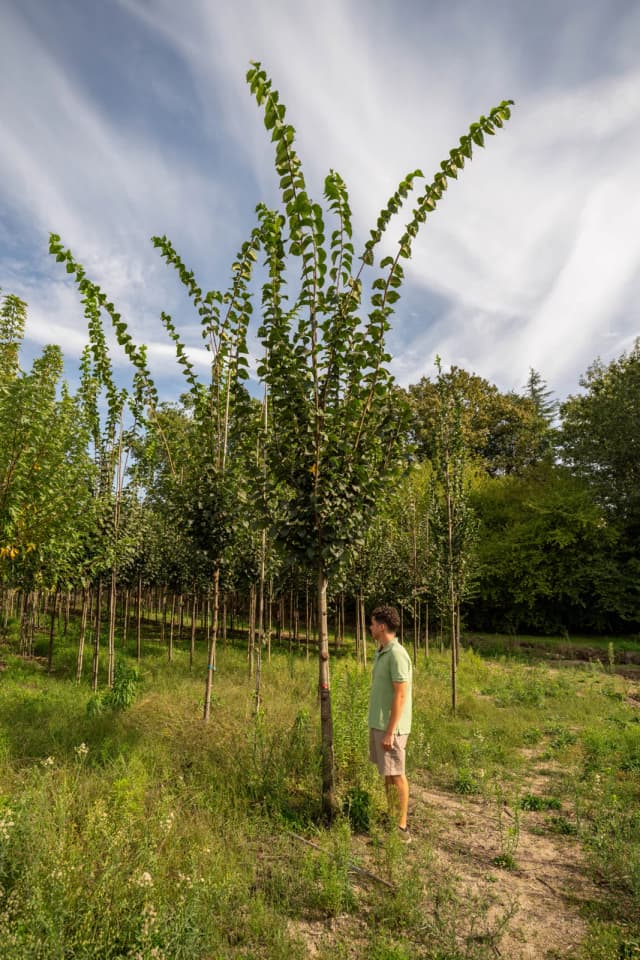
Ulmus 'Lobel'
Elm 'Lobel'
An elm of vigorous growth with a crown that is narrow at first, it becomes progressively pyramidal to oval without losing its vertical expression. Its dense, dark green, long-lasting foliage, excellent resistance to sea wind and tolerance of urban conditions make it a particularly functional tree for avenue planting and large spaces.
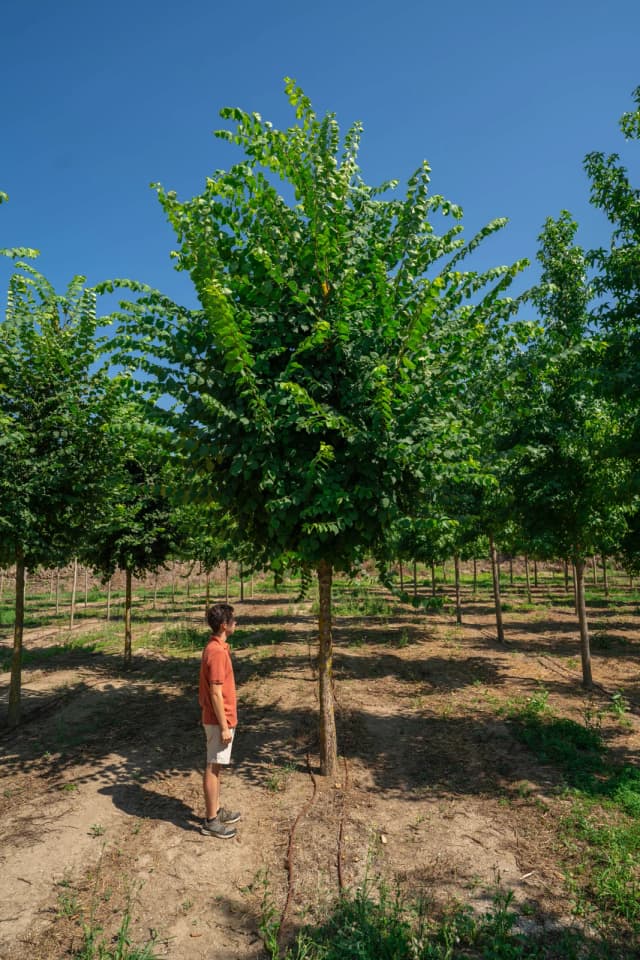
Ulmus glabra
Wych elm
A large, fast-growing tree, it develops a broad, oval and densely branched crown, able to create deep shade and a monumental presence. The large dark green leaves, very rough to the touch, take on a yellow to golden colour in autumn.
Amarante, Portugal
Come and see
your specimens.
You can touch the tree. And then reserve this plant.