

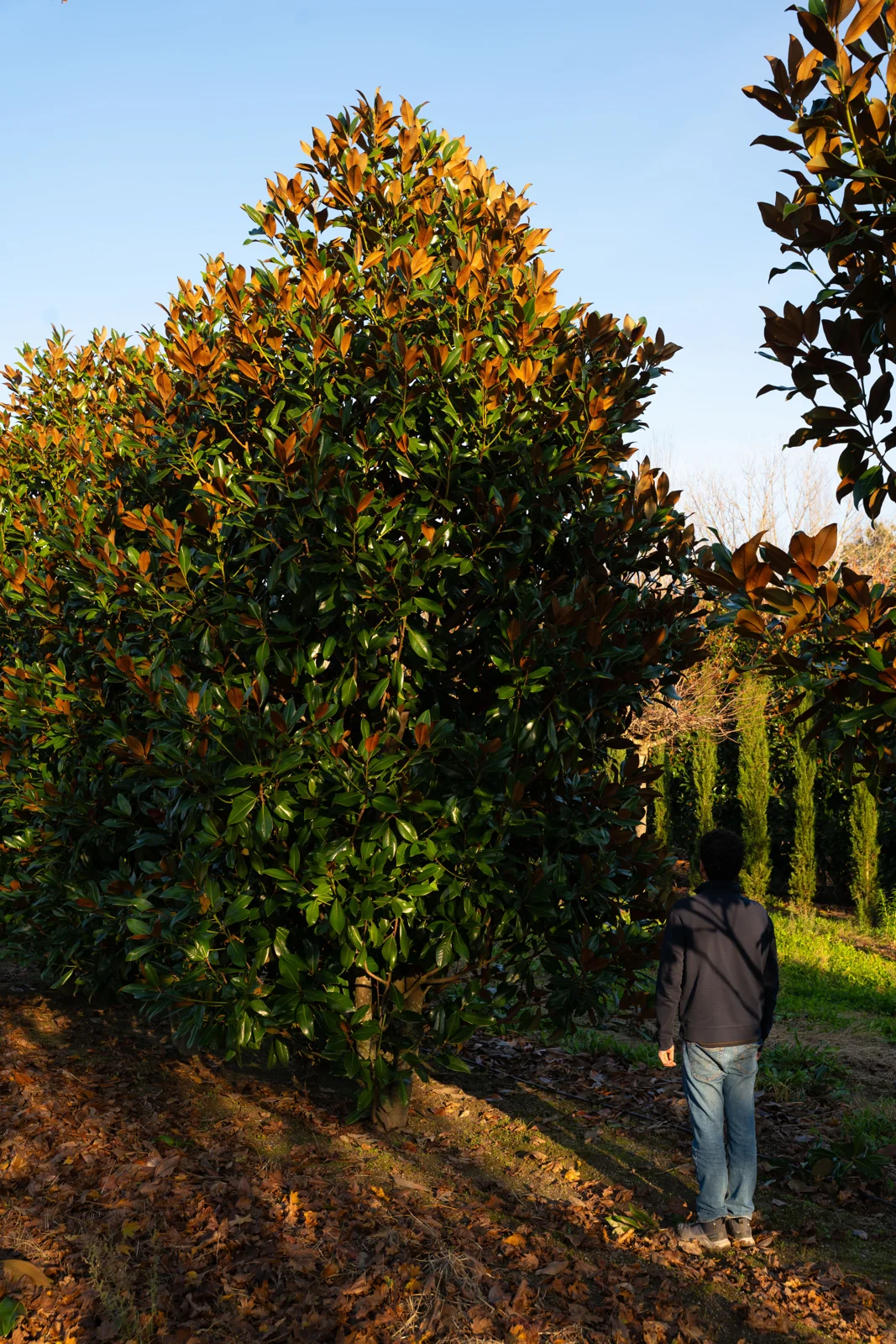
Magnolia grandiflora 'Gallisoniensis'Bull bay
A benchmark cultivar for projects that require evergreen mass and summer flowering. The dense pyramidal crown provides green structure all year round, with added interest from the scented flowering from June to September.
- Evergreen, leathery foliage, dark green and glossy, rusty brown beneath
- Scented white cup-shaped flowers, up to 25 cm in diameter
- Upright habit and dense, permanent shade twelve months a year
About this cultivar
'Gallisoniensis' is the most widely used cultivar of Magnolia grandiflora in European ornamental tree planting, and for good reason: it combines predictable vigour with a broad, regular pyramidal crown that needs no intensive formative pruning. At maturity it reaches 15 to 20 m in height and 8 to 12 m in spread, forming a dense green mass that works…Read moreShow less
'Gallisoniensis' is the most widely used cultivar of Magnolia grandiflora in European ornamental tree planting, and for good reason: it combines predictable vigour with a broad, regular pyramidal crown that needs no intensive formative pruning. At maturity it reaches 15 to 20 m in height and 8 to 12 m in spread, forming a dense green mass that works as an effective visual and acoustic barrier in parks and central reservations.
The foliage is its permanent structural asset. The leaves, large and leathery, have a dark green, glossy upper surface and an underside with a rusty-brown indumentum, which gives visual interest even outside the flowering period. The retention of leaves throughout the year makes this cultivar particularly useful in projects where the loss of the crown in winter would compromise its screening or shading function.
Flowering runs from June to September, with solitary white cup-shaped flowers that can reach 25 cm in diameter and give off an intense fragrance, noticeable from several metres away. This prolonged flowering period gives ornamental interest to public space during the months of greatest use.
In terms of soil, it prefers fertile, deep, well-drained soils, acidic to neutral in reaction, but tolerates clay and even chalky soils when drainage is adequate. It requires a sunny to partially shaded position and protection from strong, persistent winds, which makes it better suited to sheltered urban situations than to exposed seafronts. Its tolerance of urban pollution is confirmed, and its cold hardiness allows planting throughout mainland Portugal, including inland areas with minimum temperatures of -10 to -12 °C. Drought tolerance is moderate: the deep root system ensures survival in dry summer periods, but the tree benefits from supplementary watering in the first summers after transplanting and in situations of prolonged heat without rainfall.
Advice on this species
Want to know more about Magnolia grandiflora 'Gallisoniensis'?
Tell us about your project and we will advise on this species — where it does well, what size makes sense and what to expect once it is planted.
- Own production
- Mature specimens
- Reply within 1–2 days
No obligation · tailored quote