

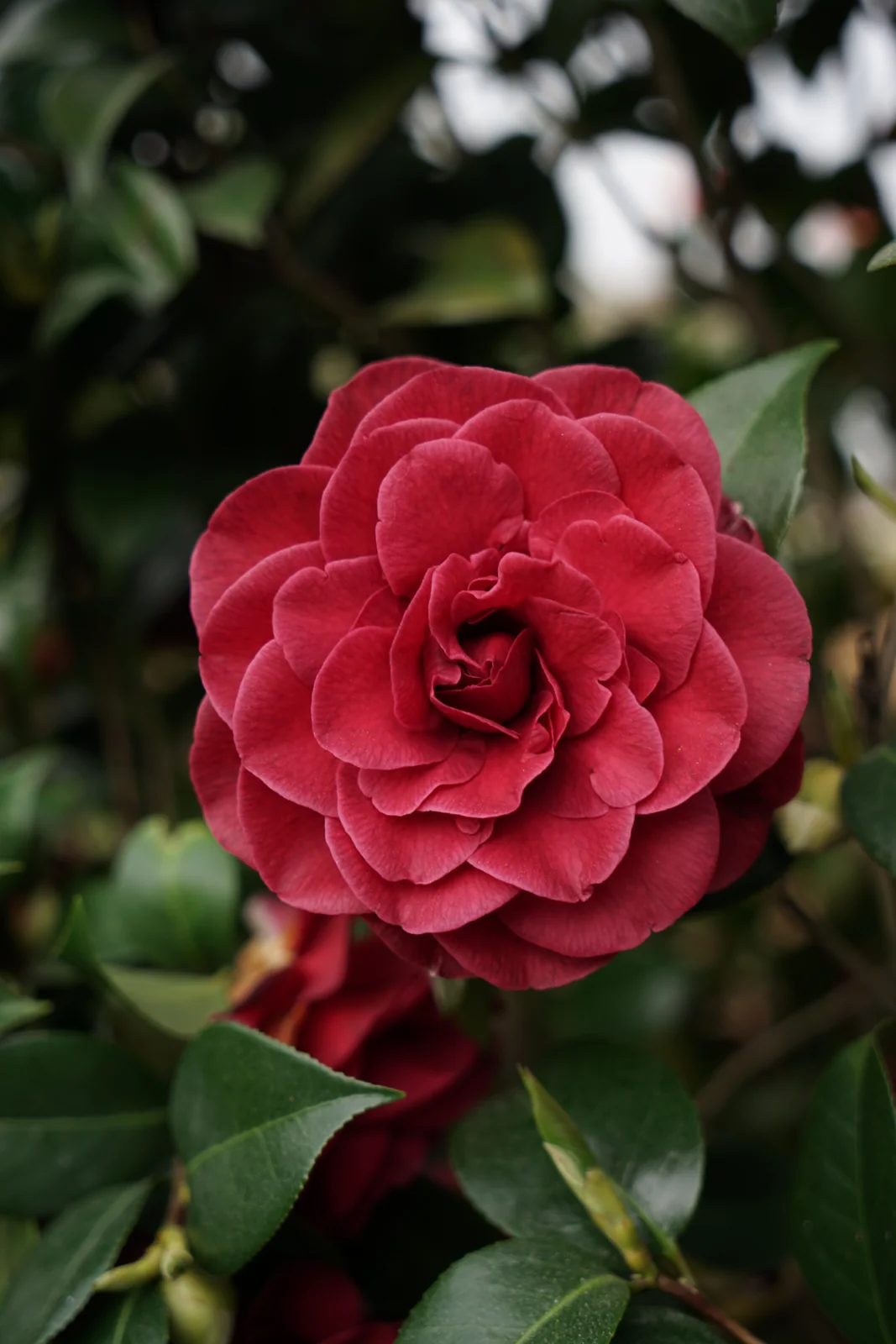
Camellia japonicaCamellia
A structural hedge or small single specimen for shaded courtyards, for the understorey of trees of the beech family in historic gardens of the North and for walled settings that call for evergreen foliage and flowering between January and April.
- Flowers of six to ten centimetres between January and April
- Red, pink, white or variegated depending on the cultivar
- Leathery evergreen leaves that reflect the light like dark varnish
About this species
A species long cultivated in Portugal, above all in Entre-Douro-e-Minho, where the centuries-old specimens in the gardens of Porto and at Quinta de Campo Bello continue to set the benchmark for size. In a contemporary project, Camellia japonica reads as a small evergreen tree of 3 to 6 m in favourable conditions, with a single stem or multi-stem, a dense…Read moreShow less
A species long cultivated in Portugal, above all in Entre-Douro-e-Minho, where the centuries-old specimens in the gardens of Porto and at Quinta de Campo Bello continue to set the benchmark for size. In a contemporary project, Camellia japonica reads as a small evergreen tree of 3 to 6 m in favourable conditions, with a single stem or multi-stem, a dense rounded crown and glossy dark green leathery foliage with a stable presence all year round. In a specification, what distinguishes a well-formed field-grown specimen from ordinary nursery stock is the girth size of the stem, the stability of the crown and regular flowering as early as the first winter after establishment.
Flowering takes place between January and April, depending on cultivar and exposure, in red, pink, white or variegated, and fills the ornamental gap of midwinter that few tree species cover in a project. The species requires acidic, moist, well-drained soil rich in organic matter; in chalky or compacted soils it suffers iron chlorosis and loss of vigour, which excludes it from much of the Lisbon fringe without sustained soil correction. It adapts from partial shade to full shade, a condition that makes it particularly useful in internal courtyards, cloisters, rows along north-facing façades and the understorey of deciduous crowns.
The root system is fibrous and not very invasive, compatible with tree pits of standard size and with the proximity of façades, but it does not tolerate prolonged waterlogging or summer dryness without maintenance watering. It withstands about -10 °C without vegetative damage, although the flowers are vulnerable to late frost and dry wind, conditions that call for shelter on the east side in inland situations. Growth is slow, which justifies choosing mature specimens whenever the project cannot tolerate an ornamental wait of two decades.
As a single specimen in a courtyard, cloister or walled garden, it takes the structural place of an evergreen magnolia, with the advantage of winter flowering and a more contained silhouette under light formative pruning, and it needs no cultural justification in a project located north of the Mondego.
Advice on this species
Want to know more about Camellia japonica?
Tell us about your project and we will advise on this species — where it does well, what size makes sense and what to expect once it is planted.
- Own production
- Mature specimens
- Reply within 1–2 days
No obligation · tailored quote