

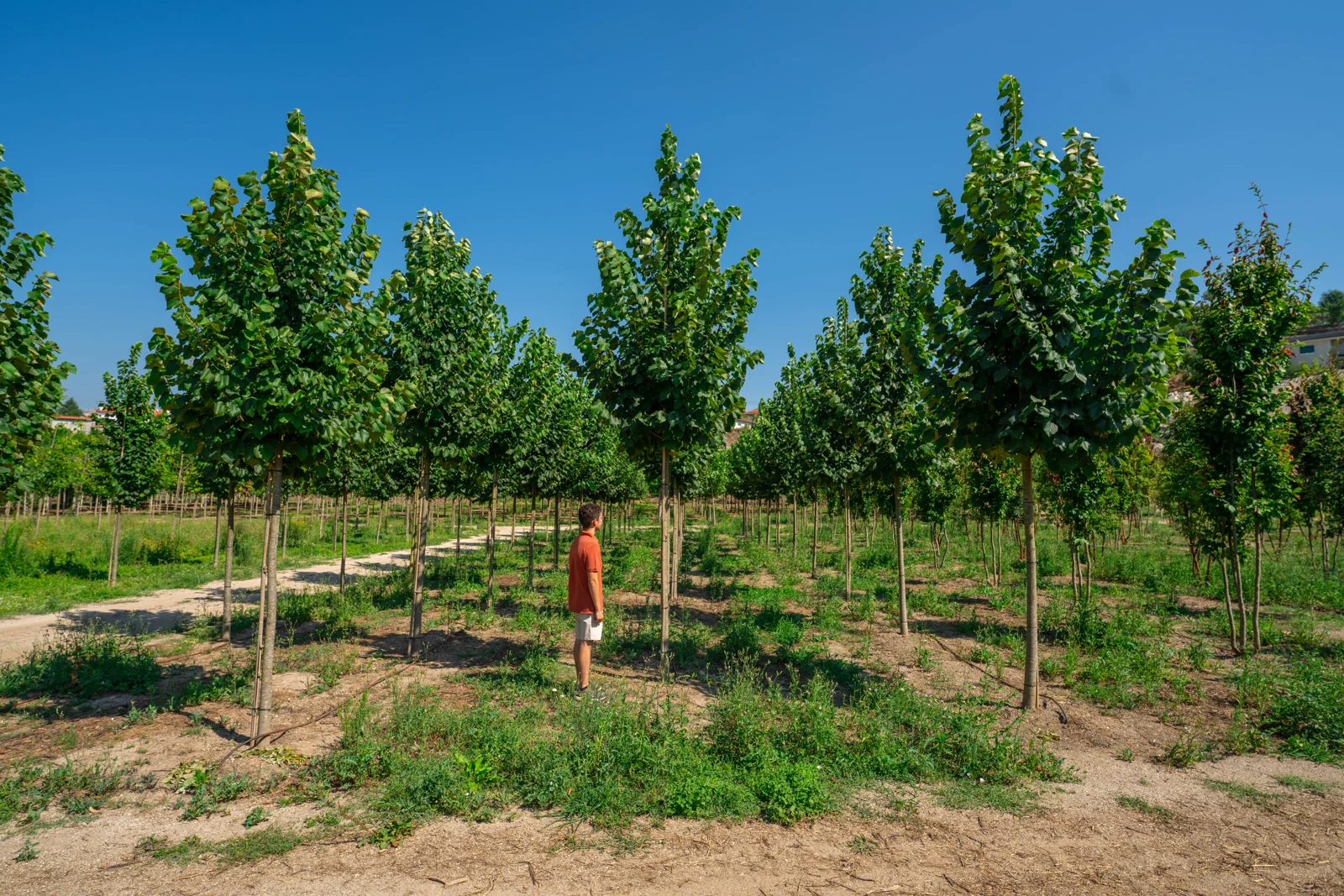
Tilia tomentosaSilver lime
Where avenue planting of lime is complicated by aphid honeydew on pavements and vehicles, this species solves the problem from the outset: the silvery foliage repels colonisation and keeps the paving clean beneath a dense crown.
- Dense, rounded crown that gives deep, even summer shade
- Leaves with a silvery underside that shimmer and lighten in the slightest breeze
- Scented cream flowers in high summer, which attract bees in large numbers
About this species
It differs from the limes most common in the Portuguese market (Tilia cordata, Tilia platyphyllos) in two characteristics relevant to design. The crown, conical and dense in a young specimen, is easily evened out by formative pruning, which makes it reliable in avenue planting and in a central reservation. The tomentose, silvery underside of the leaf also gives it a resistance…Read moreShow less
It differs from the limes most common in the Portuguese market (Tilia cordata, Tilia platyphyllos) in two characteristics relevant to design. The crown, conical and dense in a young specimen, is easily evened out by formative pruning, which makes it reliable in avenue planting and in a central reservation. The tomentose, silvery underside of the leaf also gives it a resistance to aphids that the other limes lack, reducing the honeydew that soils pavements, vehicles and street furniture beneath the crown.
Its thermal behaviour is its strongest argument for the Iberian climate. In periods of heat and drought, the leaf turns so as to expose the pubescent underside, reflecting solar radiation, lowering leaf temperature and limiting water loss through transpiration. Hence a tolerance of water stress greater than that of most of the genus, which supports its use in street planting exposed to full sun.
It adapts to loamy, clay and even chalky soils, with the only practical requirement being assured drainage, as it does not tolerate prolonged waterlogging. It withstands minimum temperatures of around -10 °C without winter stress in Portuguese conditions, so it covers everything from the coast to the northern interior. In an urban tree pit, the root system does not have the aggressive character that lifts paving, and is compatible with tree pits of ordinary size in street planting.
Of medium growth, it reaches shade-tree size (15 to 25 m in height by 10 to 15 m of crown when fully developed) over several seasons, gaining presence in a public square or urban park. The cream flowering, in July and August, is late for the genus and very rich in nectar, attracting bees and pollinators; the foliage turns yellow in autumn. The silvery leaf makes it stand out in the landscape and gives it a reading of its own in a group or as a single specimen, distinguishing it from the other limes at a distance.
Advice on this species
Want to know more about Tilia tomentosa?
Tell us about your project and we will advise on this species — where it does well, what size makes sense and what to expect once it is planted.
- Own production
- Mature specimens
- Reply within 1–2 days
No obligation · tailored quote