

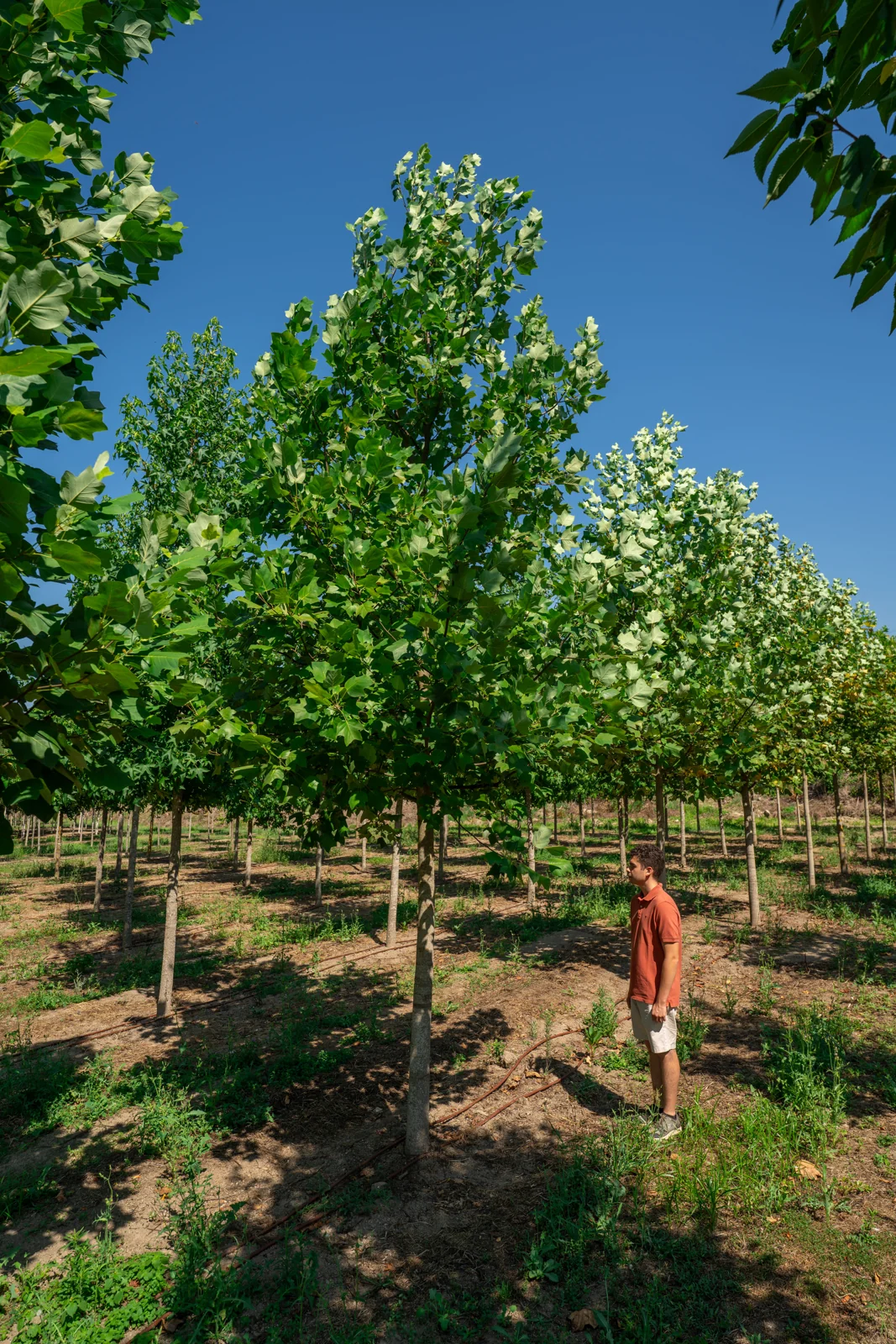
Liriodendron tulipiferaTulip tree
A fast-growing species of columnar habit that takes the place of a plane or a lime in parks and avenues, with a more upright silhouette, ornamental flowering and an intense autumn turn, requiring moist, deep, well-drained soil.
- Conical, upright crown that broadens with age into an oval silhouette
- Four-lobed leaves with an unmistakable truncated outline
- Foliage that turns a luminous golden yellow in autumn
About this species
The tulip tree is a deciduous tree of the family Magnoliaceae that reaches 20 to 35 m in height and 10 to 15 m in spread, with a narrow pyramidal crown and a straight stem that stays clear to a great height. Growth is fast: in favourable soil, a young specimen can reach 12 m in fifteen years. The columnar silhouette and limited asymmetry of habit…Read moreShow less
The tulip tree is a deciduous tree of the family Magnoliaceae that reaches 20 to 35 m in height and 10 to 15 m in spread, with a narrow pyramidal crown and a straight stem that stays clear to a great height. Growth is fast: in favourable soil, a young specimen can reach 12 m in fifteen years. The columnar silhouette and limited asymmetry of habit make it suitable for wide avenue plantings and for single planting in parks where verticality is wanted without the horizontal mass of a plane.
The leaf is simple and alternate, with four lobes and a truncated apex, glossy green on the upper surface and paler on the underside, with a long petiole that gives it movement in the wind. The autumn turn is a uniform golden yellow, stable for three to four weeks in Atlantic conditions, which makes it a relevant selection criterion in municipal projects with a requirement for seasonal interest. Flowering occurs in May and June, with solitary tulip-shaped flowers, their petals yellowish green with an orange band at the base; although showy, they are often hidden in the high crown of mature specimens.
The species requires full sun and acidic to slightly acidic soil (pH below 6.5) that is loamy, deep and regularly moist. Compacted chalky soils, clays with poor drainage or poor sands compromise its development: in dry or chalky soil the tree survives without thriving, and in periods of prolonged summer drought the leaf yellows and falls prematurely. Tolerance of water stress is moderate, which limits its use without supplementary watering in regions with a long, dry summer. It withstands minimum temperatures of -30 °C without damage, so winter cold is not a limiting factor anywhere in the country. Salt tolerance is low, which advises against its use on the seafront.
The root system is shallow and fleshy, characteristic of the Magnoliaceae, and sensitive to mechanical damage during transplanting. Transplanting should be carried out in early spring, before bud burst. In urban tree pits of less than 2 m, the root system can lift paving; in avenue plantings, allow for a generous tree pit or a continuous permeable strip. The wood is relatively weak, with a susceptibility to branch breakage in strong gales, a factor to weigh up in exposed sites. The shallow roots limit the underplanting possible beneath the spread of the crown.
In temperate Atlantic Europe the species reaches remarkable dimensions: specimens of more than 49 m are documented in northern Italy and south-western France. In Portugal, it performs best in areas of Atlantic influence with regular rainfall and deep acidic soils, where it can be an alternative to the plane in contexts where canker stain or the excessive size of Platanus x hispanica are grounds for exclusion.
Advice on this species
Want to know more about Liriodendron tulipifera?
Tell us about your project and we will advise on this species — where it does well, what size makes sense and what to expect once it is planted.
- Own production
- Mature specimens
- Reply within 1–2 days
No obligation · tailored quote