

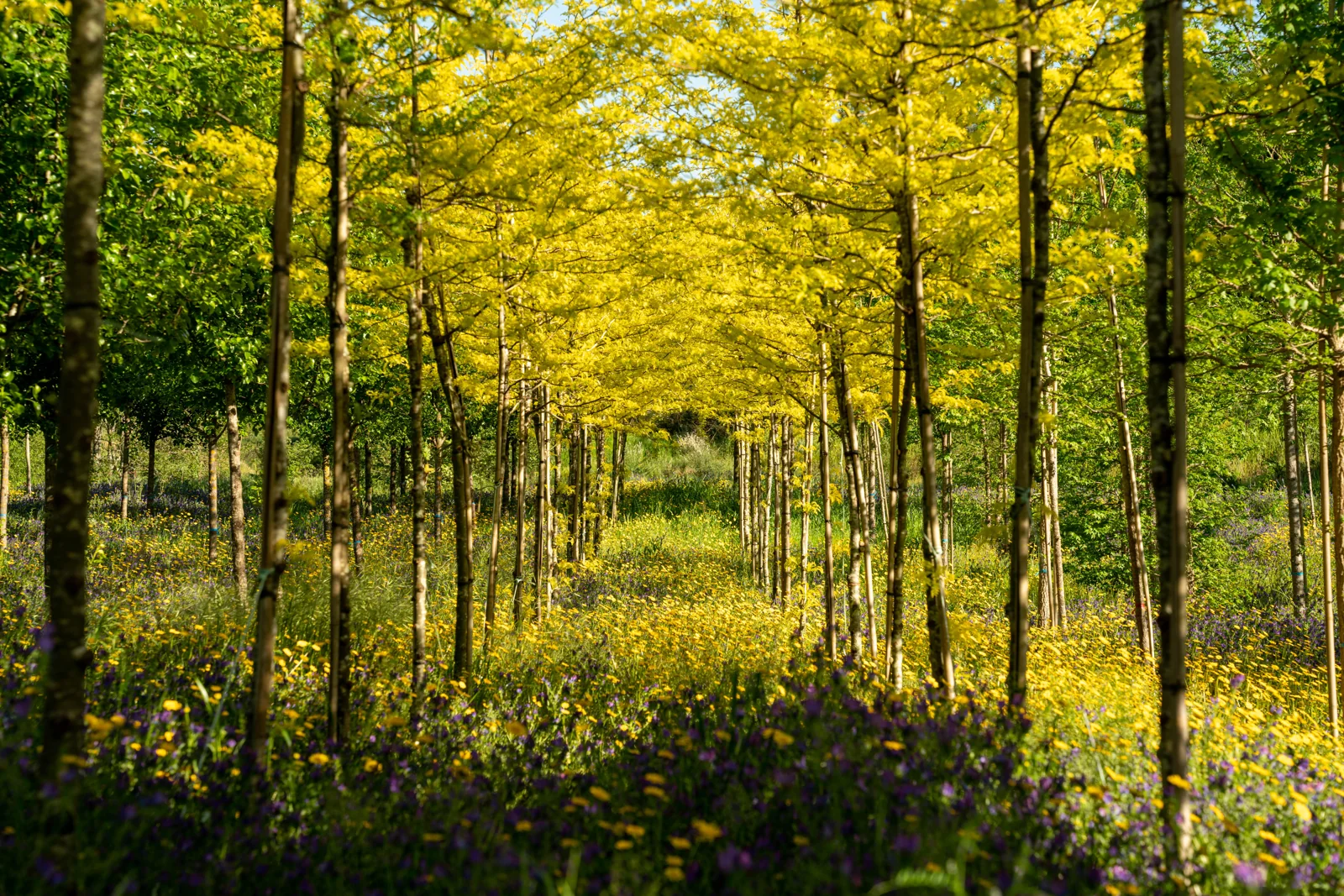
Gleditsia triacanthos 'Sunburst'Honey locust
For projects that call for shade without darkness, this golden cultivar of honey locust combines a rounded, airy crown, a complete absence of thorns and pods, and compound foliage that filters the light, allowing lawn or massed planting beneath.
- Golden foliage in spring, warm tones at autumn leaf fall
- Rounded crown that casts light shade, without darkening the lawn
- Cultivar without thorns or pods, safe beside paths
About this cultivar
The compound, finely divided foliage opens golden yellow in spring, moves to yellowish-green tones in summer and returns to warm colours in autumn, ensuring continuous colour interest. The rounded, airy crown casts a light, luminous shade, which sets this cultivar apart from trees of dense shade: it lets through enough light to…Read moreShow less
The compound, finely divided foliage opens golden yellow in spring, moves to yellowish-green tones in summer and returns to warm colours in autumn, ensuring continuous colour interest. The rounded, airy crown casts a light, luminous shade, which sets this cultivar apart from trees of dense shade: it lets through enough light to sustain lawn or massed shrub planting at the base, a decisive factor in an urban park or central reservation.
Unlike the straight species, armed with three-branched thorns and bearing long pods, 'Sunburst' derives from var. inermis and is practically free of thorns and fruit. This absence removes the risk to users and the mess of pods on the paving, qualifying it for street planting, squares and residential spaces where the straight species would not be viable.
In Portuguese conditions it reaches 10 to 15 m in height by 8 to 10 m in width, with moderate growth. It adapts to chalky, clay and poor sandy soils, as long as they are well drained, and does not tolerate prolonged waterlogging. It withstands heat, wind and moderate drought once established, and copes well with urban pollution, behaviour that supports its use in exposed city settings.
Full exposure is needed to maintain the intensity of the golden colour; in partial shade the foliage tends towards green. The genus is not among those under recognised plant-health pressure in Portugal, unlike Fraxinus with ash dieback or Platanus with canker stain, which simplifies its specification for avenue planting.
In avenue planting it occupies a register close to that of a Fraxinus or a lime, but with a more regular silhouette under formative pruning, better drought tolerance and without the plant-health exposure of the ash. The low maintenance requirement after establishment strengthens its place in municipal tree-planting projects.
Advice on this species
Want to know more about Gleditsia triacanthos 'Sunburst'?
Tell us about your project and we will advise on this species — where it does well, what size makes sense and what to expect once it is planted.
- Own production
- Mature specimens
- Reply within 1–2 days
No obligation · tailored quote