

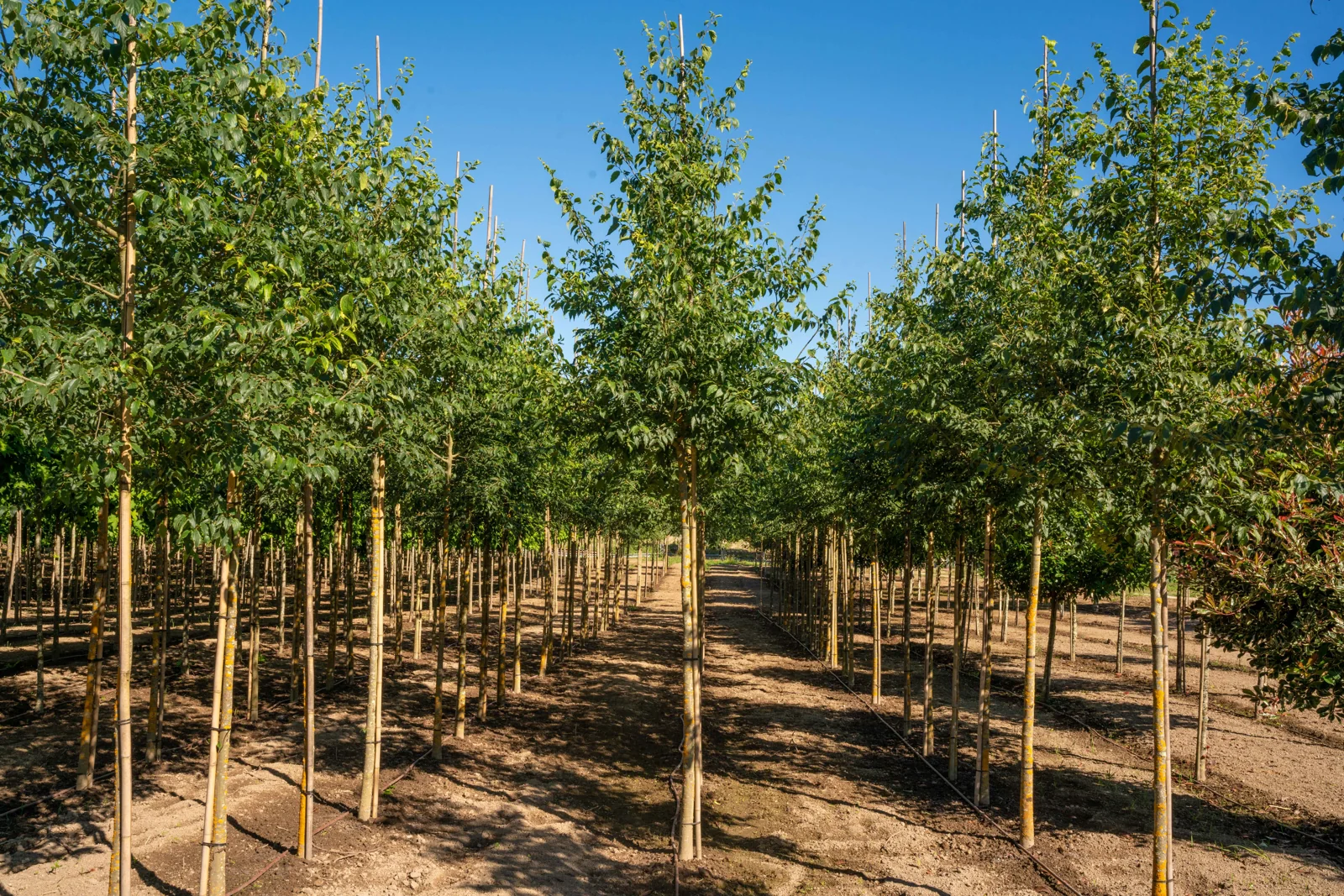
Celtis australisSouthern nettle tree
A tree native to Portugal, it combines a light grey trunk of sculptural expression with a broad, luminous crown that is effective in creating shade. Its ability to stay vigorous in stony, chalky soils, under heat and drought, makes it especially relevant to the Portuguese landscape and to urban projects prepared for a more demanding climate.
- Light grey bark, smooth for many years, which enhances the structure of mature specimens
- Rough leaves, dark green on the upper surface and grey-green on the underside
- Small, sweet, edible drupes, sought by birds as they ripen
About this species
Celtis australis, known in Portugal as lodoeiro, lódão-bastardo or agreira and, in the Minho, as padreiro, is a deciduous tree originating in the Mediterranean region and native to mainland Portugal. It develops an architecture that is upright at first and progressively becomes a broad crown, rounded to umbrella-shaped, with open branching and slightly pendulous tips. It can reach approximately 10 to 15 metres in height and 10 to 12 metres in spread, exceeding these dimensions when it has space and favourable conditions.Read moreShow less
Celtis australis, known in Portugal as lodoeiro, lódão-bastardo or agreira and, in the Minho, as padreiro, is a deciduous tree originating in the Mediterranean region and native to mainland Portugal. It develops an architecture that is upright at first and progressively becomes a broad crown, rounded to umbrella-shaped, with open branching and slightly pendulous tips. It can reach approximately 10 to 15 metres in height and 10 to 12 metres in spread, exceeding these dimensions when it has space and favourable conditions.
The trunk is one of the most distinctive features of the species. The bark stays smooth and light grey for many years, creating a sober surface that shows off the line of the main limbs. With age it may begin to come away in small plates, adding texture without losing its characteristic brightness. In mature specimens, the combination of pale trunk, organic branching and broad crown produces a presence that is at once monumental and natural.
The leaves, about 9 to 15 centimetres long, are oval to lanceolate, with a strongly serrate margin and a long, tapering tip, often slightly twisted. The upper surface is dark green and markedly rough, while the underside is paler, in grey-green tones. The wind reveals the two surfaces in turn and gives the crown movement. In autumn, the foliage takes on yellow tones before it falls.
In spring, small yellowish-green flowers appear, visually inconspicuous but of interest to pollinating insects. They are followed by rounded drupes of approximately one centimetre, which turn from green to dark red and finally to an almost black purple. When ripe they are sweet and edible, with a flavour sometimes compared to tamarind, and are also a food source sought by birds.
It prefers full sun and benefits from deep, loose, well-drained soils, but adapts particularly well to stony, chalky ground of moderate fertility. Once established, it withstands heat, periods of drought, air pollution and the proximity of paving, characteristics that explain its growing use in urban tree planting and in climate adaptation strategies. A newly planted mature specimen does, however, need deep, regular watering during the establishment period.
It is suited to wide avenues, parks, squares, large gardens and projects that aim to create shade without resorting to a visually heavy crown. It can be trained as a single stem for avenue planting or as a multi-stem form for a more naturalistic and sculptural expression. Mature specimens from Diaplant immediately bring an already defined pale trunk, expressive branching and a crown with enough scale to transform the reading and comfort of the space from the moment of planting.
Advice on this species
Want to know more about Celtis australis?
Tell us about your project and we will advise on this species — where it does well, what size makes sense and what to expect once it is planted.
- Own production
- Mature specimens
- Reply within 1–2 days
No obligation · tailored quote