

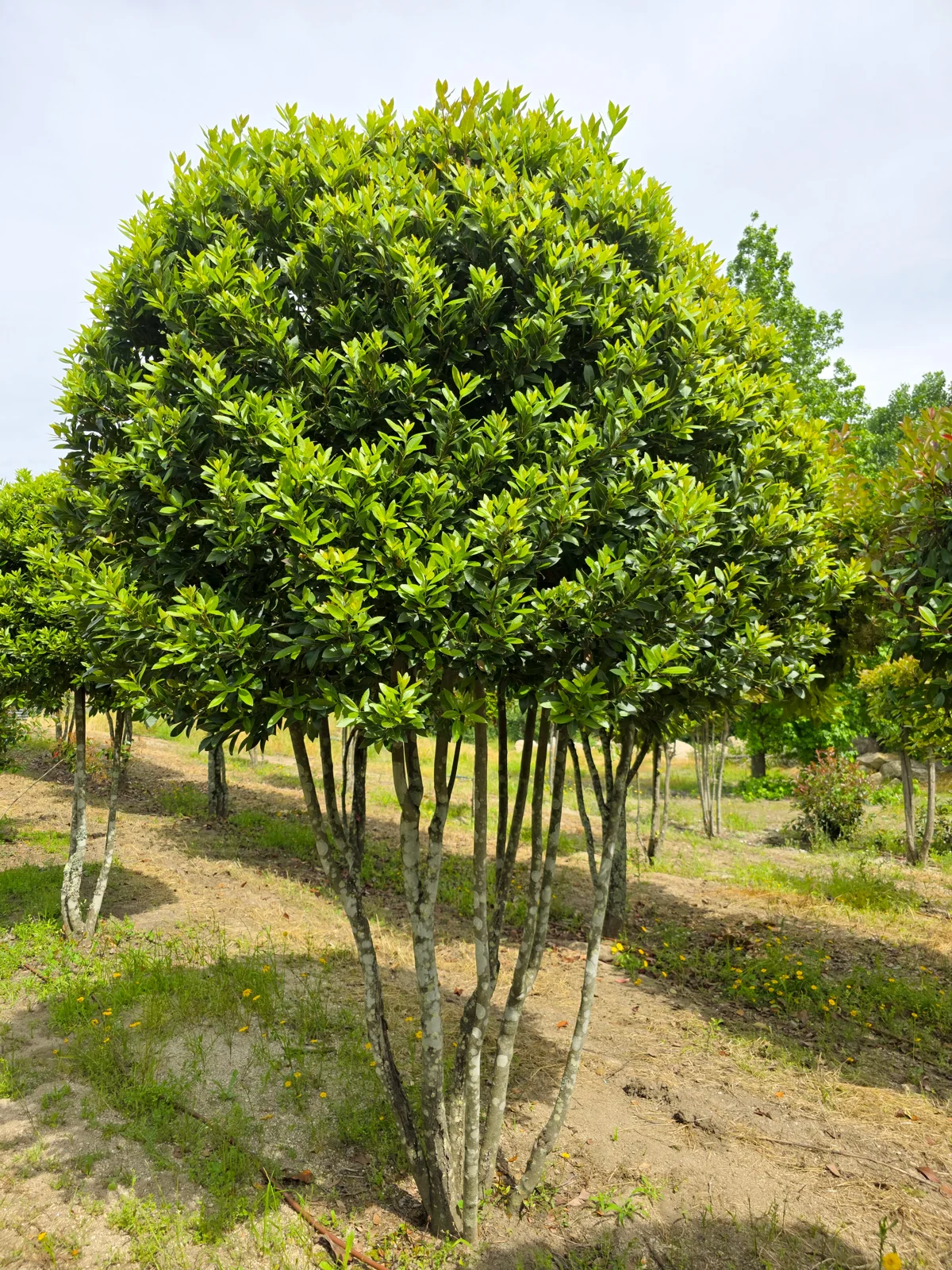
Laurus nobilisBay tree
A species to specify when the project calls for a dense evergreen mass that can be clipped and tolerates partial shade, with reliable establishment and vigorous rooting in deep, well-drained soils.
- Leathery dark green leaf, glossy and strongly aromatic
- Evergreen foliage that keeps the garden clothed all year round
- Takes to a formal hedge, pyramid or ball with the same composure
About this species
Bay is a standard specification in Portuguese projects, above all as a tall structural hedge, formal topiary and a specimen for a courtyard or walled garden. What distinguishes a mature nursery specimen at a girth size of 25–30 cm is the dense crown already stabilised, the clear stem up to pruning height and transplant establishment that is substantially more reliable than with…Read moreShow less
Bay is a standard specification in Portuguese projects, above all as a tall structural hedge, formal topiary and a specimen for a courtyard or walled garden. What distinguishes a mature nursery specimen at a girth size of 25–30 cm is the dense crown already stabilised, the clear stem up to pruning height and transplant establishment that is substantially more reliable than with young stock. For a square or avenue project, the regular conical crown allows formative pruning without losing the architectural habit that the specification assumes.
It adapts to full exposure and partial shade with equal reliability, which opens up use in shaded courtyards where few evergreens keep their foliage density. Tolerance of water stress is moderate, not absolute: a relic of the original Mediterranean laurel forest, bay responds better to moist soils with available atmospheric moisture than to prolonged dry substrate in continental inland conditions. In well-drained chalky soils it performs without stress; with seasonal waterlogging or poor drainage it is vulnerable to root rot caused by Phytophthora, a decisive factor in the choice of planting site.
In plant-health terms, the practical pressure comes from the bay sucker (Trioza alacris), which causes leaf-margin curling and galling, controllable in a well-ventilated project with timely sanitary pruning; occasional scale insects (Coccus hesperidum) rarely require intervention on vigorous specimens. The root system is non-aggressive, compatible with a 1.5 m tree pit in street planting and with a prudent separation from underground services, which opens up use in restricted street corridors where Platanus or Celtis would be ruled out.
Growth is slow to moderate, which weighs on the choice between transplanting a mature nursery tree and planting young stock: for a visual result within three or four years of the works, only stock of mature girth size delivers. The foliage is leathery, dark green and aromatic, and the dark grey, fissured bark gives winter presence in a public square. The species appears as a relict element of the laurel forest in central and northern Portugal, which supports its use under PDM (municipal master plans) that require native species wherever the municipal documentation allows.
Advice on this species
Want to know more about Laurus nobilis?
Tell us about your project and we will advise on this species — where it does well, what size makes sense and what to expect once it is planted.
- Own production
- Mature specimens
- Reply within 1–2 days
No obligation · tailored quote