

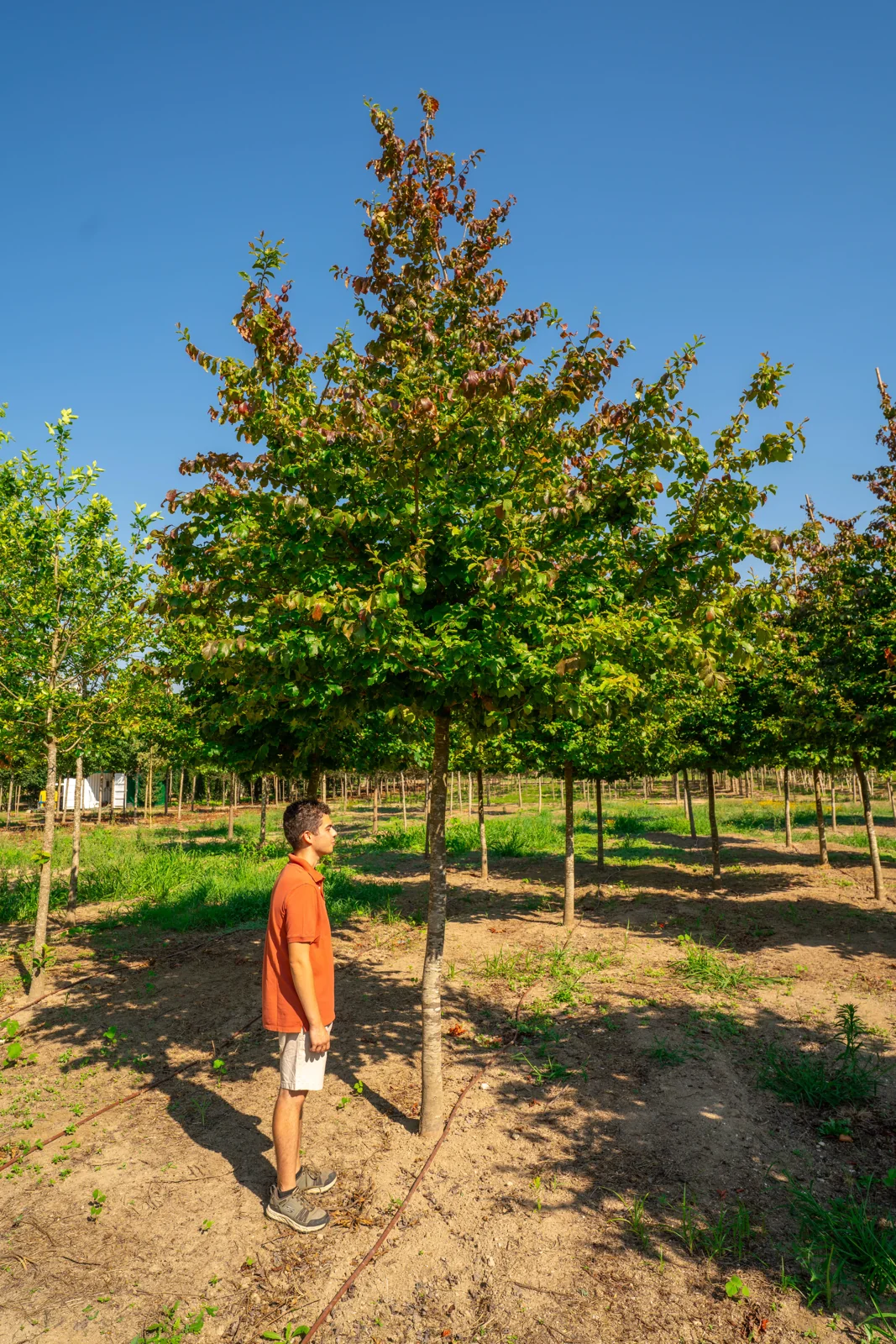
Parrotia persicaPersian ironwood
A species seldom specified in the Portuguese market but with proven performance in Atlantic and temperate Mediterranean climates. In a tree pit it takes the place of a Liquidambar or an Acer, with lower water demand, proven plant-health resistance and ornamental interest spread across the whole year.
- Autumn colour that runs from yellow to crimson in good sun
- Trunk that flakes in plates, a mosaic of green, white and light brown
- Broad, open crown on several interlaced stems, a sculptural presence
About this species
Parrotia persica is a slow-growing deciduous tree that forms a broad, dense crown, reaching 6 to 12 m in height and 6 to 10 m in spread in cultivation. The natural habit is often multi-stem and spreading, but it responds well to formative pruning to a single stem, which makes it compatible with tree pits of contained size in street plantings and squares. The…Read moreShow less
Parrotia persica is a slow-growing deciduous tree that forms a broad, dense crown, reaching 6 to 12 m in height and 6 to 10 m in spread in cultivation. The natural habit is often multi-stem and spreading, but it responds well to formative pruning to a single stem, which makes it compatible with tree pits of contained size in street plantings and squares. The wood is extraordinarily hard and the branch structure, with a tendency to inosculate, gives high resistance to wind and storms.
The root system is not very aggressive and does not present the paving-lift problems associated with the plane or the poplar. It tolerates compacted, clay and well-drained chalky soils, performing equally well in acidic substrates and in poor sandy soils. It adapts to seasonal waterlogging, which gives it versatility in projects with poor drainage. In full exposure it develops its autumn colour best; in partial shade it keeps its vegetative vigour without significant loss of leaf density.
Drought tolerance is moderate: once established, it needs no additional watering in Atlantic conditions from the Minho to the Mondego, but in Lisbon and further south it benefits from supplementary watering in the first summers. It withstands minimum temperatures of -19 °C confirmed in European cultivation and tolerates peaks of 41 °C with no recorded leaf damage. It has no significant plant-health problems in the European context, which clearly sets it apart from genera under active pressure such as Fraxinus, Platanus or Castanea.
The ornamental interest is spread across four seasons. In February and March, before the leaves emerge, petal-less flowers with visible red stamens appear on bare branches. The spring foliage emerges reddish, turns glossy dark green in summer and changes to yellow, orange, crimson or purple in autumn, often with several shades in the same crown. In winter, the flaking bark reveals a mosaic of green, white and light brown that recalls the pattern of the plane, keeping a visual presence in a public square through the leafless months.
Advice on this species
Want to know more about Parrotia persica?
Tell us about your project and we will advise on this species — where it does well, what size makes sense and what to expect once it is planted.
- Own production
- Mature specimens
- Reply within 1–2 days
No obligation · tailored quote