

Osmanthus heterophyllusOsmanthus
Close to holly in a project, with one decisive morphological difference: the leaf arrangement is opposite, not alternate. A slow-growing evergreen shrub with a dense crown, it adapts to compacted urban soils and tolerates the city climate.
- Intense, sweet scent between September and November
- Leathery, glossy evergreen foliage with a varied, rich texture
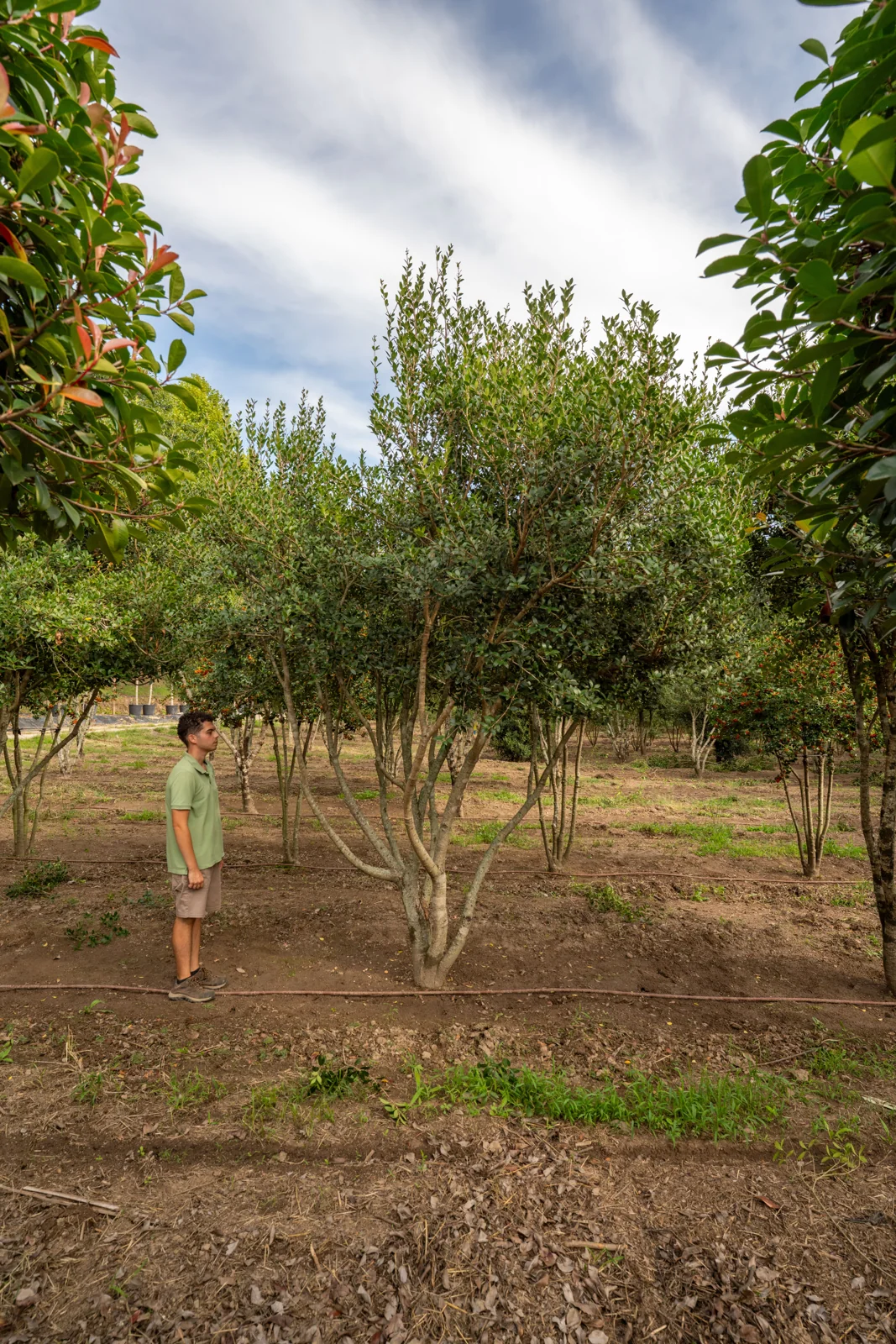
- Dense, rounded crown of three to six metres
About this species
With a compact size of between 3 and 6 metres in height and an equivalent spread, Osmanthus heterophyllus keeps a dense, rounded crown that needs no frequent formative work. The leathery, glossy dark green leaves, 3 to 7 cm long, are dimorphic: on young branches they have a spiny margin with one to four apical teeth; on the mature branches of the upper…Read moreShow less
With a compact size of between 3 and 6 metres in height and an equivalent spread, Osmanthus heterophyllus keeps a dense, rounded crown that needs no frequent formative work. The leathery, glossy dark green leaves, 3 to 7 cm long, are dimorphic: on young branches they have a spiny margin with one to four apical teeth; on the mature branches of the upper crown they tend towards an entire margin. This morphological variation, which gives rise to the epithet heterophyllus, is a functional advantage in containment hedges and anti-intrusion barriers, where the spiny young leaves of the lower levels act as a deterrent without the need for wire or railings.
The species tolerates compacted chalky soils, clay soils with moderate drainage and partial shade, conditions that are common in dense urban settings and internal courtyards. It withstands temperatures in the order of -15 to -20 °C, which covers the whole of Portugal, including the winters of inland Trás-os-Montes, with no need for additional protection. Its tolerance of air pollution and partial shading makes it usable in street plantings with limited exposure where Ilex aquifolium would perform less consistently.
Flowering, in September and October, produces white tubular flowers with four lobes, hidden by the foliage but intensely fragrant, noticeable several metres away. This is a window of sensory interest in the period of least ornamental activity in most massed shrub plantings. The species is dioecious; the fruits, dark purple drupes of 1.5 cm, rarely form in cultivation, which simplifies management in public space.
Its slow growth and contained root system make it easy to integrate into tree pits of restricted size and beds adjacent to underground services, with no documented risk of lifting paving. The species has no serious plant-health problems; monitoring should focus on scale insects and aphids in dense plantings or those with reduced air circulation. It does not appear on the lists of invasive species in Decree-Law no. 92/2019, and is compatible with PDM (municipal master plans) that impose restrictions on the use of invasive taxa in public green space.
Advice on this species
Want to know more about Osmanthus heterophyllus?
Tell us about your project and we will advise on this species — where it does well, what size makes sense and what to expect once it is planted.
- Own production
- Mature specimens
- Reply within 1–2 days
No obligation · tailored quote