

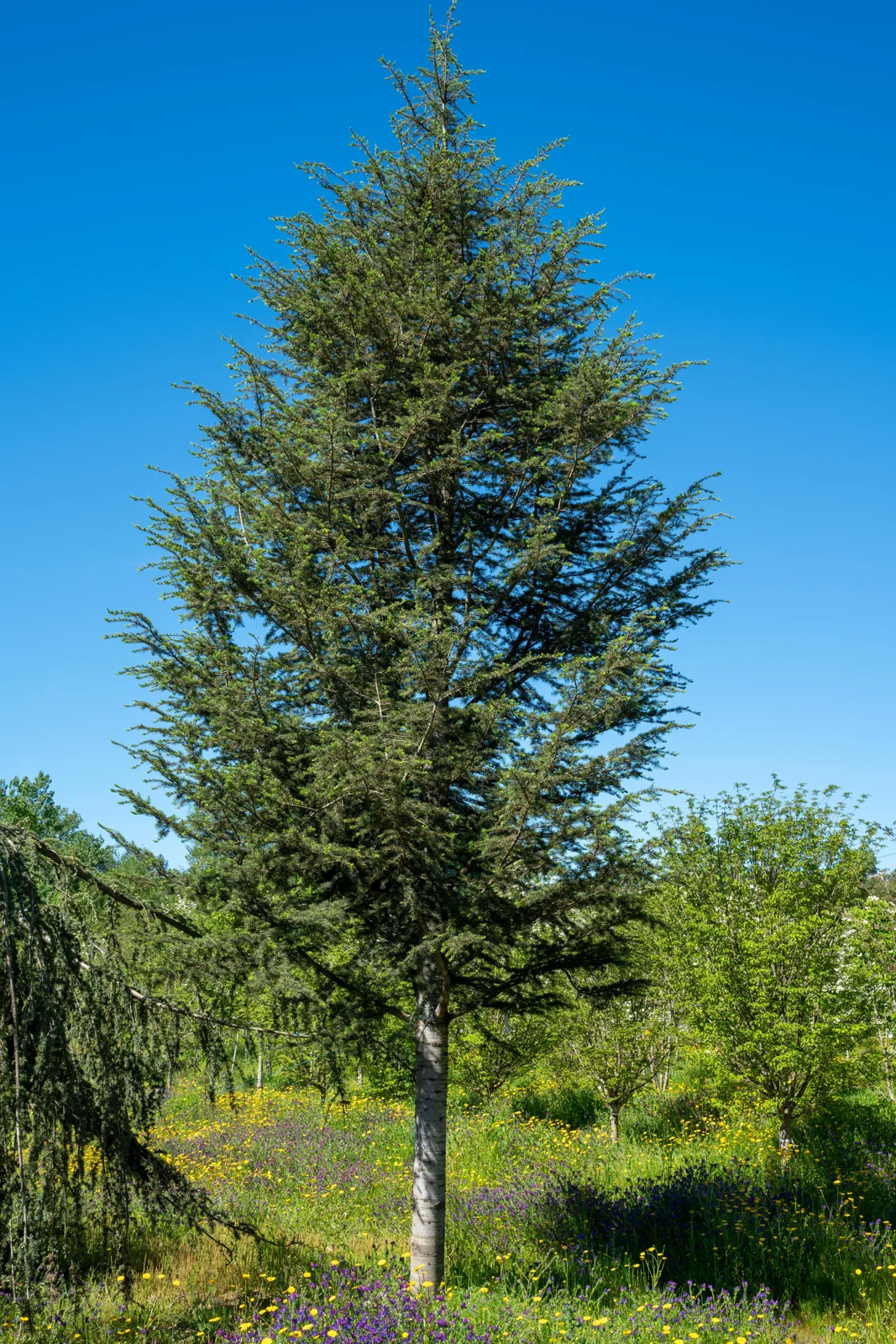
Cedrus libaniCedar of Lebanon
An evergreen conifer of extraordinary longevity and monumental presence, it develops a crown that is pyramidal at first and becomes, with age, a broad, tabular structure. The great horizontal branches form successive tiers, creating one of the most recognisable silhouettes among mature conifers.
- Broad, flattened mature crown formed of great horizontal tiers
- Powerful trunk and branching of strong sculptural expression
- Evergreen species of great longevity and deep historical value
About this species
In youth it has a conical, relatively regular crown, marked by a dominant central leader. With age, vertical growth becomes less prominent, the main branches spread horizontally and the upper part of the crown becomes broad and flattened. This transformation gives rise to the tabular architecture characteristic of mature specimens.Read moreShow less
In youth it has a conical, relatively regular crown, marked by a dominant central leader. With age, vertical growth becomes less prominent, the main branches spread horizontally and the upper part of the crown becomes broad and flattened. This transformation gives rise to the tabular architecture characteristic of mature specimens.
It can reach approximately 15 to 25 metres in height and 10 to 18 metres in spread, occasionally more in favourable conditions. The trunk becomes progressively thick and deeply fissured, and may divide into large structural limbs. The combination of the powerful base and the extensive tiers of branching gives the tree an expression that is at once stable and monumental.
The needles are stiff, short and gathered in dense tufts on the branches, in dark green to bluish-green tones. The female cones, ovoid and upright, develop on the upper branches and stay on the tree for about two years, later breaking up to release the seeds.
It grows best in full sun and in deep, well-drained soils, adapting to different textures and pH values. Once established, it has good resistance to cold and to periods of drought. It needs a large area free of obstacles to keep its lower branches and fully express the horizontal spread of the crown, and is suited to parks, historic estates, large gardens and monumental entrances.
In mature specimens from Diaplant, the architectural transformation that defines this species is already clearly under way. The consolidated trunk, the first great horizontal tiers and the scale of the crown immediately bring a historic and monumental presence, bypassing the decades needed for a young plant to acquire the unmistakable silhouette of the cedar of Lebanon.
Advice on this species
Want to know more about Cedrus libani?
Tell us about your project and we will advise on this species — where it does well, what size makes sense and what to expect once it is planted.
- Own production
- Mature specimens
- Reply within 1–2 days
No obligation · tailored quote