

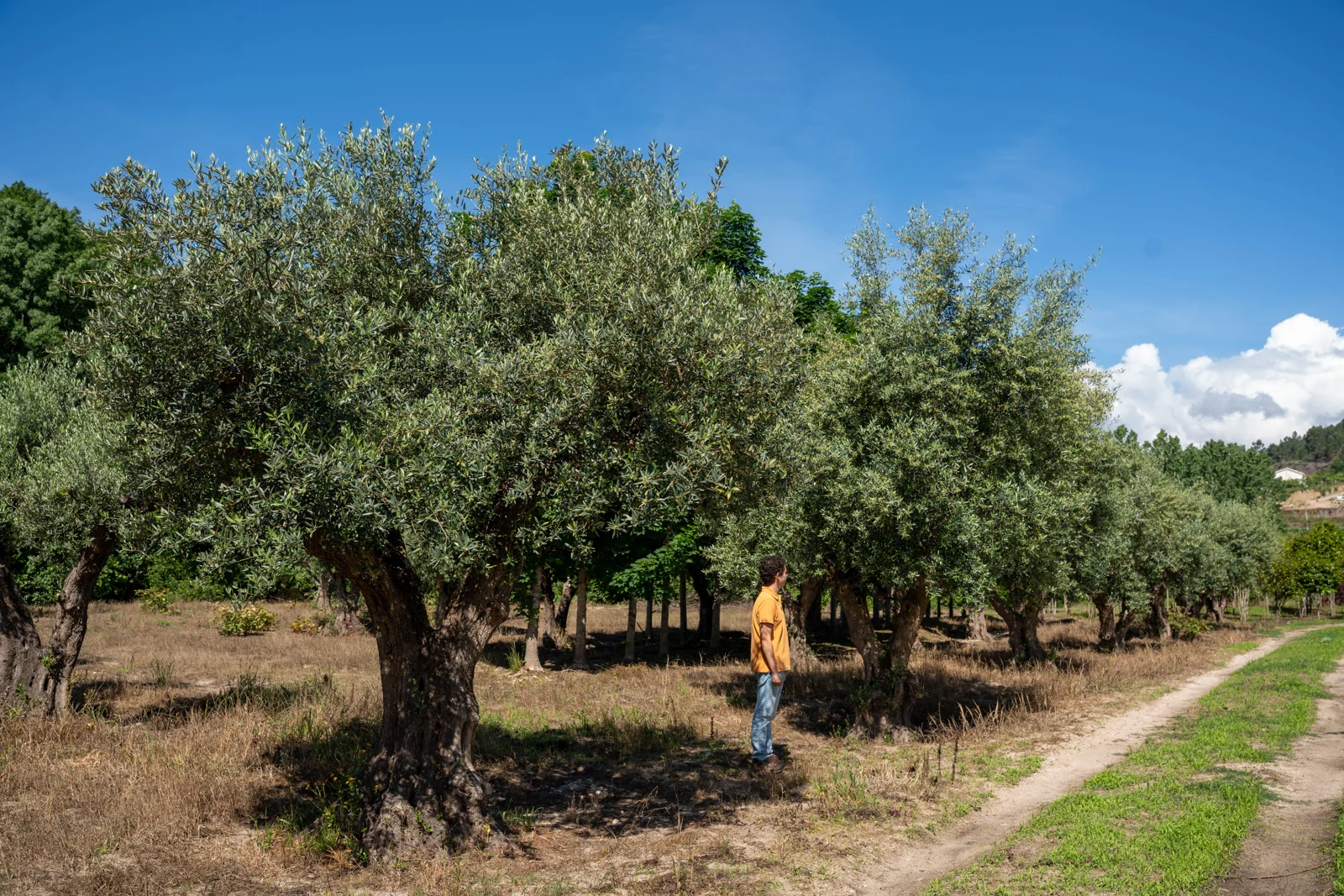
Olea europaeaOlive
The mature olive, transplanted at a large girth size, meets both the quota of native species required by many PDM (municipal master plans) and the need for an evergreen specimen with immediate character in a square, on a roundabout or in an institutional setting.
- Trunk that twists on itself, with a growing sculptural presence
- Greyish bark that opens into deep fissures with age
- Evergreen grey-green and silvery foliage that shifts with the wind
About this species
In an ornamental context, the olive differs from agricultural use in the criteria for selecting the specimen: a balanced crown, a stem with expressive twisting and a root system prepared for an urban tree pit. Slow growth, a limitation in olive oil production, becomes an advantage in a landscape project: the form stabilises early and pruning maintenance…Read moreShow less
In an ornamental context, the olive differs from agricultural use in the criteria for selecting the specimen: a balanced crown, a stem with expressive twisting and a root system prepared for an urban tree pit. Slow growth, a limitation in olive oil production, becomes an advantage in a landscape project: the form stabilises early and pruning maintenance comes down to sanitary work and the removal of basal shoots. The evergreen foliage, grey-green on the upper surface and silvery on the underside, keeps its visual presence all year round, including in winter, when many deciduous species lose their framing role.
The olive tolerates chalky, sandy and clay soils as long as they are well drained; in soils with prolonged seasonal waterlogging, the root system deteriorates quickly through asphyxia. It withstands prolonged drought once established, performing well with deficit irrigation or none at all after the second summer. Heat tolerance is high, with no leaf stress even in full exposure in the interior of the Alentejo. On the coast, it tolerates moderate salt spray, which makes it viable in coastal projects from the Algarve to the Minho, although without the resistance to direct sea wind of species such as tamarisk or stone pine.
The plant-health resilience of the olive is good overall, but the Portuguese context calls for attention to Xylella fastidiosa, with demarcated zones in the Algarve and active surveillance in the rest of the country. The olive fruit fly (Bactrocera oleae) mainly affects fruit production and is less relevant in ornamental specimens where fruiting is not the aim. Peacock spot (Spilocaea oleagina) can cause partial defoliation in wet years, controllable with preventive copper-based treatment. Regular plant-health monitoring is prudent in any olive planting, particularly in regions under pressure from Xylella.
As a native species, the olive appears on the ICNF (Portugal’s Institute for Nature Conservation and Forests) lists and meets the native flora quotas required by several municipal tree-planting regulations. The proven longevity of Portuguese specimens, of which the Oliveira do Mouchão in Mouriscas, Abrantes, with an estimated age of 3,350 years, is the best-documented case, gives the specifier an argument for permanence that few species can match.
Advice on this species
Want to know more about Olea europaea?
Tell us about your project and we will advise on this species — where it does well, what size makes sense and what to expect once it is planted.
- Own production
- Mature specimens
- Reply within 1–2 days
No obligation · tailored quote