

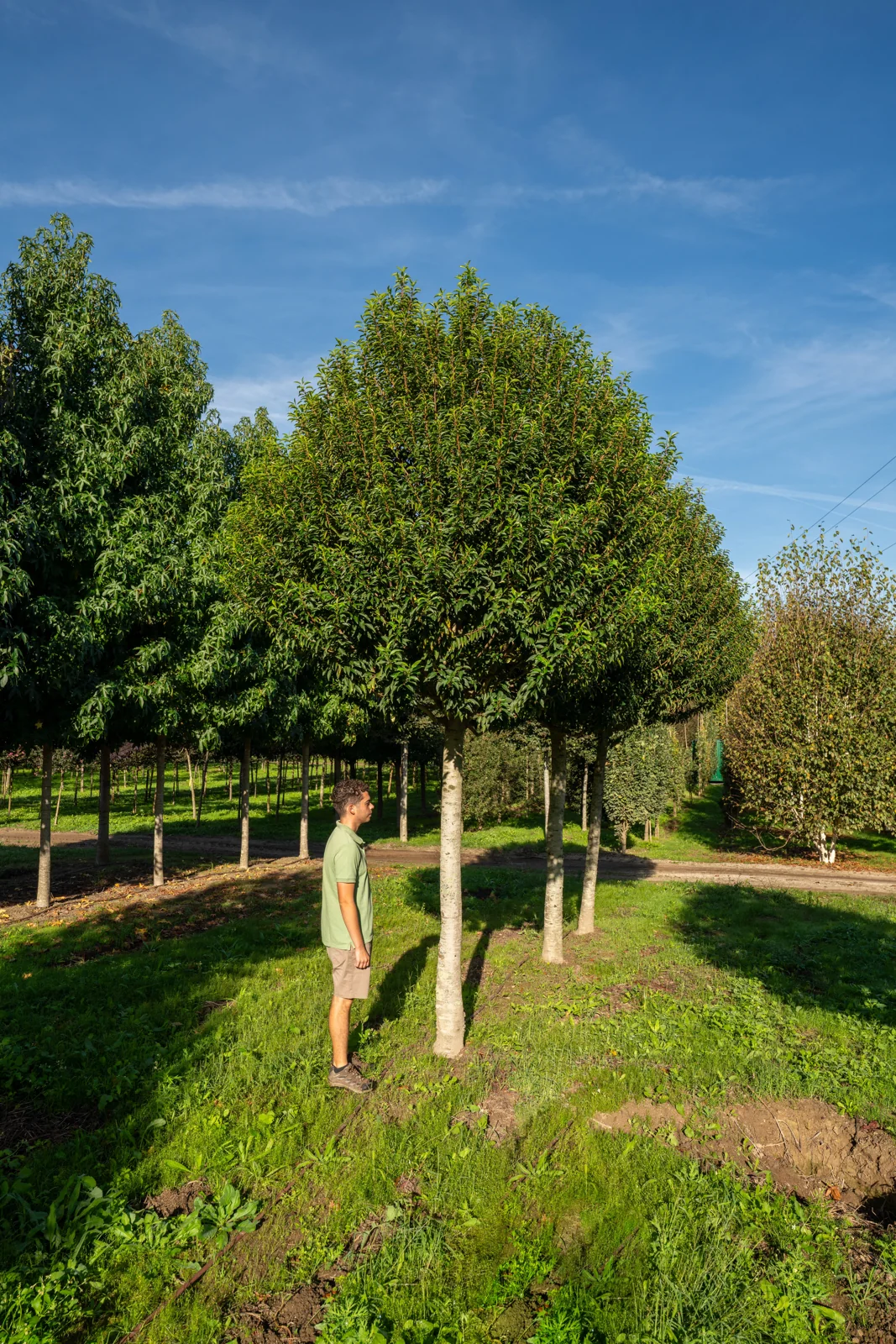
Prunus lusitanica 'Angustifolia'Portugal laurel
Where a project calls for a dense, well-structured evergreen mass, this form of Portugal laurel offers an upright, contained crown with a narrow leaf, suited to formal hedges, tall borders and framing plantings that require constant green volume throughout the year.
- Evergreen foliage, dark and glossy, dense in every season
- Leaves narrower and finer than those of the common Portugal laurel
- Naturally upright crown, which can be clipped as a formal hedge or screen
About this cultivar
Iberian in origin, this form of Portugal laurel differs from the type in its narrower, more elongated leaf, evergreen and glossy dark green, which thickens the crown and gives a finer texture to the mass of foliage. In Portuguese conditions it reaches 4 to 6 m in height by 2 to 3 m in width, with an upright, well-structured habit, which makes it more regular under formative pruning than…Read moreShow less
Iberian in origin, this form of Portugal laurel differs from the straight species in its narrower, more elongated leaf, evergreen and glossy dark green, which thickens the crown and gives a finer texture to the mass of foliage. In Portuguese conditions it reaches 4 to 6 m in height by 2 to 3 m in width, with an upright, well-structured habit, which makes it more regular under formative pruning than the straight species and suited to contained hedges and evergreen group plantings.
In place of Prunus laurocerasus, it offers the designer a native alternative with the same evergreen presence but a more compact habit and foliage of a smaller scale, useful when the specification gives weight to species of the Iberian flora. It stands up well to repeated pruning, keeping its density from base to top, so it lends itself to a structural hedge, a green divider or a single specimen trained on a clear stem.
Its soil tolerance is broad provided drainage is assured: it adapts to clay soils and poor substrates, but does not tolerate prolonged waterlogging, a condition to be resolved with drainage in compact soils or those with a high water table. In full exposure it develops a tighter crown; in partial shade it keeps its vigour, an advantage in courtyards and avenue plantings shaded by buildings.
Growth is moderate and drought tolerance sets in after establishment, supported by supplementary watering in the first summers; in the hot, dry interior it benefits from a longer period of establishment watering. It withstands the cold of the areas south of the River Mondego without winter stress and tolerates urban pollution, which recommends it for built-up settings.
In spring and early summer it produces upright racemes of small, scented white flowers that attract pollinators, followed by oval fruits that turn from red to black and are valued by birds. The genus is not under the plant-health pressures that affect the plane or the ash in the Portuguese market, and the species remains healthy in cultivation.
Advice on this species
Want to know more about Prunus lusitanica 'Angustifolia'?
Tell us about your project and we will advise on this species — where it does well, what size makes sense and what to expect once it is planted.
- Own production
- Mature specimens
- Reply within 1–2 days
No obligation · tailored quote