

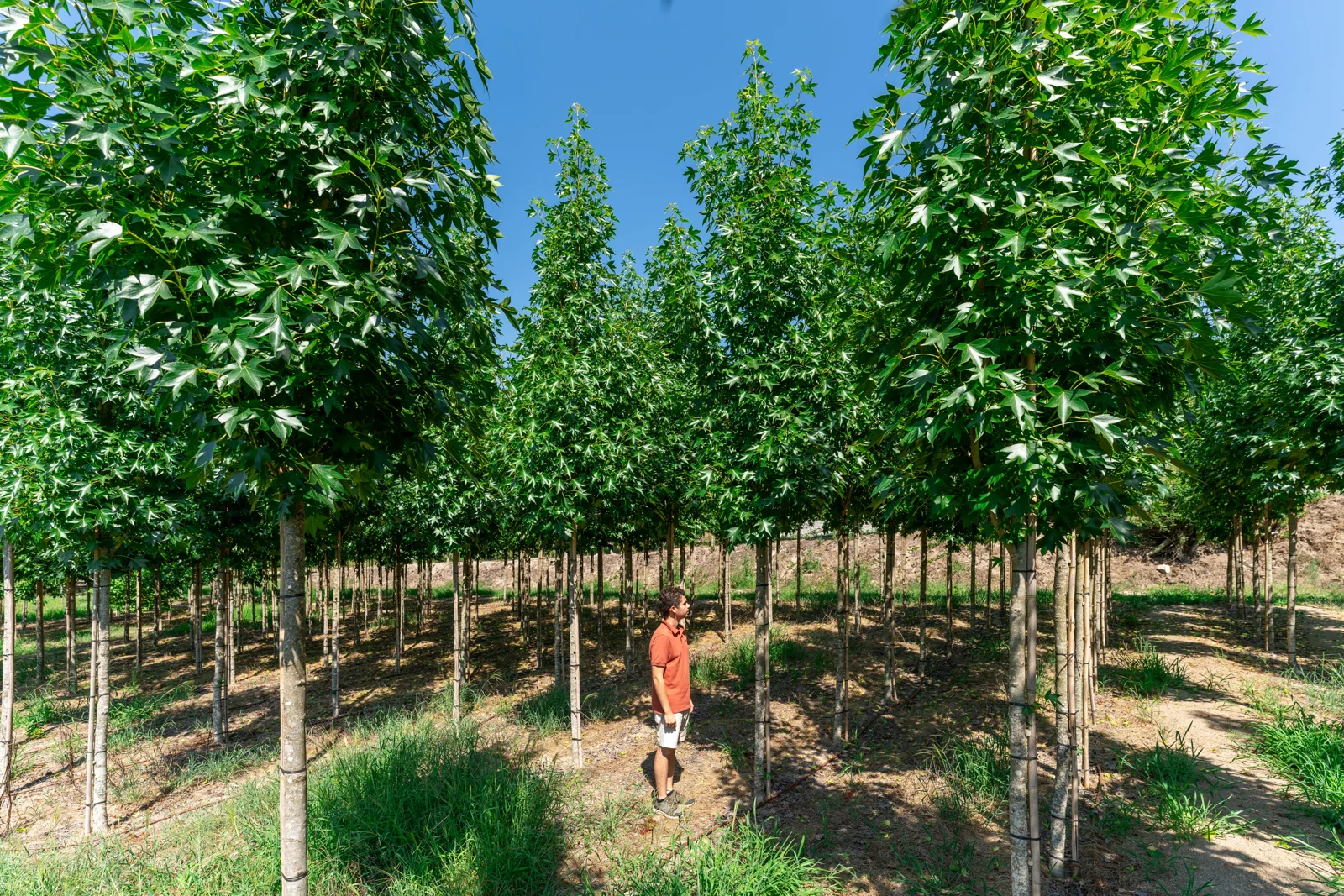
Liquidambar styraciflua 'Paarl'Sweetgum
A sweetgum cultivar selected for the uniformity of its autumn colour and for a crown more restrained than that of the straight species, which makes it particularly suitable for urban avenue planting, central reservations and parks where formal consistency between specimens is required.
- Uniform autumn colour in scarlet, deep purple and bright orange
- Colour that holds for four to six weeks before leaf fall
- Palmate, lobed leaf, glossy green, with a subtle resinous scent when touched
About this cultivar
Liquidambar styraciflua ‘Paarl’ differs from the straight species in the uniformity of its autumn colour change and the predictability of its form. Where the common sweetgum produces crowns that vary from tree to tree, with colour ranges running from yellow to purple with no constant pattern, ‘Paarl’ offers a change concentrated in scarlet red to intense purple,…Read moreShow less
Liquidambar styraciflua ‘Paarl’ differs from the straight species in the uniformity of its autumn colour change and the predictability of its form. Where the common sweetgum produces crowns that vary from tree to tree, with colour ranges running from yellow to purple with no constant pattern, ‘Paarl’ offers a change concentrated in scarlet red to intense purple, uniform within each specimen and between specimens of the same clone. In avenue planting, this translates into visual consistency along the whole planted frontage, eliminating the colour-lottery effect that makes the straight sweetgum hard to specify in municipal projects.
The pyramidal to oval crown reaches 12 to 18 metres in height and 6 to 8 metres in spread in Portuguese conditions, more restrained dimensions than the 15 to 25 metres of the straight species. This proportion allows tree pits of standard size in street planting and reduces the need for lateral containment pruning in street corridors. The stem grows straight and the branching is balanced, which limits formative pruning in the first years after planting.
It tolerates acidic, clay and sandy soils, but performs better in moist, well-drained soils. In compact chalky soils, such as those common in the Lisbon region, performance declines: the genus is sensitive to iron chlorosis at high pH, so specification on chalky soils requires prior soil analysis. It withstands moderate drought after establishment and tolerates prolonged summer heat, with confirmed tolerance to zone 9b, corresponding to minimum temperatures of around -3 °C. In the Atlantic strip from the Minho to the Centre, where winters are wetter, the shallow root system benefits from adequate drainage to avoid root asphyxia in seasonally waterlogged soils.
The ornamental interest is concentrated in autumn: the palmate foliage stays dark green and dense through the summer, providing full shade, and turns to shades of scarlet and purple that last until the end of November in Atlantic conditions. The greyish, fissured bark and the spiny, globular fruits add texture in the dormant period, although fallen fruits are a factor to weigh up in areas of heavy pedestrian traffic. Originating from a South African selection, the clone has shown itself adapted to Mediterranean and moderate Atlantic climates, with plantings widespread across Europe in recent decades.
Advice on this species
Want to know more about Liquidambar styraciflua 'Paarl'?
Tell us about your project and we will advise on this species — where it does well, what size makes sense and what to expect once it is planted.
- Own production
- Mature specimens
- Reply within 1–2 days
No obligation · tailored quote