

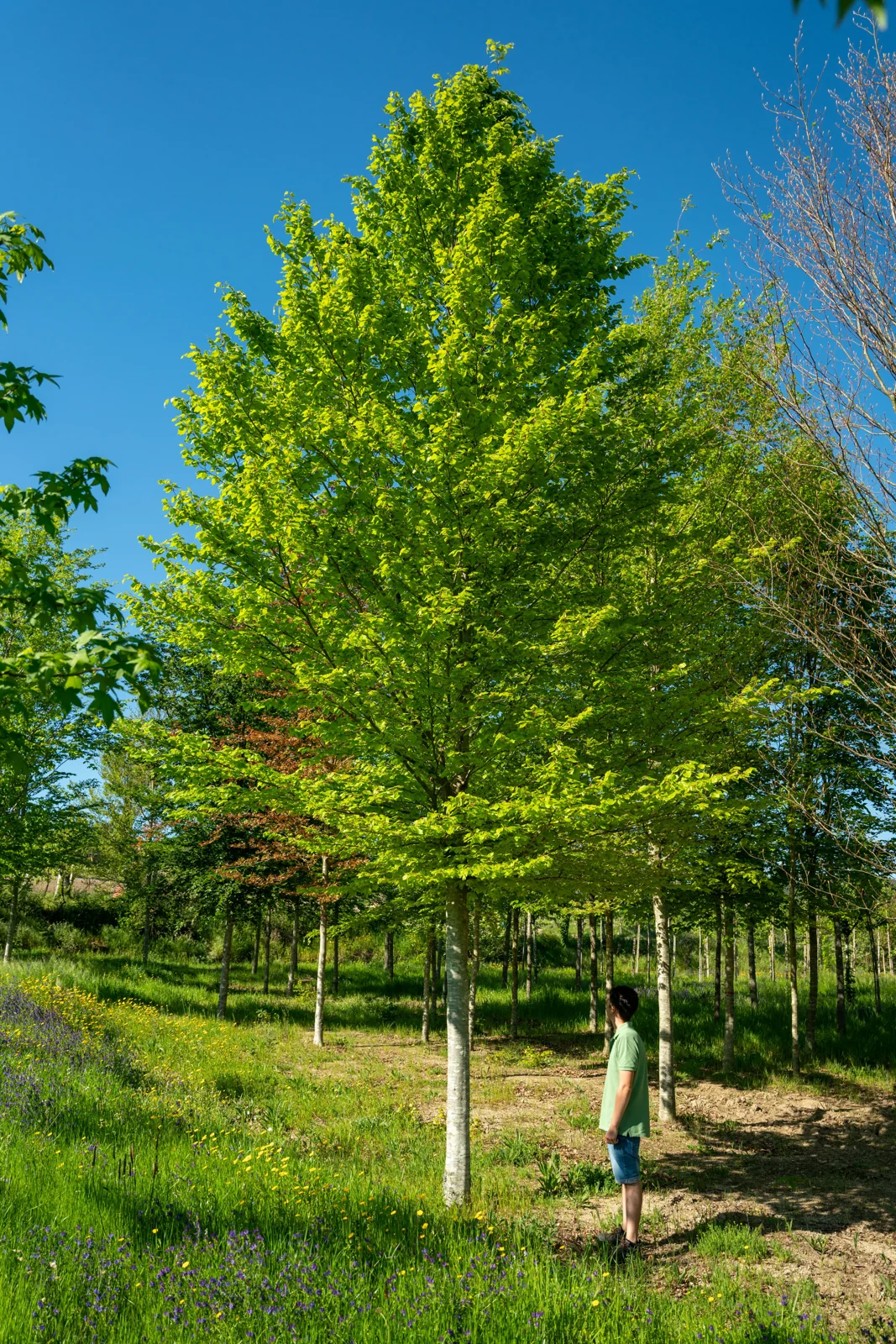
Fagus sylvaticaEuropean beech
A large deciduous tree with a broad, majestic crown, it combines luminous foliage with grey, smooth and instantly recognisable bark. The transformation of the leaves, from the light green of spring to the golden and coppery tones of autumn, reinforces its presence through the seasons.
- Monumental crown able to cast a broad area of shade
- Smooth bark in a silvery-grey tone
- Golden, copper and reddish-brown foliage in autumn
About this species
It initially has an upright habit and a relatively narrow crown, becoming progressively broad, rounded and densely branched. Mature specimens can reach approximately 25 to 30 metres in height and 15 to 20 metres in width, developing a monumental, very long-lived architecture.Read moreShow less
It initially has an upright habit and a relatively narrow crown, becoming progressively broad, rounded and densely branched. Mature specimens can reach approximately 25 to 30 metres in height and 15 to 20 metres in width, developing a monumental, very long-lived architecture.
The trunk and main branches keep for many years a smooth, thin, silvery-grey bark, which contrasts with the density of the crown. The leaves are oval, with a slightly wavy margin and a soft texture. They emerge light green and luminous in spring, turn dark green in summer and take on golden, coppery and reddish-brown tones in autumn.
The flowers are small and discreet, appearing in spring. They are followed by fruits enclosed in a spiny husk, inside which are the small triangular seeds known as beechnuts or beech mast. In young specimens and in plants trained as hedging, part of the dry foliage may remain on the branches through the winter.
It grows in sun or partial shade, in deep, fertile, moist and well-drained soils. It tolerates different textures and pH values, including chalky soils, but should be protected from waterlogged ground, excessive heat and prolonged periods of drought. It is suited to parks, large gardens, avenues, historic estates and woodland compositions.
Mature specimens from Diaplant immediately bring a defined trunk, a structured crown and a scale that is hard to achieve with young trees. The amount of foliage already present makes it possible to create, from planting, a true area of shade and the monumental expression characteristic of the European beech.
Advice on this species
Want to know more about Fagus sylvatica?
Tell us about your project and we will advise on this species — where it does well, what size makes sense and what to expect once it is planted.
- Own production
- Mature specimens
- Reply within 1–2 days
No obligation · tailored quote