

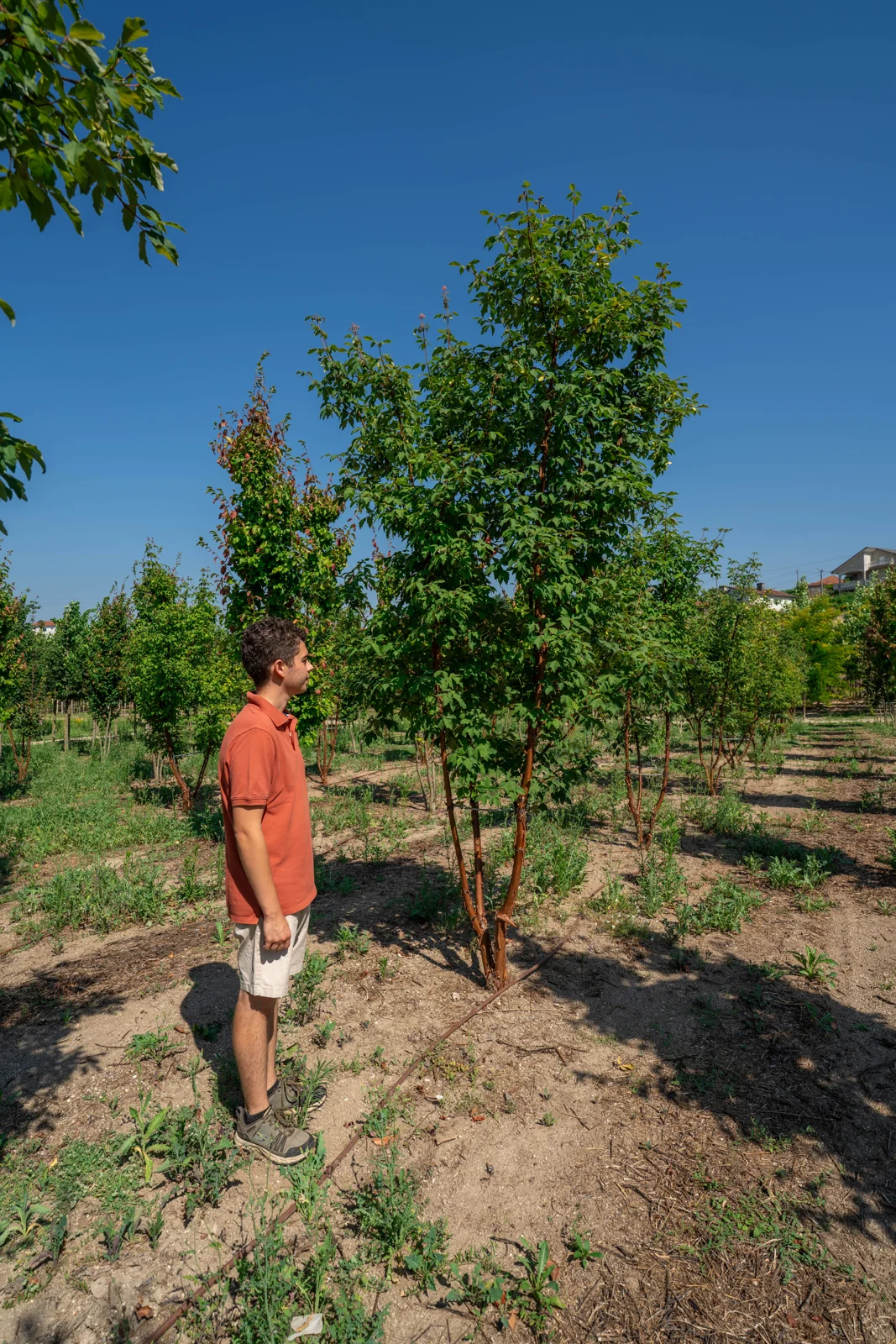
Acer griseumPaperbark maple
One of the most expressive maples in winter, recognised by its cinnamon-brown bark that peels away in thin, translucent sheets. Slow growth gradually turns the trunk and main branches into a sculptural structure, complemented by trifoliate foliage and intense autumn colour.
- Coppery bark that peels in delicate, paper-like sheets
- Leaves made up of three leaflets, an unusual arrangement among ornamental maples
- Visual interest that grows with maturity, especially after leaf fall
About this species
Native to central China, Acer griseum grows slowly as a small tree, often with several stems, reaching around 8 to 10 metres in height and 4 to 8 metres in spread. The crown, irregular and relatively open at first, acquires with age a rounded silhouette and branching of great sculptural quality.Read moreShow less
Native to central China, Acer griseum grows slowly as a small tree, often with several stems, reaching around 8 to 10 metres in height and 4 to 8 metres in spread. The crown, irregular and relatively open at first, acquires with age a rounded silhouette and branching of great sculptural quality.
The bark is its defining feature. On the older stems and branches it takes on shades of cinnamon, copper and reddish brown, peeling away in thin films that remain partly curled. When light passes through them, these sheets create translucencies and reflections that keep the tree visually active throughout the winter.
The leaves are made up of three dark green leaflets, grey-green on the underside. In autumn, the crown passes through a particularly rich sequence of yellow, orange, red and crimson. The small yellow-green flowers appear in spring, followed by a generally small number of samaras.
It prefers sun or partial shade and fertile, moist, well-drained soils, slightly acidic to neutral. In Portugal it benefits from a position sheltered from the most intense heat and from a regular supply of water during establishment. The root zone should have enough open soil, avoiding overly confined tree pits or impermeable paving close to the trunk.
It is especially suited as a specimen tree in gardens, large courtyards, entrances and compositions where it can be seen up close. Placing it in front of an evergreen backdrop or in an area lit by low sun brings out the translucency and colour of the bark. A mature specimen from Diaplant immediately brings the coppery trunk and the mature branching that this species takes many years to develop.
Advice on this species
Want to know more about Acer griseum?
Tell us about your project and we will advise on this species — where it does well, what size makes sense and what to expect once it is planted.
- Own production
- Mature specimens
- Reply within 1–2 days
No obligation · tailored quote