

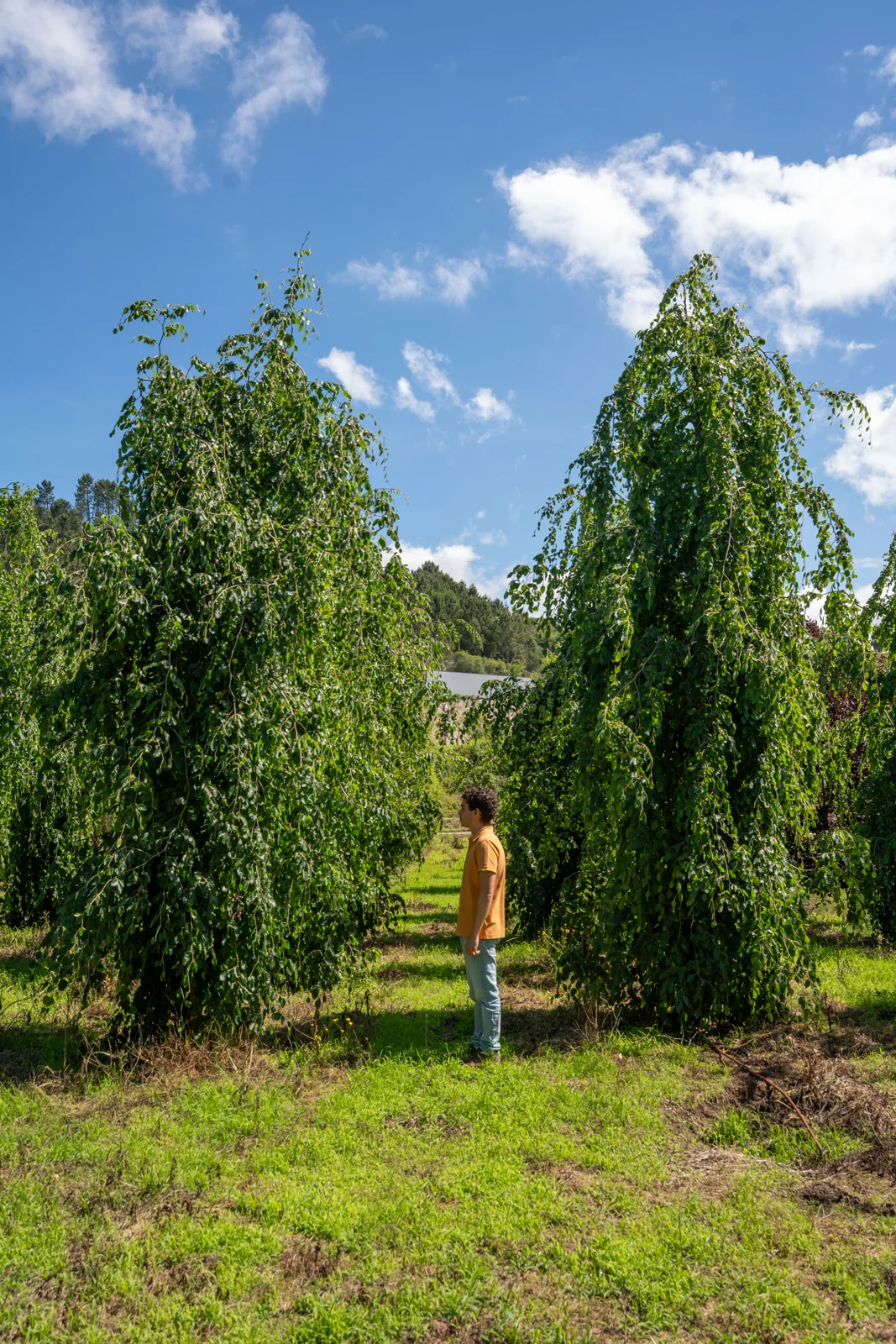
Fagus sylvatica 'Pendula'European beech
A weeping cultivar of the European beech intended for an urban park, historic garden or large green space in the north and centre of the country: it is used as a free-standing specimen, serving as a structuring focal point with an unmistakable silhouette on the location plan.
- Long, arching branches that fall like a veil to the ground
- Each mature specimen becomes a unique sculptural form
- A green chamber beneath the vault, a focal point in the middle of a lawn
About this cultivar
Its habit distinguishes this cultivar from the type. The long, arching branches draw a sculpturally broad crown, often wider than it is tall in a mature specimen, 15 to 20 m in height and 15 to 25 m in spread depending on the initial training. No two specimens are alike, so it is specified by landscape role (free-standing focal point) and not…Read moreShow less
Its habit distinguishes this cultivar from the type. The long, arching branches draw a sculpturally broad crown, often wider than it is tall in a mature specimen, 15 to 20 m in height and 15 to 25 m in spread depending on the initial training. No two specimens are alike, so it is specified by landscape role (free-standing focal point) and not by standardised silhouette, reserving a usable planting area of 20 m in diameter or more.
Behaviour on site is the eligibility filter. Beech requires deep, moist, well-drained soils, slightly acidic to neutral, with stable atmospheric and soil moisture; drought tolerance is low and heat tolerance moderate. It is placed in projects in the Minho, Douro Litoral, the inland Beiras at altitude and the central mountain ranges; in Lisbon only in the cool setting of a walled estate or historic garden with supplementary watering. In the inland Alentejo and almost all of the Algarve the species suffers heat and water stress that compromises establishment and longevity, and in those contexts the specification does not hold.
The foliage is ovate, dark green in summer, glossy, and turns to copper and gold tones that hold until late autumn, which makes it useful as a seasonal colour criterion in a specification. The smooth grey bark adds winter interest in a square or enclosed avenue. The weeping branches, carried down to the ground when the tree is not trained to a clear stem, cast dense shade beneath the crown and suppress underplanting, a condition worth anticipating at design stage.
Growth is slow to moderate and the root system is mostly shallow, with strong roots that need no root barrier in planted areas but rule out placing it in a street tree pit or next to rigid paving. Cold-hardy without reservation in Portuguese conditions, with low maintenance in a suitable location, it tolerates initial formative pruning to define a stem but needs no routine intervention once established. It does not appear on the native flora lists of the ICNF (Portugal’s Institute for Nature Conservation and Forests) and has its place in projects as an ornamental tree long cultivated in historic Portuguese gardens, with no documented invasive behaviour.
Advice on this species
Want to know more about Fagus sylvatica 'Pendula'?
Tell us about your project and we will advise on this species — where it does well, what size makes sense and what to expect once it is planted.
- Own production
- Mature specimens
- Reply within 1–2 days
No obligation · tailored quote