

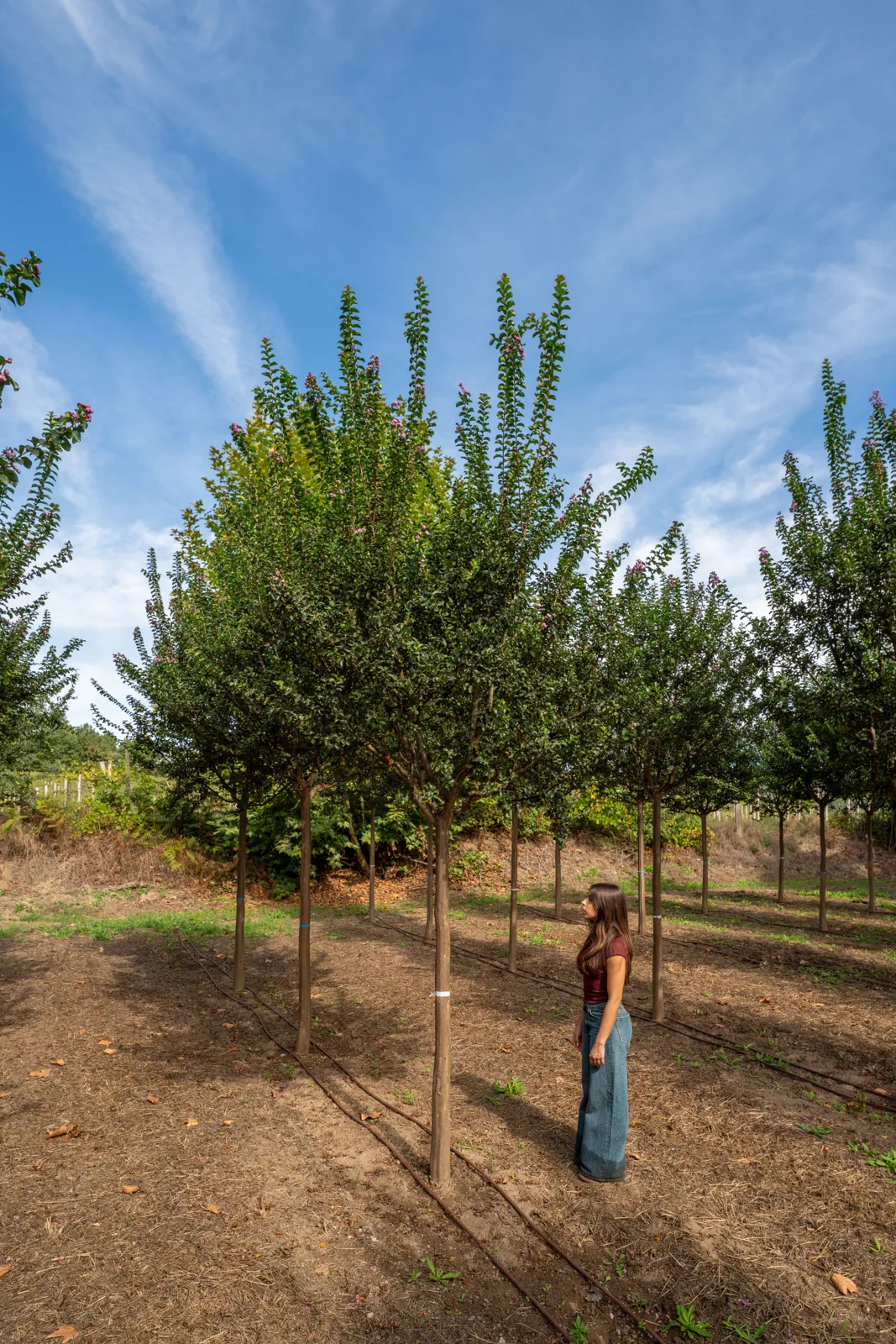
Lagerstroemia indica 'Violacea'Crape myrtle
A cultivar with intense purple flowering from July to September and a balanced size of 4 to 6 metres, suited to short avenue plantings, urban tree pits and ornamental groups where prolonged summer interest is wanted without aggressive roots.
- From July to September it is covered in dense clusters of crinkled purple flowers
- Pale bark that sheds in plates and reveals coppery tones in winter
- Foliage that turns yellow, orange and red in autumn
About this cultivar
In a Portuguese urban setting, 'Violacea' takes the place a landscape designer would reserve for a small tree with strong summer impact: a rounded crown 4 to 6 metres tall by 3 to 5 metres wide, a short stem or multi-stem form depending on how it was trained in the nursery, and fine, regular branching. It differs from the straight species and from the other selections of…Read moreShow less
In a Portuguese urban setting, 'Violacea' takes the place a landscape designer would reserve for a small tree with strong summer impact: a rounded crown 4 to 6 metres tall by 3 to 5 metres wide, a short stem or multi-stem form depending on how it was trained in the nursery, and fine, regular branching. It differs from the straight species and from the other selections of Lagerstroemia indica in the colour of its flowering, purple panicles with a wavy texture, held consistently throughout the season.
Flowering runs from July to September, overlapping the period when most ornamental trees have already ended their decorative cycle, which makes it useful in squares, central reservations and streets where visual interest is wanted in high summer. The glossy dark green foliage turns to yellow, orange and red tones in autumn, extending the ornamental value until late autumn in Atlantic conditions. In winter, the smooth bark that sheds in plates, leaving pale patches on a greyish ground, maintains the sculptural reading of the specimen when out of leaf.
It behaves as a species tolerant of summer heat and of short periods of drought once established, with a non-aggressive root system compatible with tree pits of ordinary size and with the proximity of paving. It asks for fertile, deep, well-drained soils; it accepts clay textures provided there is no prolonged waterlogging, and tolerates the well-drained chalky soils common in Lisbon and the Oeste region. Full exposure is a condition for vigorous flowering; in partial shade flowering is noticeably reduced.
It withstands minimum temperatures close to -10 °C, behaviour confirmed in the continental conditions of the central and northern interior; in the coastal areas south of the River Mondego it shows no significant winter stress. It tolerates urban pollution and the compacted environment of a square well. Maintenance is limited to light formative pruning in late winter and the occasional removal of basal shoots when a single-stem form is to be kept.
Advice on this species
Want to know more about Lagerstroemia indica 'Violacea'?
Tell us about your project and we will advise on this species — where it does well, what size makes sense and what to expect once it is planted.
- Own production
- Mature specimens
- Reply within 1–2 days
No obligation · tailored quote