

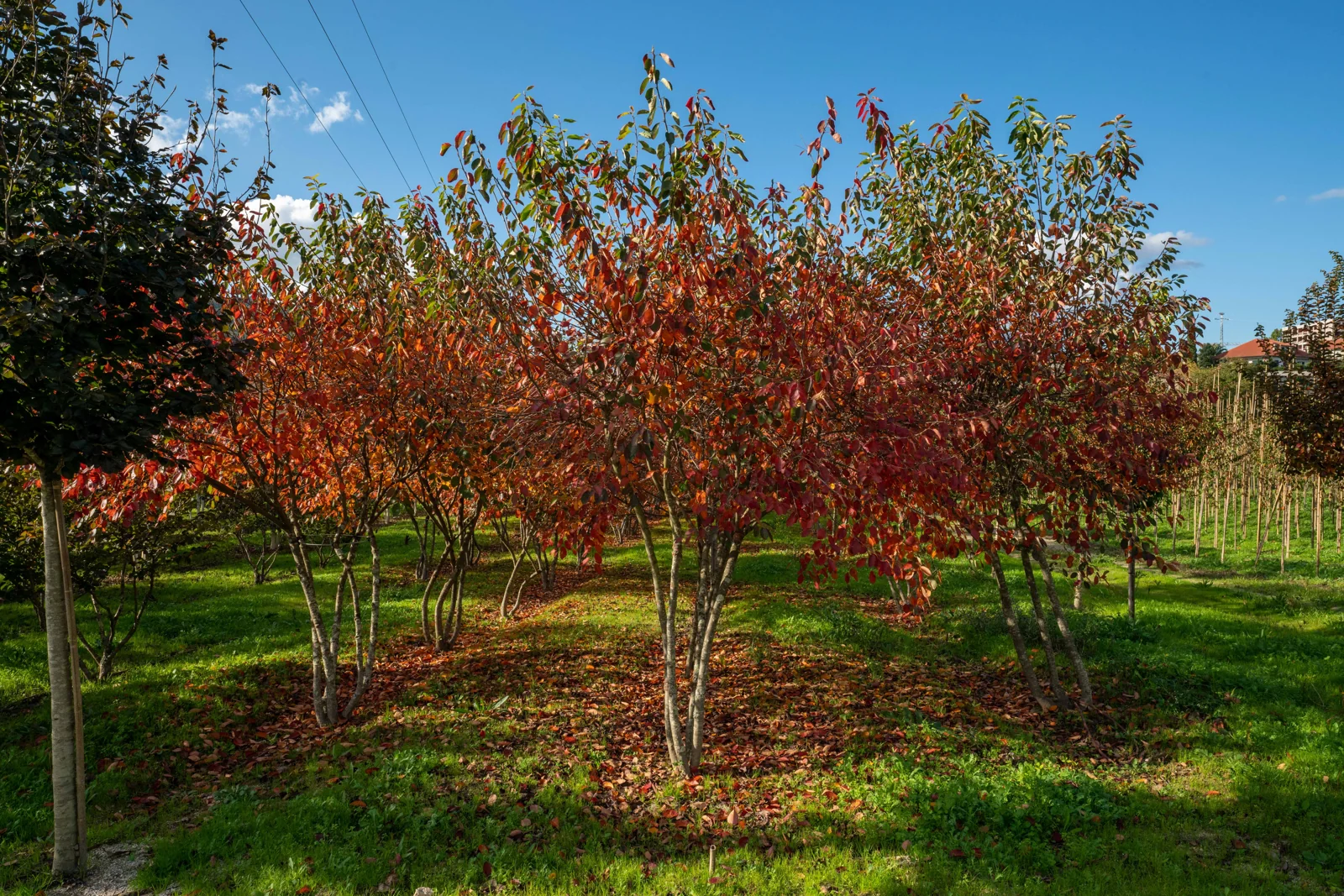
Amelanchier lamarckiiJuneberry
A small tree often grown as a multi-stem, it stands out for its particularly complete succession of seasons. The white blossom coincides with the bronze new growth, followed by edible blue-black fruits, intense autumn colour and a delicate structure of grey branches during the winter.
- Spring contrast between white flowers and deeply bronzed leaves, and strong autumn colour
- Broad, vase-shaped crown, with horizontal branching and an expressive winter silhouette
- Abundant production of sweet fruits that combines ornamental value and biodiversity
About this species
Amelanchier lamarckii grows at first as a large upright shrub, forming with age a small tree with a broad, semi-dense, irregular crown. Mature specimens often have several stems and progressively more horizontal branches, building an open, vase-shaped architecture. It can reach approximately 6 to 9 metres in height and spread.Read moreShow less
Amelanchier lamarckii grows at first as a large upright shrub, forming with age a small tree with a broad, semi-dense, irregular crown. Mature specimens often have several stems and progressively more horizontal branches, building an open, vase-shaped architecture. It can reach approximately 6 to 9 metres in height and spread.
In early spring, the leaves emerge in deep bronze tones, almost simultaneously with numerous loose clusters of white flowers. This meeting of dark foliage and pale petals is one of the most characteristic images of the species and allows the flowering to be read through the full depth of the crown.
During the summer, blue-black berries form, sweet, juicy and edible, much sought after by birds. In autumn, the foliage turns into an intense combination of yellow, orange and red. After leaf fall, the grey bark and fine branching keep a graphic structure of great quality.
It adapts to sun or partial shade and to different soil textures, preferring fertile, moist, well-drained ground. It is highly resistant to cold and wind. In Portugal, deep watering during establishment and in periods of prolonged drought is important to preserve the density of the crown, the fruiting and the quality of the autumn colour.
It is especially suited to parks, large gardens, naturalistic plantings, woodland edges and compositions that favour biodiversity. The multi-stem form allows the crown and the line of the stems to be seen at the same time. A mature specimen from Diaplant immediately offers that broad, layered architecture, with flowering wood and fruiting capacity already developed.
Advice on this species
Want to know more about Amelanchier lamarckii?
Tell us about your project and we will advise on this species — where it does well, what size makes sense and what to expect once it is planted.
- Own production
- Mature specimens
- Reply within 1–2 days
No obligation · tailored quote