

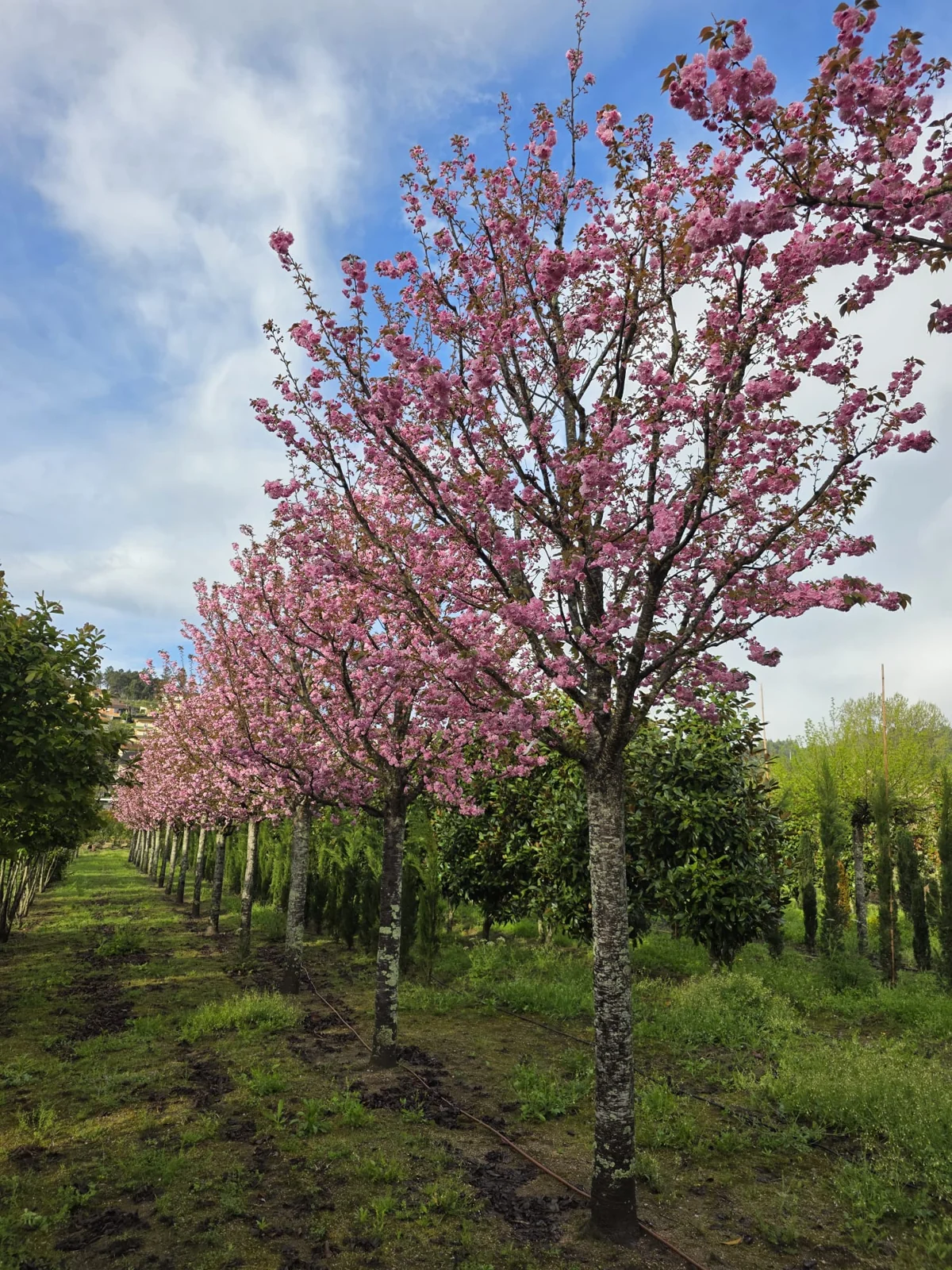
Prunus serrulata 'Kanzan'Japanese flowering cherry
One of the most emblematic Japanese cherries, ‘Kanzan’ turns its whole crown into an intensely pink composition in late spring. The double flowers, the contrast with the bronze new growth and the vase-shaped architecture give it a presence that is at once exuberant and formal.
- Large double flowers, carried in dense, bright pink clusters
- Bronze foliage that emerges at the same time and intensifies the colour of the blossom
- Vase-shaped crown that broadens with age, creating particularly expressive flowering arches in avenue planting
About this cultivar
Prunus serrulata ‘Kanzan’ is one of the most widely recognised and internationally used Japanese ornamental cherries. It belongs to the group of garden cherries traditionally known as sato-zakura, selected over centuries for the form of the crown and, above all, for the exuberance of the flowers.Read moreShow less
Prunus serrulata ‘Kanzan’ is one of the most widely recognised and internationally used Japanese ornamental cherries. It belongs to the group of garden cherries traditionally known as sato-zakura, selected over centuries for the form of the crown and, above all, for the exuberance of the flowers.
The tree at first has an upright, well-defined architecture, with ascending main branches that form a vase-shaped crown. As it matures, the branching opens, gains width and may arch slightly at the tips, creating a broad, domed silhouette. It generally reaches 8 to 10 metres in height and can approach a similar spread when it grows freely. The trunk has smooth, greenish-brown bark, marked by the horizontal lenticels characteristic of the genus Prunus, while the young shoots show reddish-brown tones.
Flowering takes place between late April and early May, slightly later than that of many ornamental cherries. The crimson buds open into large double flowers, approximately 4 to 5 centimetres across, carried in dense clusters of two to five. The bright pink to purplish-pink colour and the high number of petals create a blossom of great volume, capable of partly hiding the structure of the branches. As the flowers are very double, fruit formation is rare.
The young foliage emerges at the same time as the flowers, in a copper to reddish-bronze colour that adds depth to the composition. During the summer, the leaves turn dark green, often keeping a slightly bluish underside. In autumn, the crown takes on yellow and orange tones, extending the ornamental interest beyond flowering.
It grows best in full sun and in a deep, moderately fertile, moist, well-drained soil. It adapts to different textures and pH values, including soils containing lime, provided there is no persistent waterlogging. To preserve the symmetry of the crown and the quality of the flowering, it benefits from a position with good light and some protection from strong winds. Pruning should be limited to formative work, safety and the removal of unsuitable branches, and is preferably carried out after flowering or during the summer.
Its regular architecture and the intensity of its flowering make ‘Kanzan’ especially suited to entrances, parks, public gardens, large estates and avenue planting intended to create a floral sequence that reads strongly. In plantings on both sides, the progressive opening of the crowns can form a true gallery of flowers over the route.
A mature specimen from Diaplant immediately brings the vase-shaped structure characteristic of the cultivar and a significant amount of flowering wood. This maturity makes it possible to obtain, from the first cycles after planting, a flowering display with a scale and visual continuity very different from those offered by young trees still in formation.
Advice on this species
Want to know more about Prunus serrulata 'Kanzan'?
Tell us about your project and we will advise on this species — where it does well, what size makes sense and what to expect once it is planted.
- Own production
- Mature specimens
- Reply within 1–2 days
No obligation · tailored quote