

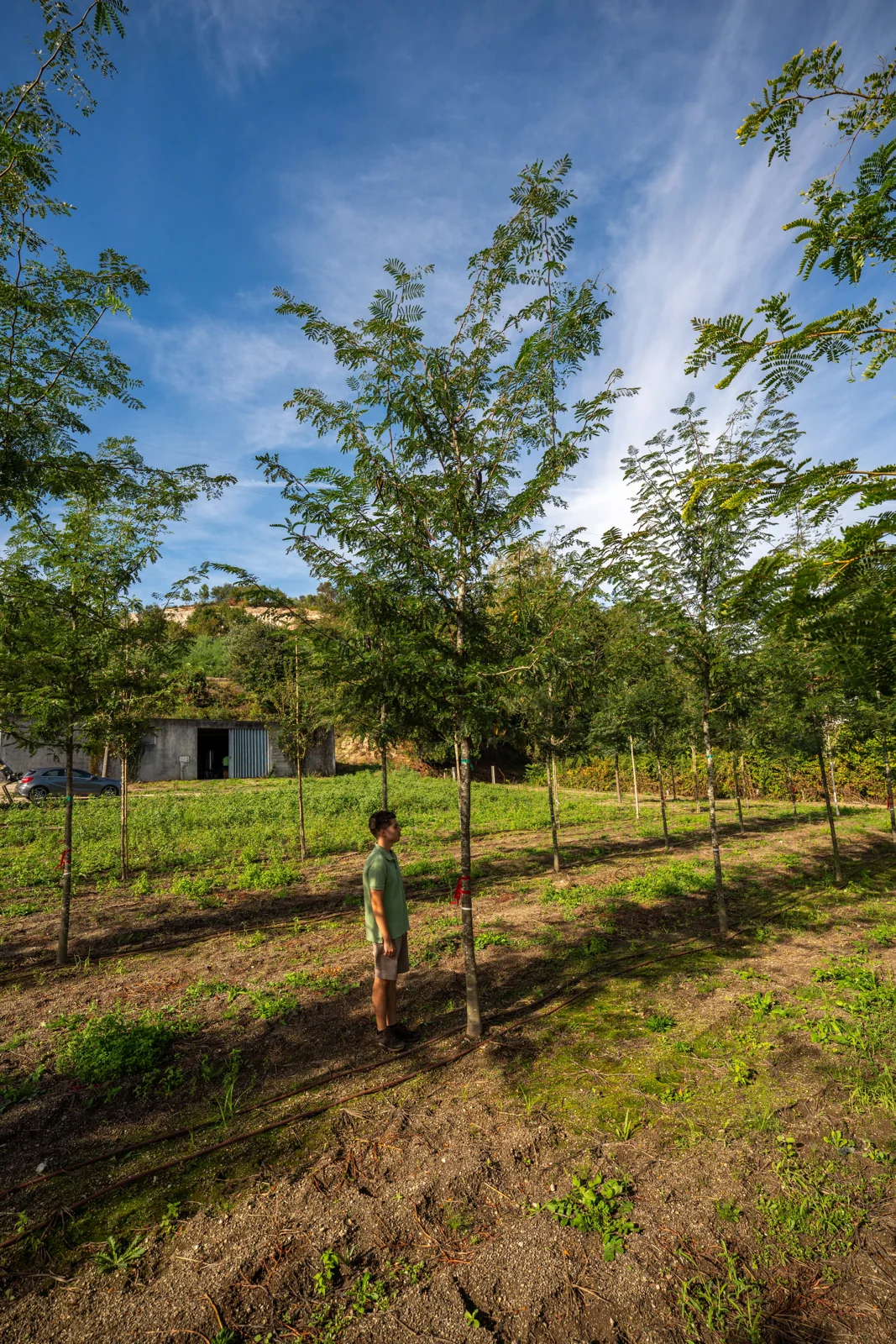
Gleditsia triacanthos 'Inermis'Honey locust
A thornless cultivar of Gleditsia triacanthos, selected for urban tree planting where the straight species is ruled out by its thorns; in street planting and squares it takes the place of a plane or an ash, with proven tolerance of drought and pollution.
- Fine pinnate foliage that filters the light into a cool half-shade
- Light shade in which the lawn and the planting bed beneath go on living
- Golden foliage in autumn before it falls
About this cultivar
In a trade catalogue, 'Inermis' is of interest for what separates it from the straight species: the almost total absence of thorns, characteristic of the cultivar, which makes it usable in street planting, squares and public parks without the risk that makes the typical Gleditsia triacanthos unsuitable for an urban context. In direct comparison, it occupies a functional place…Read moreShow less
In a trade catalogue, 'Inermis' is of interest for what separates it from the straight species: the almost total absence of thorns, characteristic of the cultivar, which makes it usable in street planting, squares and public parks without the risk that makes the typical Gleditsia triacanthos unsuitable for an urban context. In direct comparison, it occupies a functional place close to that of the shade plane or the narrow-leaved ash, with the technical advantage of not being under the plant-health pressure that affects those genera in Portugal (canker stain in Platanus, ash dieback in Fraxinus).
In Portuguese conditions it usually reaches 12 to 18 m in height by 8 to 12 m in spread, with relatively fast growth in the first years after establishment. It adapts to a range of soils, including poor and dry ones, provided drainage is assured; the deep root system gives good stability in a tree pit and rarely compromises the adjacent paving. Once established it withstands moderate drought, wind, coastal salt spray and the pollution load typical of a main road, factors that support its recurrent use in street planting and in medium-scale urban parks.
The crown is broad, slightly irregular and airy, with compound leaves and small leaflets that filter the light rather than block it: it casts a light shade, a type useful where the aim is to shade a paved surface or a bench without compromising the lawn, the shrub understorey or the growth of half-light species near the base. In autumn, the foliage takes on yellow to golden tones, with a relatively clean leaf fall owing to the small size of the leaflet.
In maintenance, the genus has a stable plant-health profile in Portugal, which reduces the risk of early replacement compared with the planes and ashes it has been replacing in several urban specifications. Formative pruning is conventional, aimed at maintaining the raised crown required in street planting and at correcting the tendency to multiple stems in young specimens.
Advice on this species
Want to know more about Gleditsia triacanthos 'Inermis'?
Tell us about your project and we will advise on this species — where it does well, what size makes sense and what to expect once it is planted.
- Own production
- Mature specimens
- Reply within 1–2 days
No obligation · tailored quote