

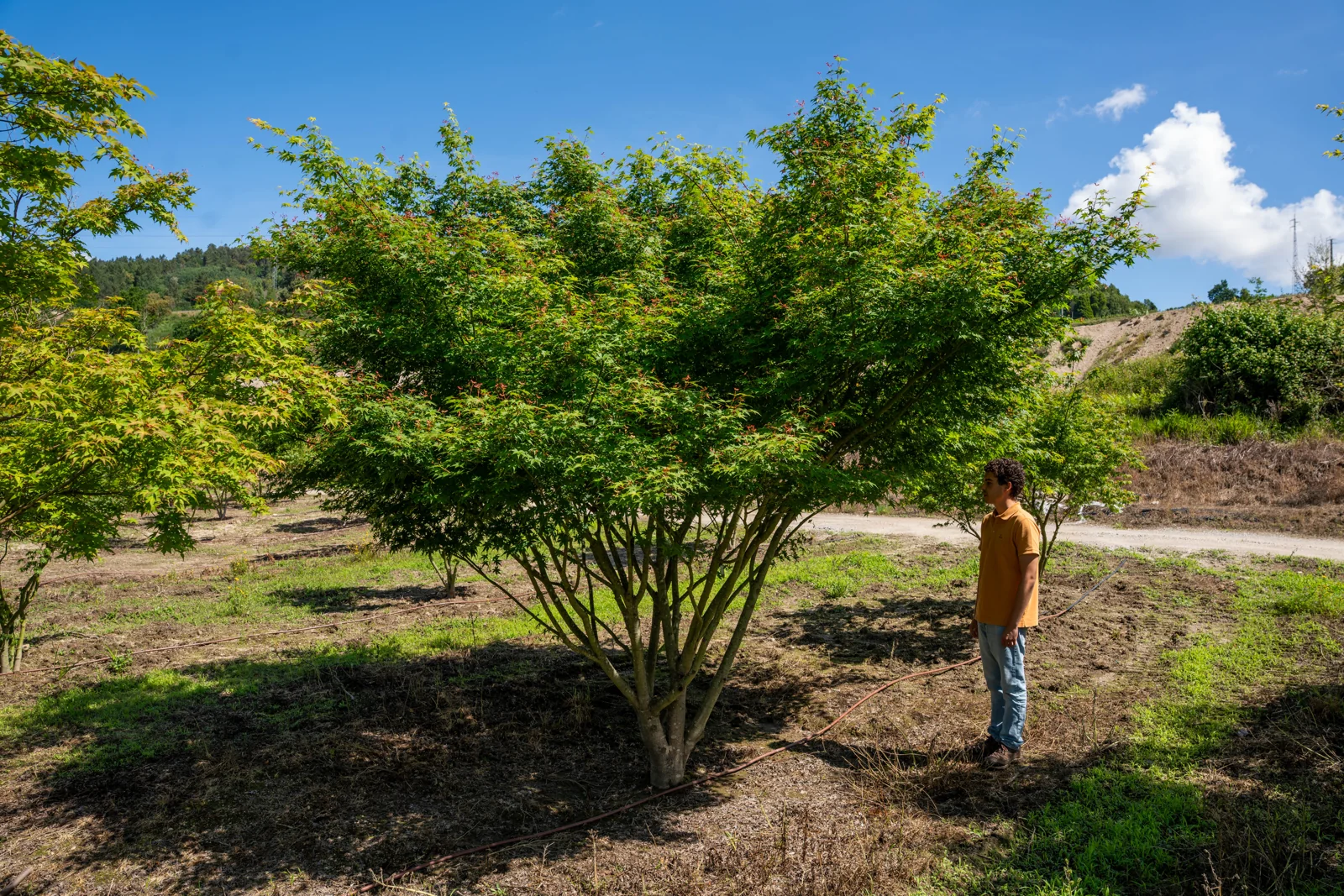
Acer palmatumJapanese maple
A central species in the Japanese garden tradition, it combines fine, progressively layered branching with palmate leaves that transform the expression of the crown through the year. The botanical form, with green foliage, keeps a more natural character than the many cultivars selected from this species.
- Botanical parent of an extraordinary diversity of ornamental cultivars
- Fine, layered branching that remains expressive after leaf fall
- Palmate leaves with five to seven lobes, intensely coloured in autumn
About this species
Native to Japan, Korea and China, Acer palmatum grows as a large shrub or small tree, often with several stems. It can reach approximately 8 metres in height in Portugal, forming a progressively broad crown, rounded or fan-shaped, with fine branches arranged on different planes.Read moreShow less
Native to Japan, Korea and China, Acer palmatum grows as a large shrub or small tree, often with several stems. It can reach approximately 8 metres in height in Portugal, forming a progressively broad crown, rounded or fan-shaped, with fine branches arranged on different planes.
The leaves normally have five to seven long, pointed lobes, sometimes nine. The luminous green of spring deepens during the summer and turns, in autumn, into a variable combination of yellow, orange, red and crimson. The delicacy of the leaf lets light pass through the crown and reveal the structure of the branches.
In spring, small red-purple flowers appear in hanging clusters, followed by pairs of samaras that are reddish at first. Although discreet, these elements complement the foliage and add to the interest of the tree when seen up close.
It prefers partial shade or gentle sun, protected from dry wind and the most intense afternoon exposure. The soil should be rich in organic matter, moist and well drained, without sharp swings between waterlogging and dryness. In Portugal, protection of the root zone and deep watering during establishment are decisive in preserving the quality of the foliage.
It is suited to courtyards, entrances, Japanese gardens, water margins and compositions beneath high-crowned trees. It should be placed where the branching and the seasonal changes can be appreciated at close range. A mature specimen from Diaplant immediately brings several stems, a layered crown and the architectural maturity that is the true identity of this species.
Advice on this species
Want to know more about Acer palmatum?
Tell us about your project and we will advise on this species — where it does well, what size makes sense and what to expect once it is planted.
- Own production
- Mature specimens
- Reply within 1–2 days
No obligation · tailored quote