

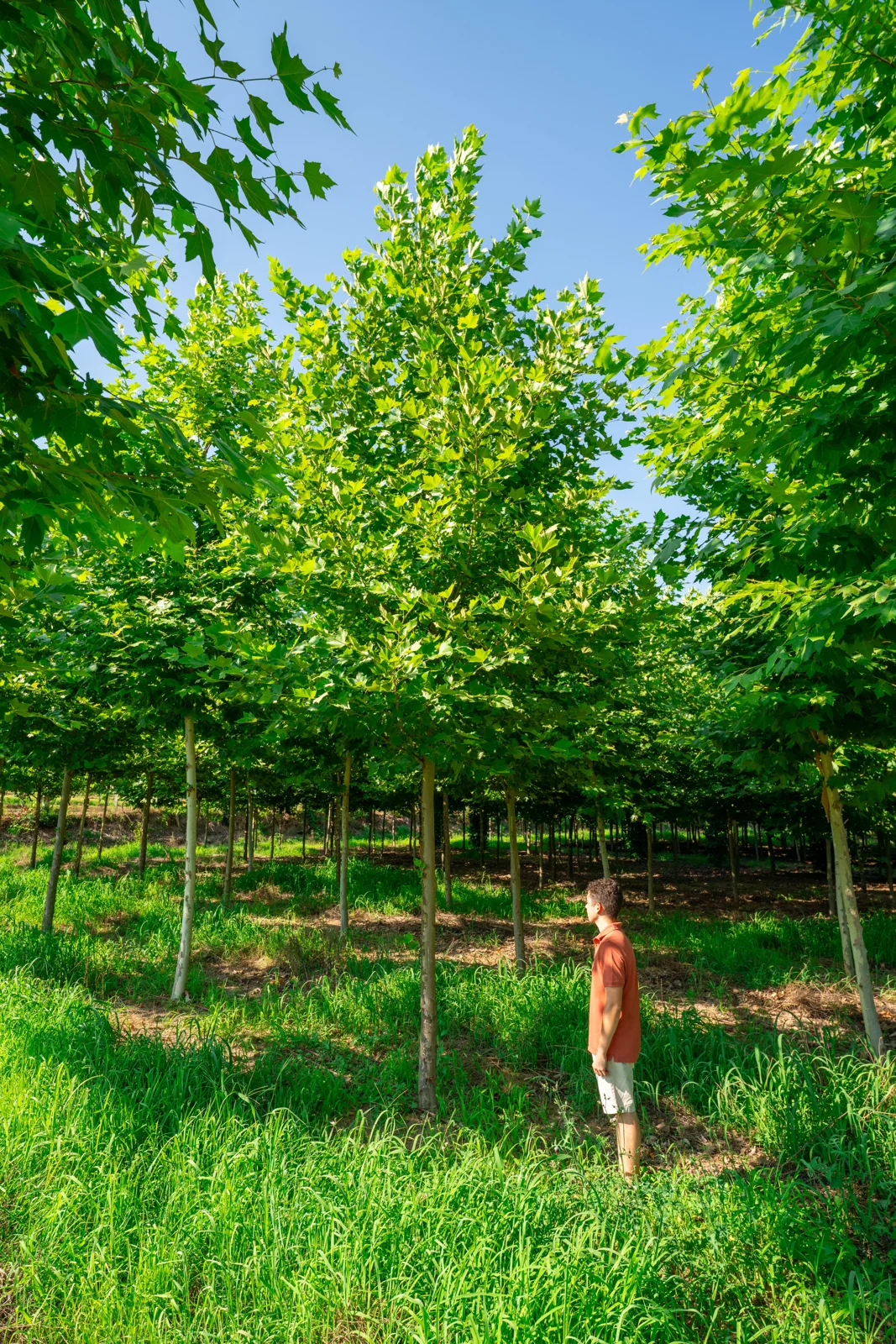
Platanus × hispanicaLondon plane
One of the most emblematic urban trees in Europe, it combines a monumental shade crown with the extraordinary mosaic bark that makes the trunk recognisable in any season. Its ability to stay vigorous in hard-surfaced environments and to respond to different forms of training explains its centuries-long presence in avenues, squares and parks.
- Peeling bark that reveals a mosaic of cream, green, grey and brown tones
- Exceptional ability to create great vaults of shade in an urban setting
- Strong response to pruning, extreme heat and salinity
About this species
Platanus × hispanica, also widely sold as Platanus × acerifolia, is a hybrid historically associated with the cross between Platanus orientalis and Platanus occidentalis. Cultivated for several centuries, it has become one of the structuring trees of the great urban landscapes of Europe. It shows fast growth, a vigorous trunk and an initially regular crown, which develops into a broad, rounded to oval vault, carried by large, progressively more horizontal branches. In favourable conditions it can reach 20 to 30 metres in height, occasionally more, and approximately 18 to 25 metres in width.Read moreShow less
Platanus × hispanica, also widely sold as Platanus × acerifolia, is a hybrid historically associated with the cross between Platanus orientalis and Platanus occidentalis. Cultivated for several centuries, it has become one of the structuring trees of the great urban landscapes of Europe. It shows fast growth, a vigorous trunk and an initially regular crown, which develops into a broad, rounded to oval vault, carried by large, progressively more horizontal branches. In favourable conditions it can reach 20 to 30 metres in height, occasionally more, and approximately 18 to 25 metres in width.
The bark is its strongest visual signature. As the trunk increases in diameter, the outer layers come away in irregular plates, successively revealing cream, grey-green, yellow and brown areas. This almost camouflage-like pattern intensifies in mature specimens and holds interest throughout the winter, when the structure of the tree is completely exposed.
The leaves are large, generally 12 to 25 centimetres, palmate and divided into three to five lobes, recalling the leaves of maples — the feature that gave rise to the epithet acerifolia. They form an abundant green crown during the summer, taking on yellow to golden-brown tones in autumn. In May, separate male and female flowers appear, though on the same tree, gathered in small spherical structures. They are followed by the characteristic globe-shaped, slightly spiny fruits, often grouped in pairs, which can remain hanging on the branches for part of the winter.
It grows best in sun, in deep, fertile soils with moderate water availability, but adapts to a very wide range of textures and pH values. Once established, it withstands heat, dry periods, air pollution, moderate compaction and the proximity of paving. This combination explains its historical use in environments where few trees manage to develop large crowns. In paved areas, the project must ensure a generous rooting volume and construction solutions able to accommodate the vigour of the roots without conflict with the surfacing.
Its strong ability to reshoot from old wood allows it to be trained as a natural-crown tree, a clear-stem avenue planting, a pollard, a candelabra, a roof-trained canopy or a formal structure. This versatility does not remove the need for a formative strategy: the intended architecture and the clear height beneath the crown must be defined from the first years, avoiding late corrections to branches that are already well developed.
It is particularly suited to wide avenues, squares, parks, car parks, large estates and projects where the tree must take on a structural rather than merely decorative role. A mature specimen from Diaplant immediately brings effective shade, scale and identity, as well as the sculptural presence of a trunk whose bark already shows the characteristic mosaic of the species. Siting must respect the future size of the crown, the distances to buildings and infrastructure, and the need for deep watering during the establishment period.
Advice on this species
Want to know more about Platanus × hispanica?
Tell us about your project and we will advise on this species — where it does well, what size makes sense and what to expect once it is planted.
- Own production
- Mature specimens
- Reply within 1–2 days
No obligation · tailored quote