

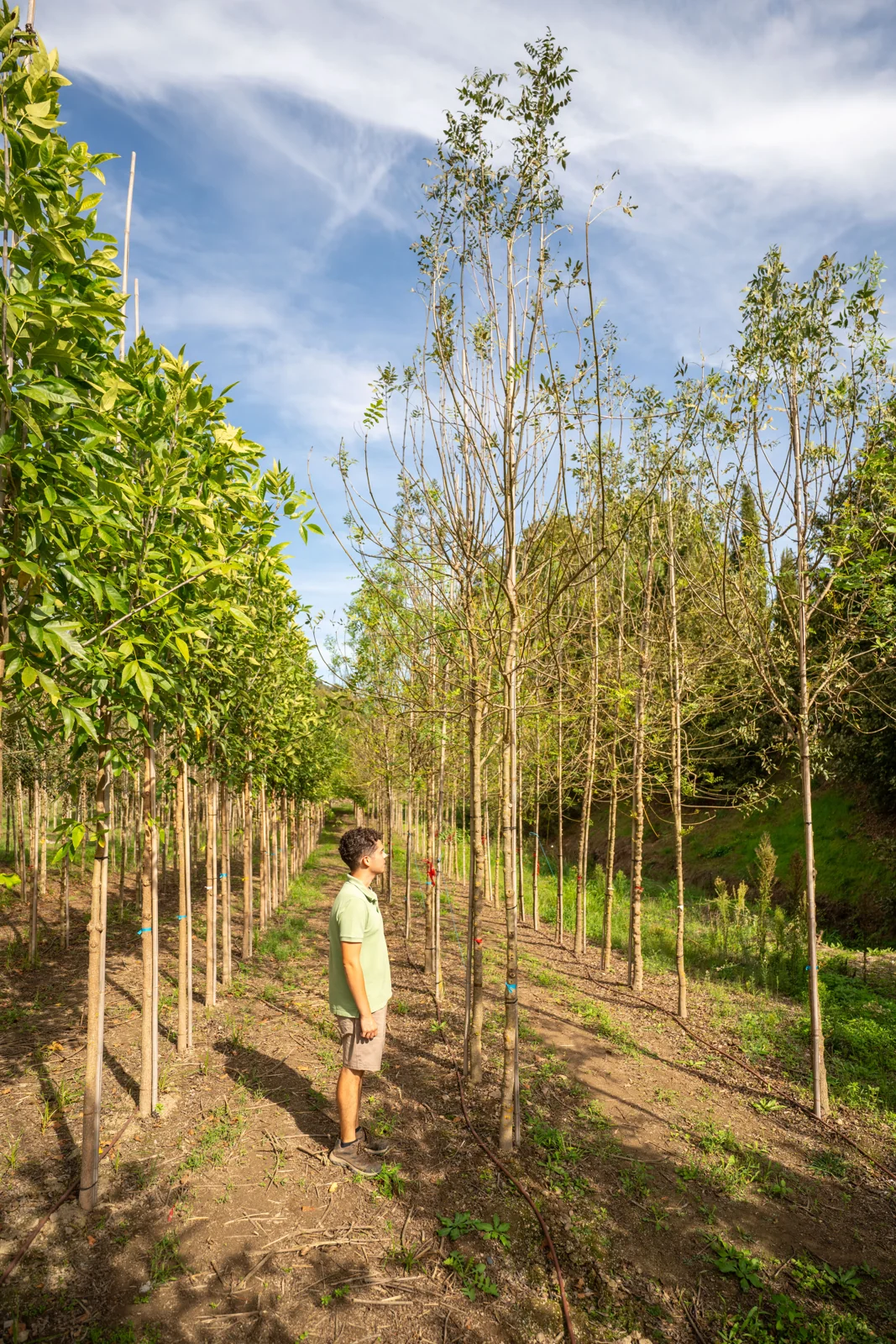
Fraxinus angustifoliaNarrow-leaved ash
A native tree with a strong riverside identity, it stands out for its broad and relatively transparent crown, made up of compound leaves with particularly narrow leaflets. It combines adaptation to deep, periodically moist soils with a Mediterranean resilience that lets it come through dry periods once well established.
- Structuring species of Portuguese ash woods and riparian woodland
- Narrow, glossy leaflets that produce a light, mobile, luminous crown
- Autumn colour ranging from golden yellow to wine red
About this species
Fraxinus angustifolia, known locally as the common ash or narrow-leaved ash, is a deciduous tree native to Portugal and characteristic of the Mediterranean landscape. It occurs naturally on the banks of rivers and watercourses in the warmer regions, and is also part of deciduous woodland on deep soils. This relationship with the riverside landscape gives it particular value in projects that seek to reconcile tree planting, territorial identity and ecological continuity.Read moreShow less
Fraxinus angustifolia, known locally as the common ash or narrow-leaved ash, is a deciduous tree native to Portugal and characteristic of the Mediterranean landscape. It occurs naturally on the banks of rivers and watercourses in the warmer regions, and is also part of deciduous woodland on deep soils. This relationship with the riverside landscape gives it particular value in projects that seek to reconcile tree planting, territorial identity and ecological continuity.
It grows relatively fast and develops a crown that is oval at first and becomes progressively broader, rounded and informal. The main branching is vigorous, but the fine texture of the branches and foliage keeps the crown visually light. In favourable conditions it can reach approximately 15 to 20 metres in height and 8 to 10 metres in spread, occasionally reaching 25 metres. Its final scale requires space, but makes it possible to create a true tree structure in parks, avenues and large gardens.
The leaves are compound and can reach 15 to 25 centimetres in length. Each leaf generally has 7 to 13 narrow, lanceolate, serrated, dark green leaflets, with a slightly glossy surface. This finer foliage is the main visual difference from Fraxinus excelsior and gives a crown of delicate texture, shot through with light and easily stirred by the wind. In autumn, the leaflets take on golden-yellow tones, which may develop into orange or wine-red shades depending on the soil and the seasonal conditions.
The bark is smooth and grey at first, becoming progressively darker and deeply furrowed in mature specimens. Before the leaves are fully developed, small yellowish-green flowers appear in clusters. They are followed by the samaras, dry fruits with an elongated wing that helps dispersal by wind. When produced in quantity, they remain in clusters and add a light texture to the crown during late summer and autumn.
It grows best in full sun and in deep, fertile soils with a regular supply of water. It nevertheless tolerates different textures, from sandy to clay ground, as well as neutral or chalky soils. Its ecological peculiarity lies in its ability to make use of moist, periodically wet soils without being limited exclusively to those contexts: once established, it withstands periods of summer drought and relatively demanding urban conditions. It also shows good resistance to wind, cold, the proximity of paving and the salinity associated with de-icing operations.
It is especially suited to parks, wide avenues, large estates, naturalised banks and projects to restore riparian galleries. In avenue planting it creates continuity and rhythm without producing an excessively heavy mass; used on its own, it develops a broad crown capable of structuring a clearing or a large area of lawn. The filtering foliage gives comfortable shade while keeping some light at ground level.
The mature specimens from Diaplant make it possible to bring in immediately the scale and expression that make this species relevant. An ash that is already formed offers, from planting, a defined trunk, developed main branching and a crown volume capable of giving shade and framing the space. During establishment, deep and regular watering is essential to restore the relationship between a tree naturally associated with moist soils and its new planting site.
Advice on this species
Want to know more about Fraxinus angustifolia?
Tell us about your project and we will advise on this species — where it does well, what size makes sense and what to expect once it is planted.
- Own production
- Mature specimens
- Reply within 1–2 days
No obligation · tailored quote