

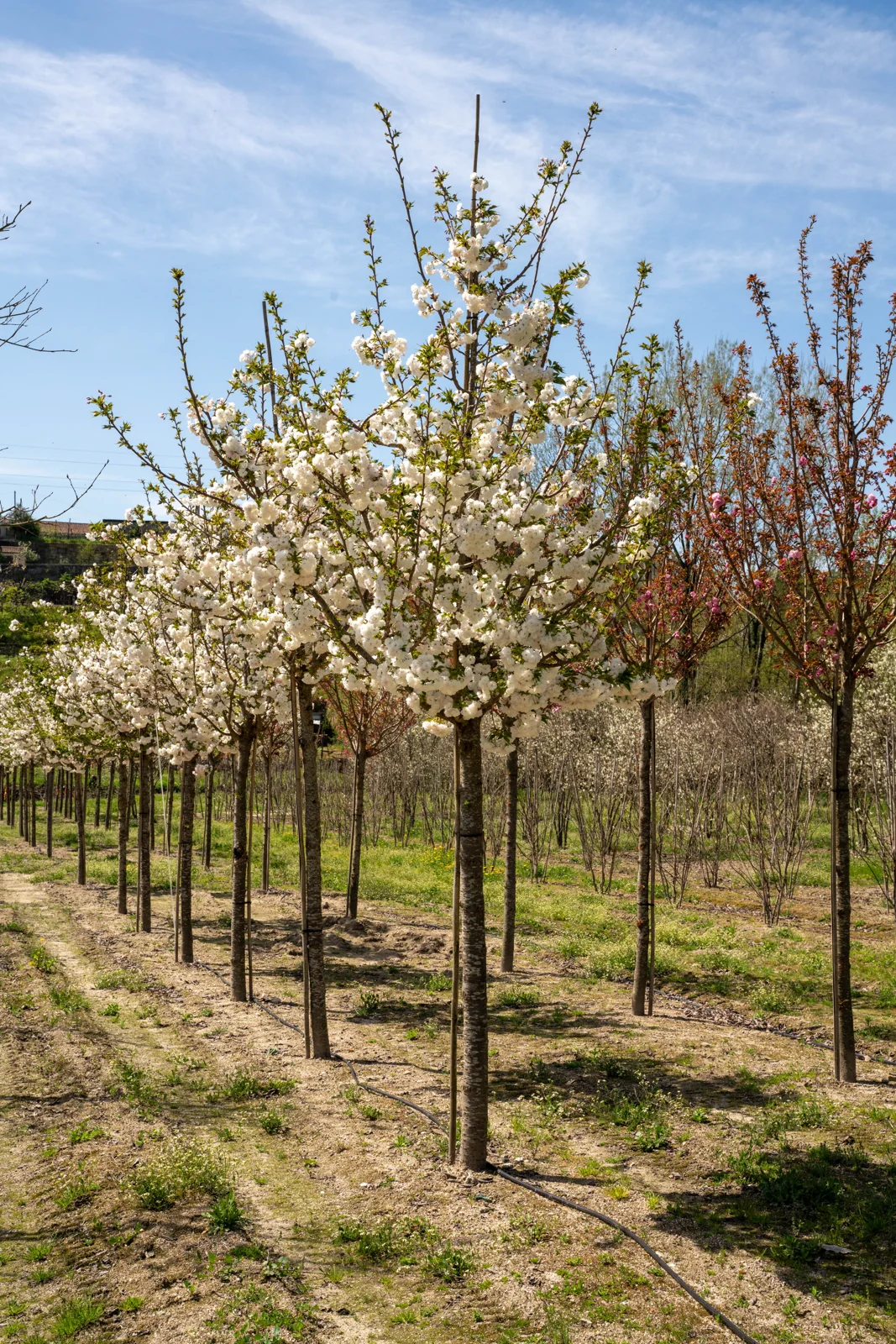
Prunus serrulata 'Shirotae'Japanese flowering cherry
For projects that call for a spring-flowering specimen with an open, contained habit, this cultivar of Japanese flowering cherry stands out for its horizontal crown and semi-double white flower, distinct from the upright, vase-shaped habit of the more common 'Kanzan'.
- Broad, almost horizontal crown, four to six metres in diameter
- Dense clusters of pure white, lightly scented flowers in April
- Bronze new growth in spring, orange and brown foliage in autumn
About this cultivar
It differs from the species and from the pink-flowered cultivars in its broad, open and markedly horizontal crown, which in Portuguese conditions settles at 4 to 6 metres in height with a similar spread. This low, spreading branch structure takes the place, in a project, of a broad-crowned single specimen, intended for situations that call for lateral extent…Read moreShow less
It differs from the species and from the pink-flowered cultivars in its broad, open and markedly horizontal crown, which in Portuguese conditions settles at 4 to 6 metres in height with a similar spread. This low, spreading branch structure takes the place, in a project, of a broad-crowned single specimen, intended for situations that call for lateral extent rather than verticality, unlike the vase-shaped habit of 'Kanzan'. Its size and form make it suitable for groups in lawn, large courtyards and group planting, less so for narrow avenue planting, where its lateral spread requires generous tree pits.
The April flowering is the central specification criterion: large, pure white, semi-double flowers in dense, hanging clusters, with a mild scent, accompanied by the bronze young shoots that extend the spring interest. In autumn the deciduous foliage, dark green and ovate, turns to orange and brownish tones, giving it a second period of ornamental value that is relevant in a municipal project.
Its performance on site demands careful siting. The species prefers fertile, moist, well-drained and slightly acidic soils, in full exposure, and does not tolerate waterlogging or poor drainage, so in compacted clay soils drainage must be corrected. Tolerance of drought and salt spray is low, which calls for supplementary watering during establishment and the first summers and shelter from strong wind and sea spray in projects on the Atlantic coast.
Of moderate growth, it is hardy to about -10 °C, with no winter stress in the centre and north of mainland Portugal. The bark is thin and sensitive to mechanical damage, which calls for stem protection in street planting and careful formative pruning. It adapts to an urban context provided it has room to spread horizontally, which makes it a defensible choice where the project seeks white flowering with an open habit rather than the upright silhouette of the pink cultivars.
Advice on this species
Want to know more about Prunus serrulata 'Shirotae'?
Tell us about your project and we will advise on this species — where it does well, what size makes sense and what to expect once it is planted.
- Own production
- Mature specimens
- Reply within 1–2 days
No obligation · tailored quote