

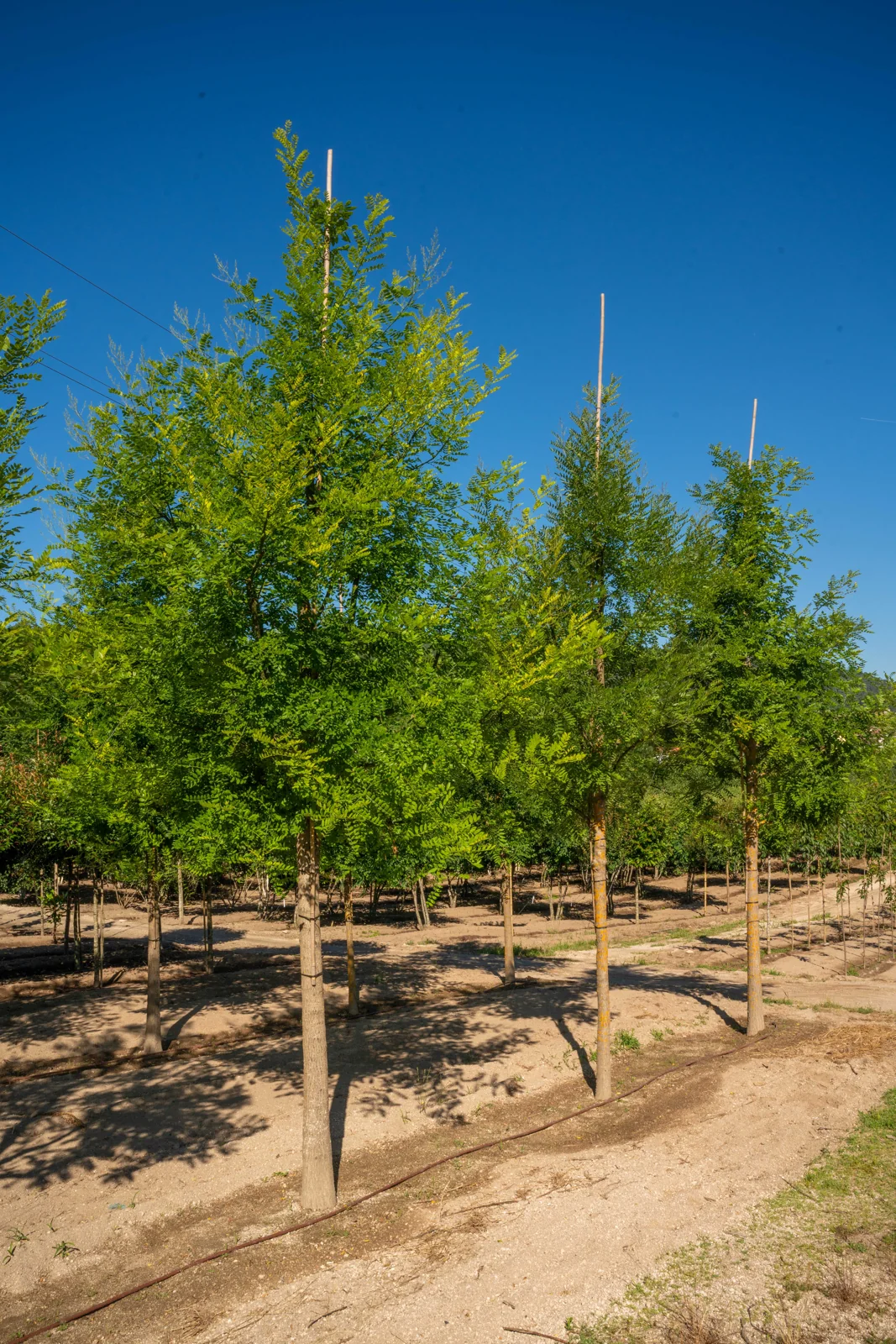
Sophora japonicaJapanese pagoda tree
A street selection with a regular, ascending oval crown, for street planting and avenue planting where uniformity, rapid establishment and tolerance of summer heat and compaction are required, without the plant-health pressure that today constrains ash and plane.
- Cream, lightly scented flowers in August and September
- Light, pinnate crown that casts a cool, dappled shade over a terrace
- Deep roots and drought tolerance after two or three summers of establishment
About this cultivar
It differs from the seed-raised species above all in its regularity: the ascending oval crown, more restrained and uniform, gives consistency in avenue planting, whereas the seed-raised pagoda tree tends to branch low and open a broad, irregular crown. The fine, glossy pinnate foliage and the more vigorous establishment make this selection an option when the specification…Read moreShow less
It differs from the seed-raised species above all in its regularity: the ascending oval crown, more restrained and uniform, gives consistency in avenue planting, whereas the seed-raised pagoda tree tends to branch low and open a broad, irregular crown. The fine, glossy pinnate foliage and the more vigorous establishment make this selection an option when the specification requires specimens comparable with one another and a crown that forms relatively early.
In terms of behaviour on site, it is one of the shade trees most robust under heat stress: it withstands prolonged summer heat, air pollution and dryness once established, behaviour explained by its origin on continental slopes in China and Korea, with hot summers. Its cold hardiness is broad, with no risk of winter stress in Portuguese conditions. It adapts to loamy, sandy and moderately chalky soils, provided they are well drained; the decisive soil factor is drainage, as it does not tolerate prolonged waterlogging.
Given the absence of significant pest and disease pressure and its tolerance of compaction and urban air, it stands as an avenue-planting alternative to ash in the context of ash dieback and to plane where the aim is to avoid canker stain and the maintenance it imposes. It resists salt spray well to a moderate degree, which makes it usable in sheltered coastal situations, although on an exposed seafront it benefits from shelter during establishment.
Its root behaviour is compatible with a standard urban tree pit when the specimen is trained with a straight stem from the formative stage; grown freely it tends to branch low, so early formative pruning is decisive. The wood is relatively brittle, and structural pruning that reduces vulnerability to wind is advisable.
It flowers in cream to white panicles between July and September, a late ornamental phase that is useful in a project calendar in which few large trees are in flower; it attracts bumblebees and bees. The foliage stays green until late in autumn, with a brief turn to yellow. Growth is medium but consistent, making it possible to reach avenue girth size within a reasonable project timescale from an already formed specimen.
Advice on this species
Want to know more about Sophora japonica?
Tell us about your project and we will advise on this species — where it does well, what size makes sense and what to expect once it is planted.
- Own production
- Mature specimens
- Reply within 1–2 days
No obligation · tailored quote