

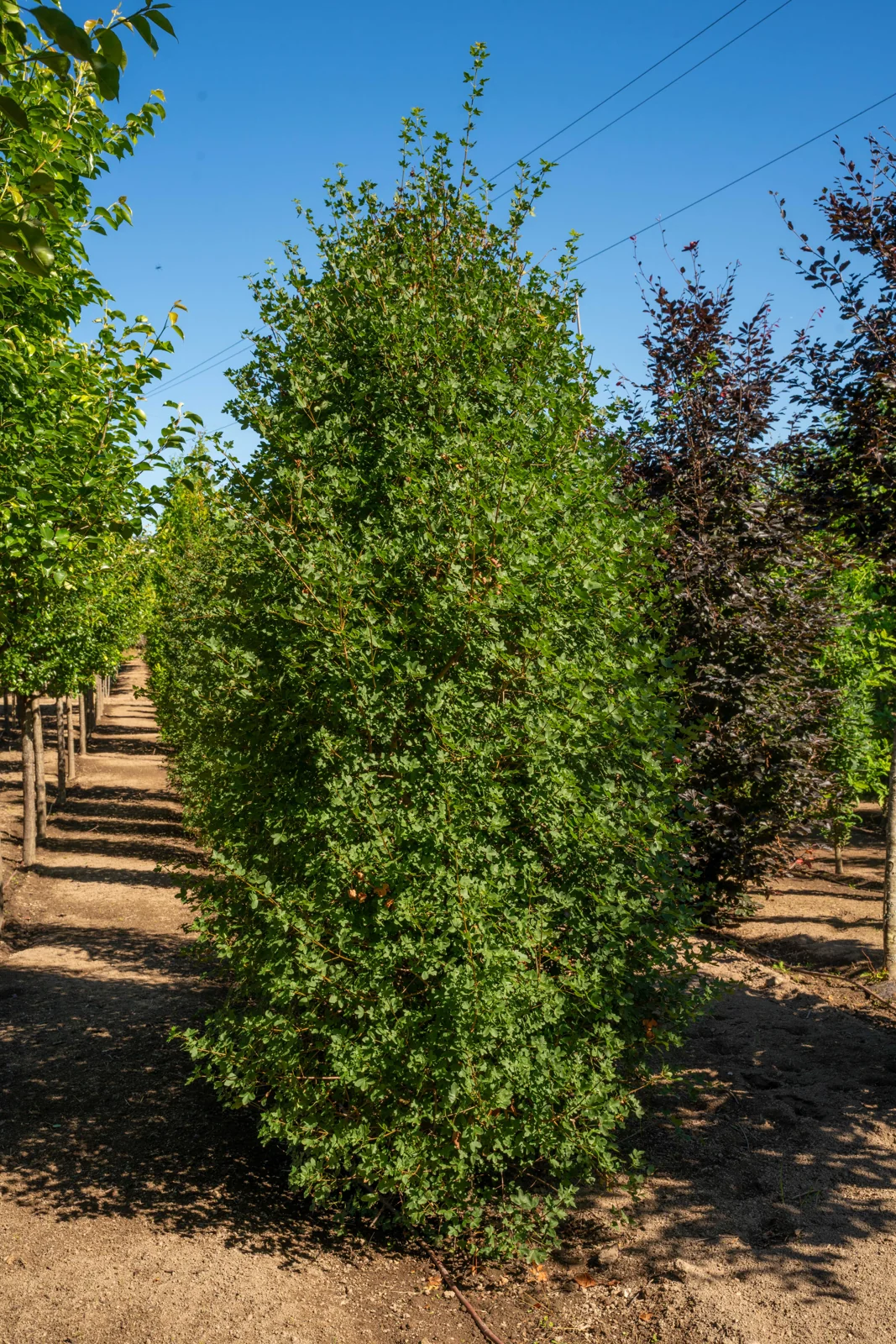
Acer monspessulanumMontpellier maple
A native maple of Mediterranean character, the Montpellier maple stands out for its ability to form a dense, cool crown in dry, stony, chalky soils. The small leathery leaves, divided into three rounded lobes, allow it to keep a delicate leaf scale without losing resistance to heat and drought.
- One of the native Portuguese maples best adapted to Mediterranean drought
- Small, glossy, leathery and distinctly three-lobed leaves
- A particular affinity with stony soils and soils of limestone origin
About this species
Acer monspessulanum is a species native to mainland Portugal, associated with scrub, mixed woodland and rocky slopes. It grows as a small tree or large shrub, often with several stems, generally reaching 6 to 8 metres in height and 4 to 6 metres in width. Slow growth produces a broad, rounded, densely branched crown.Read moreShow less
Acer monspessulanum is a species native to mainland Portugal, associated with scrub, mixed woodland and rocky slopes. It grows as a small tree or large shrub, often with several stems, generally reaching 6 to 8 metres in height and 4 to 6 metres in width. Slow growth produces a broad, rounded, densely branched crown.
The leaves, at only 3 to 5 centimetres, have three entire, rounded lobes. The upper surface is dark green and glossy, while the underside has a blue-green tone. This compact, leathery foliage gives the crown a fine texture, very different from the more exuberant image of maples from humid climates.
In late April or early May, small hanging clusters of greenish-yellow flowers appear, at roughly the same time as the new leaves. They are followed by samaras whose wings lie almost parallel. In autumn, the crown takes on an intense yellow colour, sometimes accompanied by orange tones.
It prefers full sun and well-drained soils, with a special affinity for chalky, dry, stony ground. Once established, it tolerates heat, wind, cold and prolonged periods of low water availability. In an urban setting it should have an area of permeable soil that allows the root system to develop in a balanced way.
It is suited to Mediterranean gardens, projects with native vegetation, parks, small squares and spaces that call for a shade tree adapted to demanding conditions. A mature specimen from Diaplant immediately brings a formed crown and a framework of stems that the species, because of its slow growth, would take many years to build.
Advice on this species
Want to know more about Acer monspessulanum?
Tell us about your project and we will advise on this species — where it does well, what size makes sense and what to expect once it is planted.
- Own production
- Mature specimens
- Reply within 1–2 days
No obligation · tailored quote