

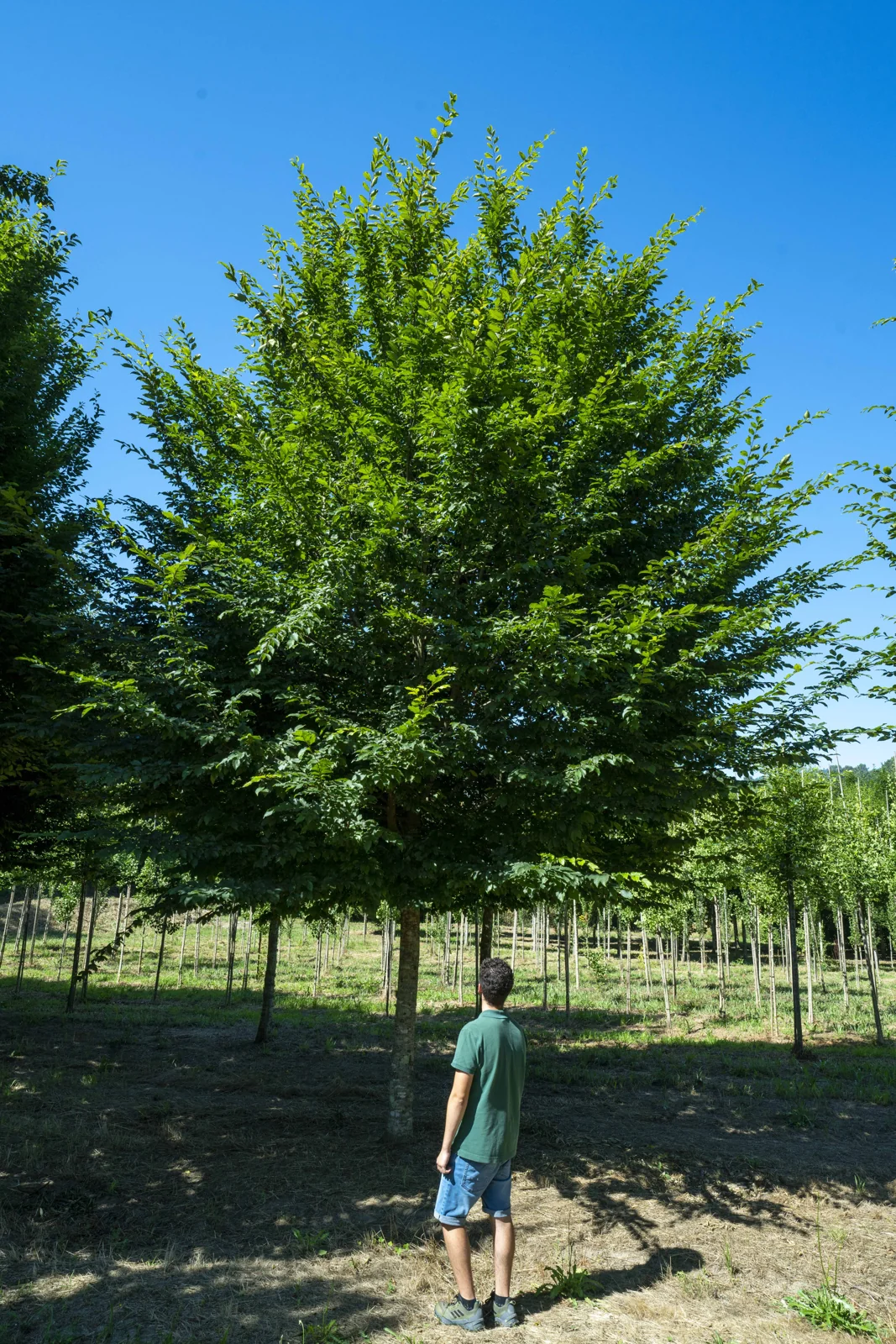
Carpinus betulusHornbeam
A European tree with a dense crown and great longevity, recognised by its deeply fluted grey trunk and its strongly textured foliage. Its extraordinary response to pruning allows it to be used both in its natural form and in hedges, pleached screens, avenue plantings and rigorously trained plant structures.
- Grey, smooth, fluted trunk, with an almost muscular expression
- Densely branched crown, highly receptive to pruning
- Golden foliage in autumn, with partial retention of dry leaves in trained forms
About this species
Carpinus betulus develops an initially conical crown, which becomes progressively oval, broad and rounded. The lower branches may take on a more pendulous position in mature specimens, creating a solid, densely branched silhouette. It can reach approximately 15 to 20 metres in height and 10 to 15 metres in width when it grows freely.Read moreShow less
Carpinus betulus develops an initially conical crown, which becomes progressively oval, broad and rounded. The lower branches may take on a more pendulous position in mature specimens, creating a solid, densely branched silhouette. It can reach approximately 15 to 20 metres in height and 10 to 15 metres in width when it grows freely.
The trunk has smooth grey bark, marked by longitudinal flutes that become more expressive with age. The leaves are oval, strongly veined and doubly serrate at the margin. They emerge a fresh green in spring and turn golden yellow before the autumn fall.
In spring, discreet catkins appear, followed by small fruits grouped in hanging structures similar to those of the hop. When pruned regularly, part of the dry foliage may remain on the branches through the winter, extending the screening capacity and the definition of the trained forms.
It adapts to sun or partial shade and makes few demands on the soil, although it prefers fertile, well-drained ground. It tolerates cold, wind, different moisture levels and moderate periods of drought once established. Its excellent response to pruning allows it to be used as a park or avenue tree, a large hedge, a pleached screen, a pergola, a palisade or an architectural element.
A mature specimen from Diaplant immediately brings a defined trunk, a dense crown and the scale needed to structure the space. In trained forms, the volume and geometry already established make it possible to create, from planting, green walls, framing or formal sequences that would take many years to form from young plants.
Advice on this species
Want to know more about Carpinus betulus?
Tell us about your project and we will advise on this species — where it does well, what size makes sense and what to expect once it is planted.
- Own production
- Mature specimens
- Reply within 1–2 days
No obligation · tailored quote