

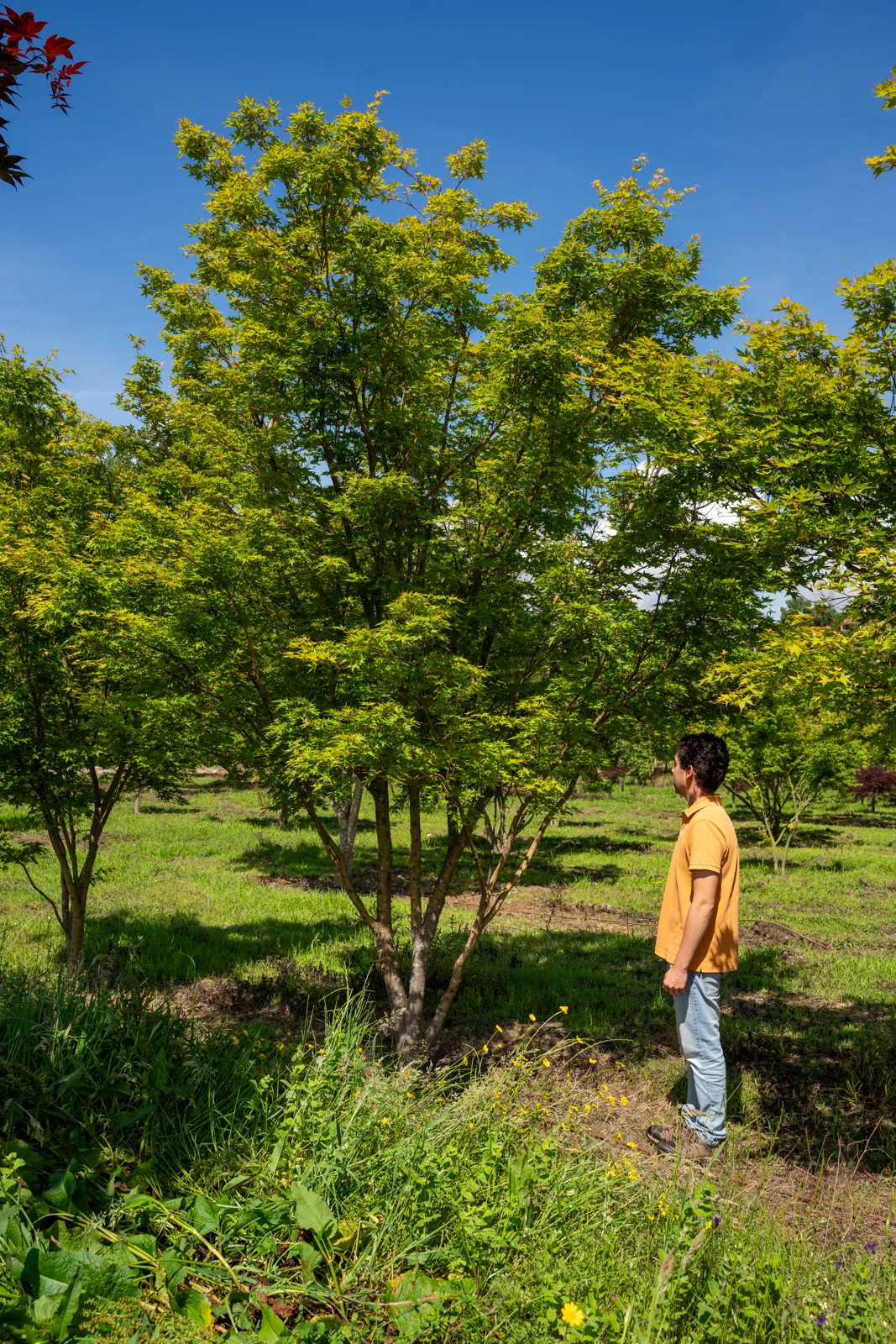
Acer palmatum 'Sangokaku'Japanese maple
Known as the coral-bark maple, it extends the interest of the Japanese maple beyond leaf fall. During the winter, the young branches take on an intense coral red and turn the bare structure of the tree into its main ornamental feature.
- Coral-red young branches that reach their fullest expression during the winter
- Leaf sequence of pinkish yellow in spring, green in summer and golden yellow in autumn
- Reference cultivar among the Japanese maples valued for the colour of their wood
About this cultivar
‘Sangokaku’ forms a large shrub or small tree of upright growth, whose crown, narrow at first, becomes progressively broader and oval. It usually reaches 4 to 6 metres in height and 2.5 to 4 metres in spread, and can attain larger dimensions in old specimens.Read moreShow less
‘Sangokaku’ forms a large shrub or small tree of upright growth, whose crown, narrow at first, becomes progressively broader and oval. It usually reaches 4 to 6 metres in height and 2.5 to 4 metres in spread, and can attain larger dimensions in old specimens.
The young branches are the feature that truly sets this cultivar apart. After leaf fall, the wood takes on a luminous coral-red tone, particularly intense on the most recent growth. The fine branching is fully visible during the winter, creating contrast with conifers, dark green hedges, pale walls or frost-covered surfaces. This feature places it in the Red Wood Group of the Maple Society classification.
In spring, the five-lobed leaves open in yellowish-green tones, often edged with pink or red. They turn light green during the summer and change to golden yellow, sometimes with orange glints, before falling and revealing the coral structure of the branches once more.
It prefers a sheltered spot, in gentle sun or partial shade, with fertile, moist, well-drained soil. Winter light helps to bring out the colour of the wood, while a good supply of water during the growing season favours the formation of the new branches that will produce the coral effect.
It is suited to Japanese gardens, courtyards, entrances, path edges and compositions designed to hold interest in winter. A mature specimen from Diaplant immediately brings a branched architecture capable of structuring the space all year round, together with a significant quantity of coloured young wood that makes the winter effect visible from planting.
Advice on this species
Want to know more about Acer palmatum 'Sangokaku'?
Tell us about your project and we will advise on this species — where it does well, what size makes sense and what to expect once it is planted.
- Own production
- Mature specimens
- Reply within 1–2 days
No obligation · tailored quote