

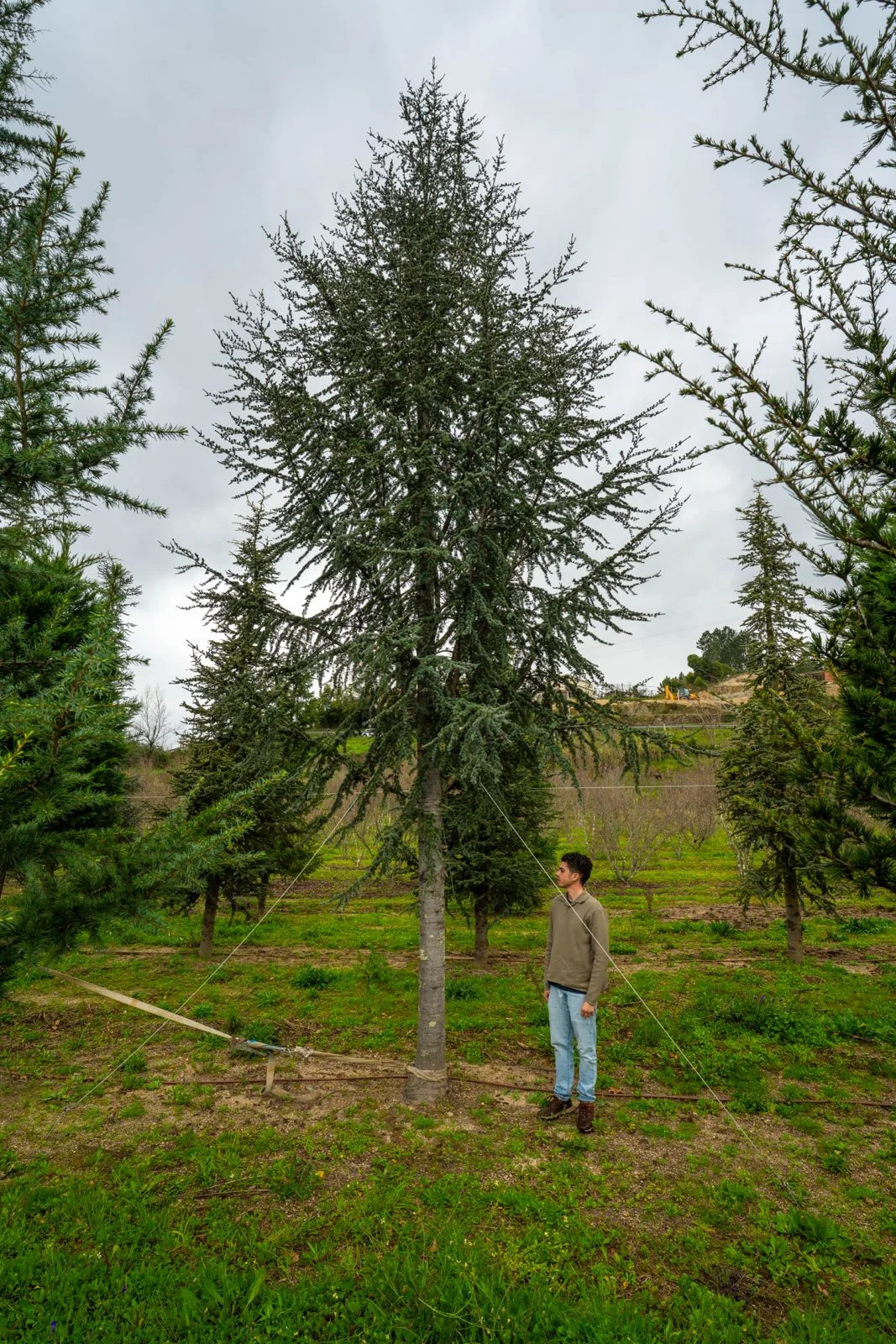
Cedrus atlantica 'Glauca'Atlas cedar
With the silvery-blue foliage that sets the cultivar apart from the botanical type, this conifer has established itself in historic Portuguese parks and avenues as an architectural feature with a broad crown and an unmistakable silhouette.
- Silvery-blue needles in dense clusters that make the crown stand out from a long way off
- Pyramidal habit when young, opening into strong, horizontal branches with age
- A long-lived conifer that gains presence with every decade
About this cultivar
The silvery-blue foliage of 'Glauca' is what sets this cultivar apart from the typical form of the species. The short, rigid needles appear in dense tufts on horizontal, strongly structured branches, giving a texture that reads from a distance and keeps its visual presence through the winter, when most deciduous alternatives give up the…Read moreShow less
The silvery-blue foliage of 'Glauca' is what sets this cultivar apart from the typical form of the species. The short, rigid needles appear in dense tufts on horizontal, strongly structured branches, giving a texture that reads from a distance and keeps its visual presence through the winter, when most deciduous alternatives give up the leading role. In a project, it takes the architectural role of a large conifer without the dark-green uniformity of Cedrus deodara or Cupressus sempervirens in avenue planting.
Its performance in Portuguese conditions is consistent. It withstands summer drought well after establishment, tolerates the air pollution of the streets of Greater Porto and Greater Lisbon, and adapts to chalky or clay soils as long as drainage is effective. Salt tolerance is low: it is ruled out on the exposed Atlantic seafront. Its cold hardiness (minimum temperatures down to around -15 °C) covers the interior of Trás-os-Montes and the Beira without reservation.
The tap-rooted system calls for planning. Late transplanting is difficult without a rootball stabilised over successive growing-on seasons; on site, establishment depends on a wide planting hole, assured drainage and protection from prevailing winds in the first years. The depth of the roots makes the cultivar unsuitable for narrow tree pits or the proximity of underground services: its natural setting is the urban park, the avenue on a wide central reservation, the garden of a country estate, the single specimen within a group planting.
Growth is slow to moderate. The crown opens with age, loses the strictly pyramidal habit of youth and gains spreading horizontal branches that settle the tree into the scale of the landscape. In a municipal project or a long-term private garden, it is a choice for longevity: century-old specimens are documented in historic Portuguese gardens, and the curve of landscape return justifies buying at an already formed girth size.
Advice on this species
Want to know more about Cedrus atlantica 'Glauca'?
Tell us about your project and we will advise on this species — where it does well, what size makes sense and what to expect once it is planted.
- Own production
- Mature specimens
- Reply within 1–2 days
No obligation · tailored quote