

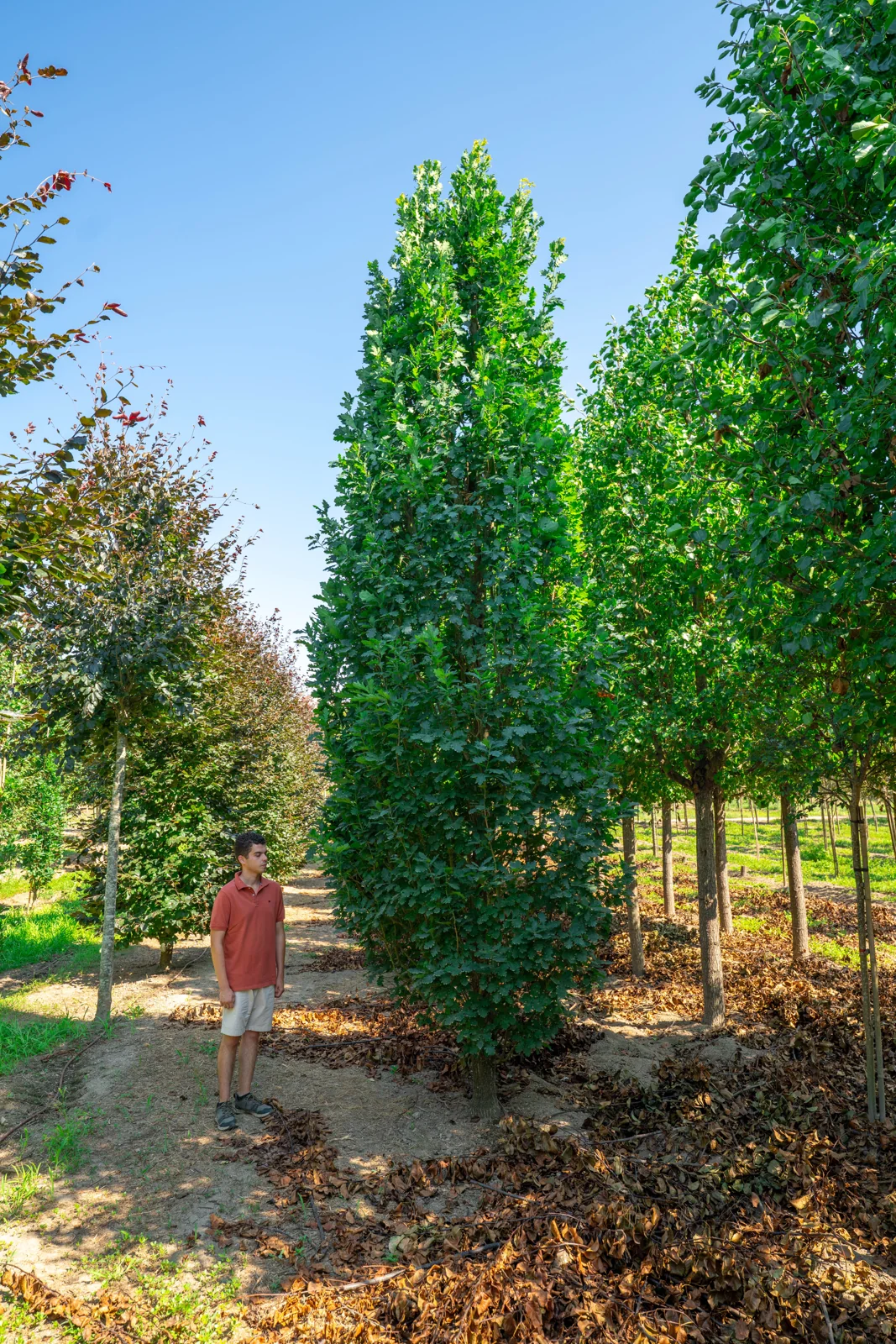
Quercus robur 'Fastigiata Koster'English oak
With a narrow, strongly vertical silhouette, it occupies the air space without imposing it on the ground: the columnar form that a confined street or a central reservation calls for when the stature of the oak is wanted without the broad crown.
- Narrow, upright crown, around 4 metres in spread
- Reaches around 20 metres in height at maturity
- The stature of an oak in a limited space
About this cultivar
Form is the argument. Where Quercus robur of the botanical type opens a broad, rounded crown incompatible with tight tree pits, this fastigiate selection keeps dense, ascending branching wrapped around the stem, at around 20 m in height by only 4 m in spread at maturity. The height-to-spread ratio allows confined urban avenue planting,…Read moreShow less
Form is the argument. Where Quercus robur of the botanical type opens a broad, rounded crown incompatible with tight tree pits, this fastigiate selection keeps dense, ascending branching wrapped around the stem, at around 20 m in height by only 4 m in spread at maturity. The height-to-spread ratio allows confined urban avenue planting, central reservations and squares where an open-crowned oak would require successive reduction pruning.
Its soil behaviour and hardiness are those of the English oak, a species native to Portugal and present on the national flora lists, which supports its inclusion in specifications with a quota of native species. It adapts to almost all soil types, including compacted clay and chalky soils, and withstands frost without winter stress in Portuguese conditions. Drought tolerance is moderate: once established, it needs no routine watering, but asks for attention to watering in the first summers in dry soil and full exposure.
For the urban context, two facts weigh on the decision. The variety tolerates air pollution and the proximity of asphalt, which makes it defensible in street corridors and in street planting over paving. The root system of the oak is tap-rooted and deep, a pattern less aggressive towards paving than that of shallow-rooted species, although in a tight tree pit it is always necessary to allow for space and separation from underground services.
The deciduous foliage, dark green and lobed, turns a stable yellowish brown in the Atlantic autumn, a sober colour register suited to a municipal project. The genus is broadly subject to powdery mildew in humid climates and to a range of leaf pests particular to Quercus, although none of them constitutes, in Portugal, the acute plant-health pressure of the ash or the plane. Medium growth: allow several years for the column to define its line in a project, a pace consistent with the longevity and structural stability that the oak offers in permanent tree planting.
Advice on this species
Want to know more about Quercus robur 'Fastigiata Koster'?
Tell us about your project and we will advise on this species — where it does well, what size makes sense and what to expect once it is planted.
- Own production
- Mature specimens
- Reply within 1–2 days
No obligation · tailored quote