

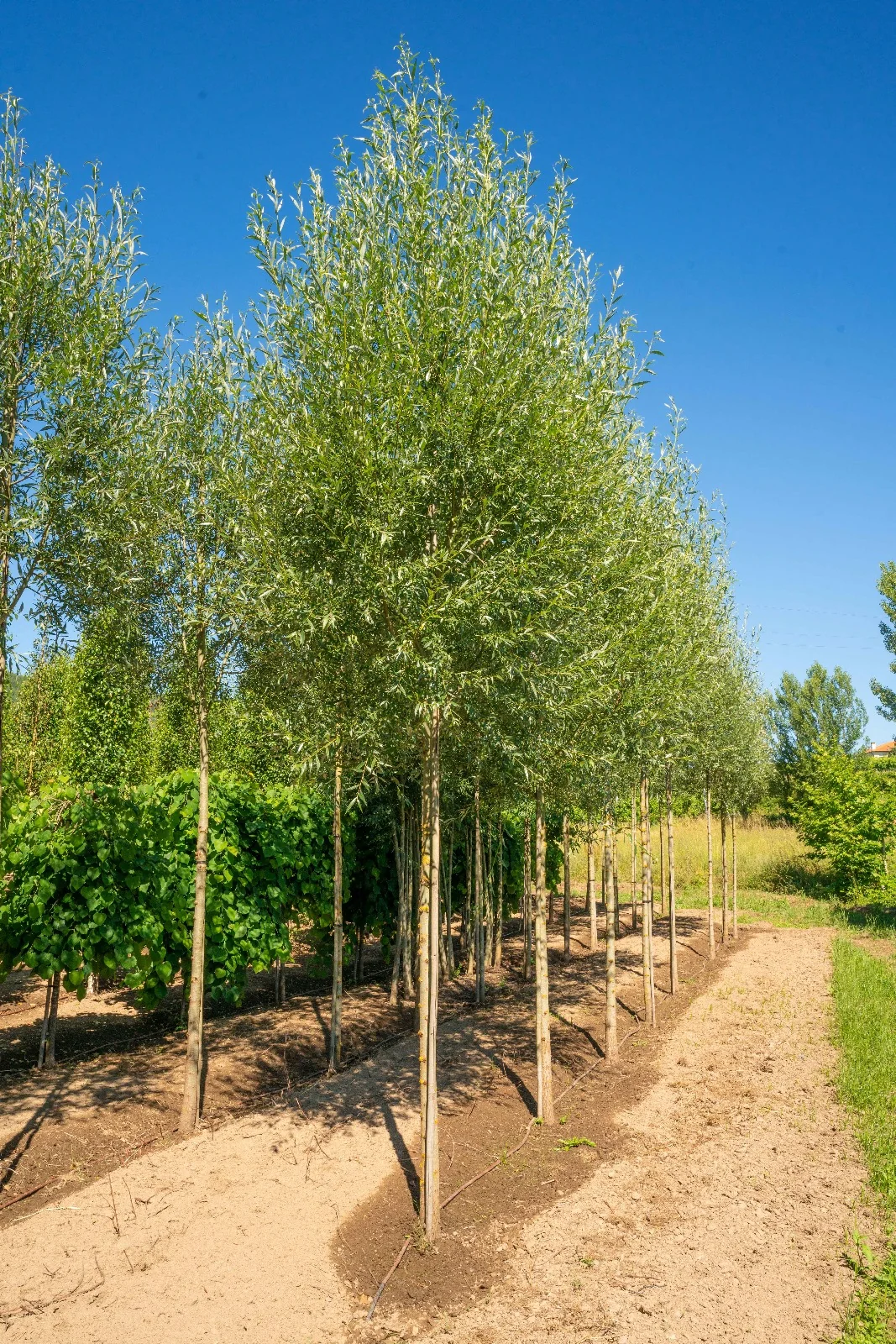
Salix albaWhite willow
A native riparian species for the restoration of watercourses, riverside gallery woodland and waterlogged slopes, where its wide-spreading root system stabilises unstable banks and its rapid growth closes the tree canopy in a few growing seasons.
- Silvery foliage that glints in the lightest breeze
- Soft yellow catkins in early spring, before the leaves
- Fast growth, giving height and presence in a few seasons
About this species
Fast-growing and of medium to large size, it reaches 15 to 25 m with an irregular, sometimes leaning crown and grey-brown bark that becomes deeply fissured with age. In riparian avenue planting or in mass planting on a bank, it takes the place of Fraxinus angustifolia and the black poplar, with more secure establishment in permanently moist soil and faster canopy closure…Read moreShow less
Fast-growing and of medium to large size, it reaches 15 to 25 m with an irregular, sometimes leaning crown and grey-brown bark that becomes deeply fissured with age. In riparian avenue planting or in mass planting on a bank, it takes the place of Fraxinus angustifolia and the black poplar, with more secure establishment in permanently moist soil and faster canopy closure in the first decade.
Its behaviour on site is defined by its dependence on water: the species requires moist to waterlogged soils and does not thrive under prolonged summer dryness without supplementary watering. The wide-spreading root system draws moisture from an extensive area, which makes it decisive in stabilising slopes and unstable banks, but advises against its use near underground services, narrow tree pits or paving, where the shallow roots lift surfacing and interfere with drainage. Its place is the watercourse, the pond edge, the wet park and the seasonally saturated slope, contexts in which few tree-sized species establish with equal certainty.
It tolerates seasonal waterlogging and compacted clay soils well, provided its root zone stays moist; in poor sandy soil or dry chalky soil it loses vigour and asks for establishment watering in the first summers. The wood is light and brittle, sensitive to damage by wind, snow or ice, so formative pruning should establish a balanced framework of main limbs early, and its placement favours positions sheltered from the prevailing wind.
It is part of the native flora of Portugal and answers native species quotas in PDM (municipal master plans) and municipal specifications, with no documented invasive behaviour in the riparian plantings of the centre and north. The lanceolate foliage, grey-green from the silvery down on the underside, turns yellow in autumn; the yellow catkins from March to April and the greenish young shoots sustain interest from late winter. It provides shade and wind shelter in a wet park from the fifth year in a favourable situation.
Advice on this species
Want to know more about Salix alba?
Tell us about your project and we will advise on this species — where it does well, what size makes sense and what to expect once it is planted.
- Own production
- Mature specimens
- Reply within 1–2 days
No obligation · tailored quote