

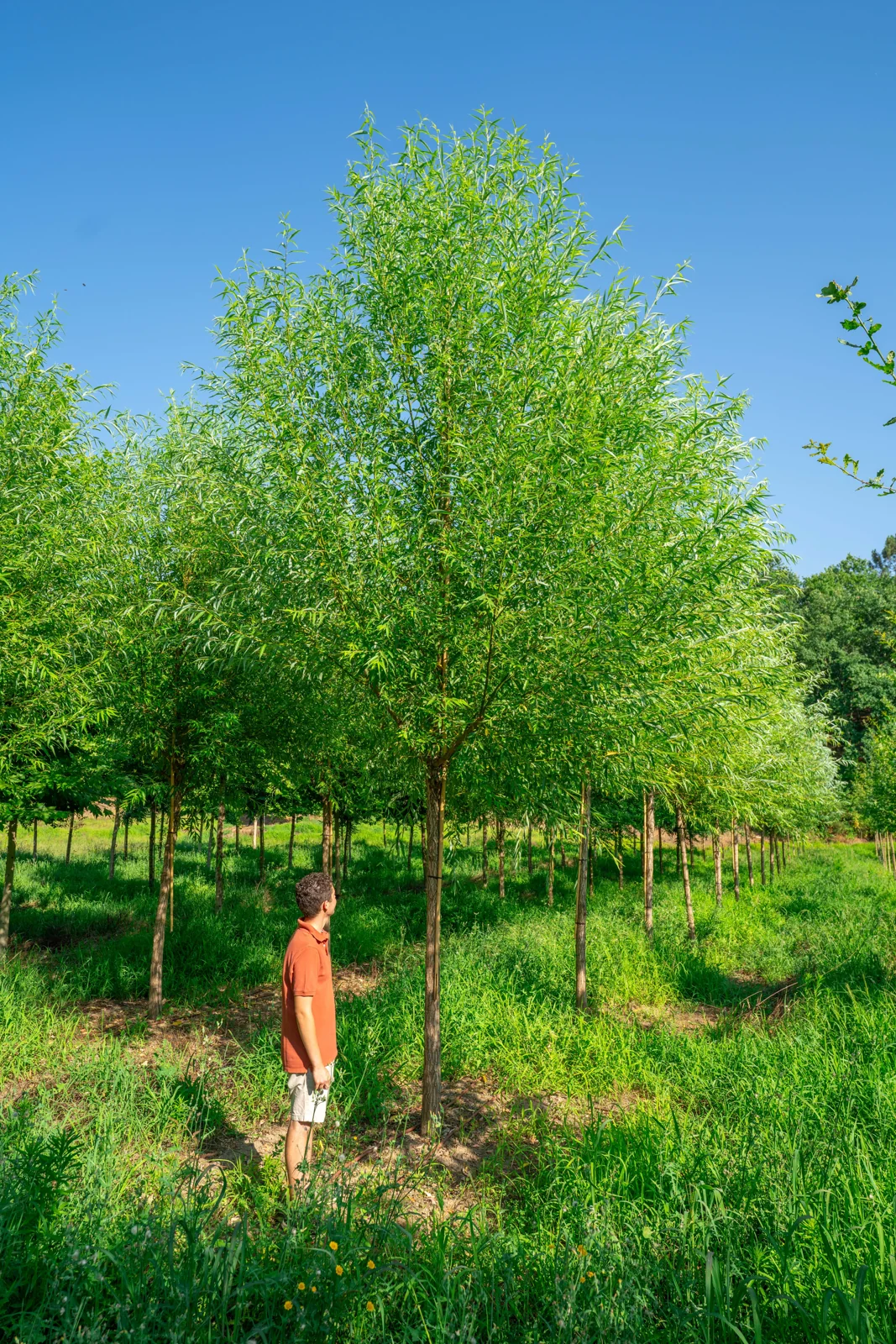
Salix fragilisCrack willow
A fast-growing deciduous willow with a broad, irregular crown, native to the banks of European rivers. Narrow, glossy leaves, yellowish catkins in spring and a vigorous root system that holds slopes and banks. A tree for renaturalisation, for wetlands and for parks with water.
- Grows fast in moist soil and stabilises banks and slopes
- Narrow, glossy leaf, catkins in April, yellow in autumn
- European waterside species, suited to renaturalisation
About this species
Salix fragilis reaches 10 to 20 metres with a broad, irregular and open crown, on a short trunk and strong main branches. The young twigs break off with a snap at the joint, which gives the species its name and is its natural way of spreading downstream.
The leaves, lanceolate and serrate, are glossy green above and paler beneath, and turn yellow in autumn. The catkins appear in April, with the leaves, and feed the first insects of the season.
It wants moist to waterlogged soil and full sun, grows fast and roots easily from cuttings, which makes it useful in soil bioengineering, in stabilising banks and slopes and in quickly creating shade and shelter in wetlands. The roots are vigorous and seek out water, so it is planted away from pipes, drains and foundations.
Advice on this species
Want to know more about Salix fragilis?
Tell us about your project and we will advise on this species — where it does well, what size makes sense and what to expect once it is planted.
- Own production
- Mature specimens
- Reply within 1–2 days
No obligation · tailored quote