

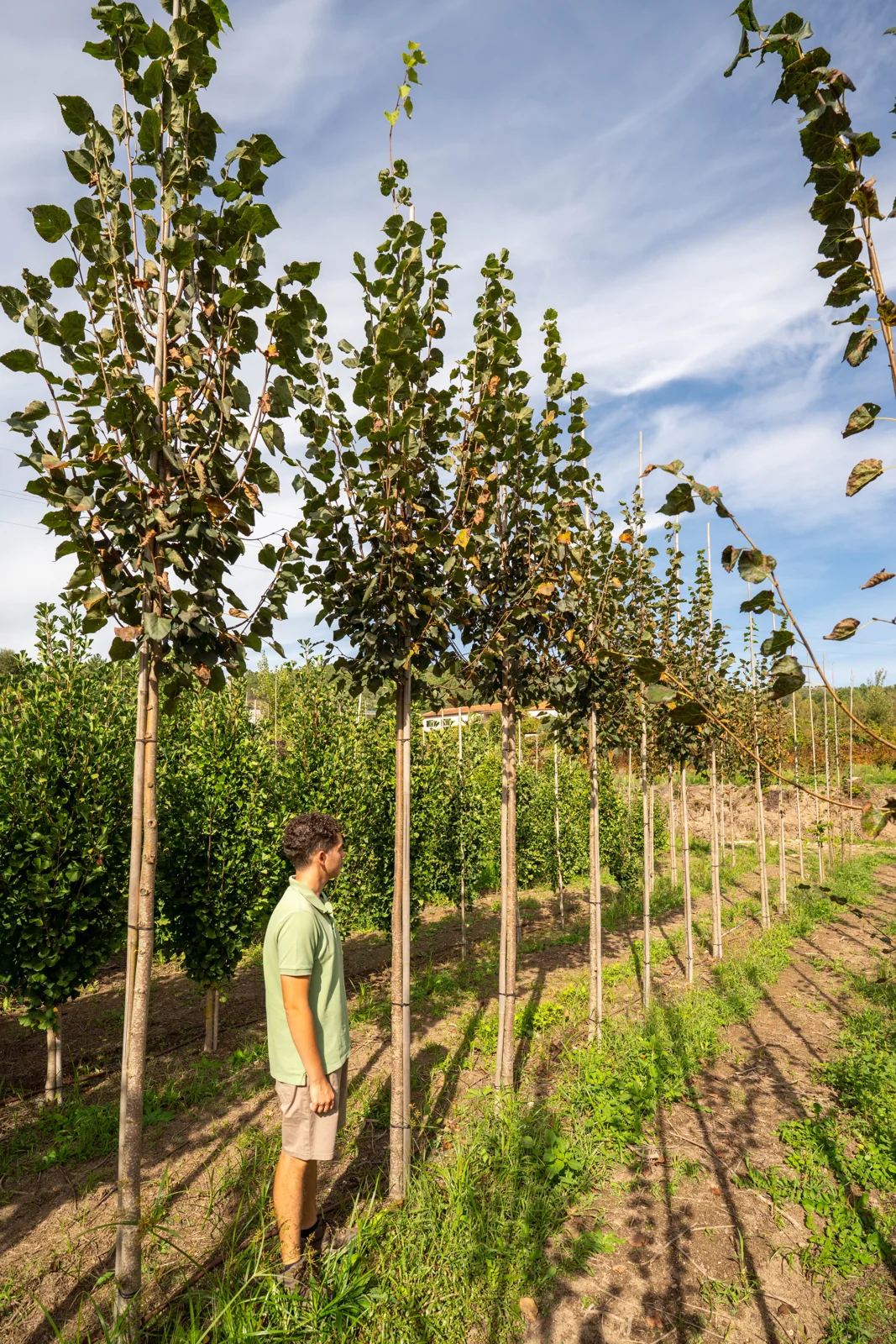
Tilia cordata 'Greenspire'Small-leaved lime
A selection of particularly uniform growth, it forms a dense, symmetrical pyramidal crown, supported by a straight central leader and ascending branches. In early summer, the dark green foliage surrounds numerous clusters of yellowish-cream flowers whose scent and abundance of nectar turn the whole tree into an important centre of activity for pollinators.
- Regular pyramidal crown that creates formal, visually uniform avenue planting
- Intensely scented summer flowering, very rich in nectar
- Leaves larger than those of the species, forming a dense, continuous mass of shade
About this cultivar
Tilia cordata ‘Greenspire’ is an American selection of the small-leaved lime, introduced by Princeton Nurseries in 1961. It was chosen for its uniform growth, its straight central leader and its ability to form a regular crown. These characteristics make its behaviour more predictable than that of seed-raised specimens of the species, an important difference in avenues and projects that depend on the repetition of trees with similar proportions.Read moreShow less
Tilia cordata ‘Greenspire’ is an American selection of the small-leaved lime, introduced by Princeton Nurseries in 1961. It was chosen for its uniform growth, its straight central leader and its ability to form a regular crown. These characteristics make its behaviour more predictable than that of seed-raised specimens of the species, an important difference in avenues and projects that depend on the repetition of trees with similar proportions.
In youth it has a narrowly pyramidal silhouette, with structural branches angled obliquely upwards. As it matures, the crown broadens and develops into an oval to ovoid shape, keeping dense, balanced branching well distributed around the trunk. It can reach approximately 12 to 20 metres in height and 7 to 10 metres in spread, depending on the soil, the climate and the space available for root development.
The leaves are simple, alternate and recognisable by their rounded shape, deeply heart-shaped base and abruptly tapered tip. In ‘Greenspire’ they are generally larger than in the species, reaching around 7 to 12 centimetres. The upper surface is dark green and slightly glossy, while the underside is a paler bluish green. The compact arrangement of the foliage creates a crown of dense shade during the summer. In autumn, the leaves turn yellow to golden tones.
Between June and July, hanging clusters of approximately five to nine pale yellow or cream flowers appear. Although each flower is small, the flowering as a whole becomes very evident through the intense scent that surrounds the crown. The high nectar production attracts bees, butterflies and other insects, and the continuous activity of pollinators can be heard beneath a mature tree in full flower.
Each flower cluster is attached to an elongated, light green bract that later helps to disperse the small fruits. These are rounded to ovoid, greyish at first and covered in a felt-like texture, becoming brown and smoother during late summer. Fruiting is discreet and does not interfere with the formal reading of the crown.
The trunk has dark brown bark, little marked at first but progressively furrowed with age. The young shoots change from green to reddish and brown tones. In winter, leaf fall reveals the ascending organisation of the branching and confirms one of the main advantages of the selection: a clear architecture maintained even without leaves.
It adapts to sun or partial shade, although a bright position favours a more compact crown and abundant flowering. It prefers fertile, moist, well-drained soils, but accepts sandy, loamy or clay textures and different pH values. Once established, it tolerates moderate periods of drought, severe cold, wind and urban conditions. In Portuguese regions with hot summers, deep watering during dry periods preserves the density of the crown and reduces early leaf fall.
Its good response to pruning makes it possible to correct the form, raise the crown progressively or integrate the tree into formal compositions. Even so, the natural architecture of ‘Greenspire’ generally requires fewer corrective interventions than unselected forms. In an urban context, a soil volume in keeping with its mature size should be ensured, along with a permeable surface sufficient for the entry of water and oxygen.
It is suited to wide avenues, tree-lined car parks, parks, prominent entrances and large gardens that call for a shade tree with an orderly appearance. It can also form part of formal compositions or regular sequences in which the repetition of the crowns sets rhythm and depth.
Diaplant’s mature specimens make the advantage of this selection especially visible. Planting already formed trees immediately brings straight trunks, matching crowns and a continuous line of shade, reducing the time needed to achieve the intended uniformity. The amount of mature wood also provides a far more expressive scented flowering from the first years of the project.
Advice on this species
Want to know more about Tilia cordata 'Greenspire'?
Tell us about your project and we will advise on this species — where it does well, what size makes sense and what to expect once it is planted.
- Own production
- Mature specimens
- Reply within 1–2 days
No obligation · tailored quote