

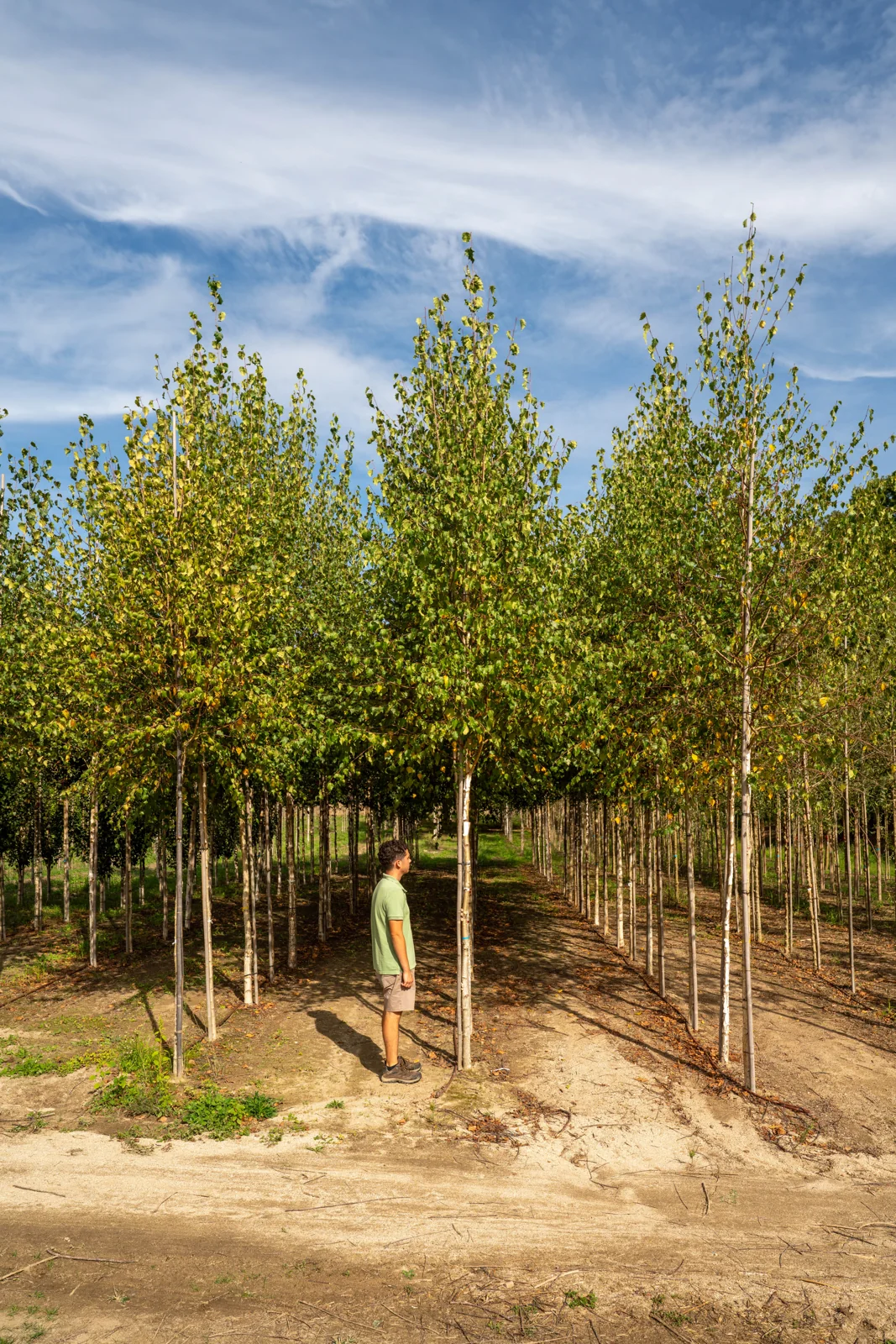
Betula pendulaSilver birch
The combination of white trunk, luminous crown and fine, clearly pendulous twigs gives Betula pendula an immediately recognisable silhouette. It is a fast-growing pioneer species, able to bring verticality without creating a heavy visual mass and to hold landscape interest all year round.
- White, lightly peeling bark, progressively contrasted by black fissures at the base
- Long, pendulous branches that give the crown movement and transparency
- Pioneer species of high value for insects, birds and natural regeneration processes
About this species
Betula pendula is a deciduous tree with a wide European and Asian distribution, particularly associated with temperate landscapes. Its pioneer character allows it to colonise open ground, clearings and mineral soils with little competition quickly. In a landscape context, this ability translates into rapid early growth and a tree presence that establishes itself visually in less time than many trees of similar size.Read moreShow less
Betula pendula is a deciduous tree with a wide European and Asian distribution, particularly associated with temperate landscapes. Its pioneer character allows it to colonise open ground, clearings and mineral soils with little competition quickly. In a landscape context, this ability translates into rapid early growth and a tree presence that establishes itself visually in less time than many trees of similar size.
It generally develops a well-defined vertical leader and a crown that is narrow and irregularly oval at first. With age, the main branches spread, while the terminal twigs remain fine and pendulous. This combination produces an open, light crown that is constantly animated by the wind. It can reach approximately 15 to 20 metres in height and 8 to 12 metres in spread, exceeding these dimensions in particularly favourable forest conditions.
The trunk is the main identifying feature of the species. On young specimens, the bark changes from brown tones to a progressively brighter white, marked by dark horizontal lenticels. It then peels away in thin, papery layers. On mature specimens, the base of the trunk becomes deeply fissured and almost black, creating a very expressive contrast with the upper part, which remains white. This transformation gives the tree interest even in winter, when its whole architecture is exposed.
The leaves are small, alternate and triangular to rhomboid, measuring approximately 3 to 6 centimetres, with a doubly serrate margin. The light green colour and small size of the leaves contribute to the transparency of the crown, letting light through and casting a dappled shade. In autumn, all the foliage takes on golden-yellow tones that heighten the contrast with the white trunk.
The species is monoecious, producing male and female catkins on the same tree. The male catkins are elongated and pendulous, turning yellowish green during spring, while the female ones are smaller and upright at first. After wind pollination, cylindrical, pendulous fruiting catkins form, releasing numerous small, winged seeds in late summer and autumn.
Betula pendula plays an ecological role far greater than the lightness of its crown suggests. The foliage provides food and support for numerous insects, while the small seeds are eaten by various seed-eating birds. The branching offers shelter and nesting sites, and the rapid colonisation of open ground creates the conditions for the later establishment of more demanding forest species.
It prefers full sun and loose soils, moist to moderately dry, especially of sandy or loamy texture. It also grows in relatively poor, acidic ground, provided the root system has sufficient oxygen. Its shallow rooting benefits from an area of open, permeable soil protected by an organic mulch. In Portugal it performs best in the North, in the Centre and in places at altitude or with moderate summers; in the hottest regions it should be planted in moist soils with regular summer watering.
It is particularly suited to parks, naturalistic gardens, woodland compositions and projects that call for a tree of great presence with little visual weight. It works well on its own on lawns, in small groups of white trunks or combined with dark vegetation that intensifies the contrast. The multi-stem form strengthens the sculptural effect and brings the composition closer to a natural birch glade.
Mature specimens from Diaplant make it possible to obtain immediately what makes this species special: white trunks already developed, visible pendulous branching and a crown sufficiently formed to create height, movement and contrast. Planting in groups of different sizes makes it possible to build from the outset a naturalised composition that, with young plants, would require several growth cycles.
Advice on this species
Want to know more about Betula pendula?
Tell us about your project and we will advise on this species — where it does well, what size makes sense and what to expect once it is planted.
- Own production
- Mature specimens
- Reply within 1–2 days
No obligation · tailored quote