

Nyssa sylvaticaTupelo
A slow-growing North American species with deciduous foliage and an autumn colour change among the most intense in the catalogue, positioned for projects on acidic soils that seek an alternative to Liquidambar styraciflua with less aggressive roots and greater tolerance of seasonal waterlogging.
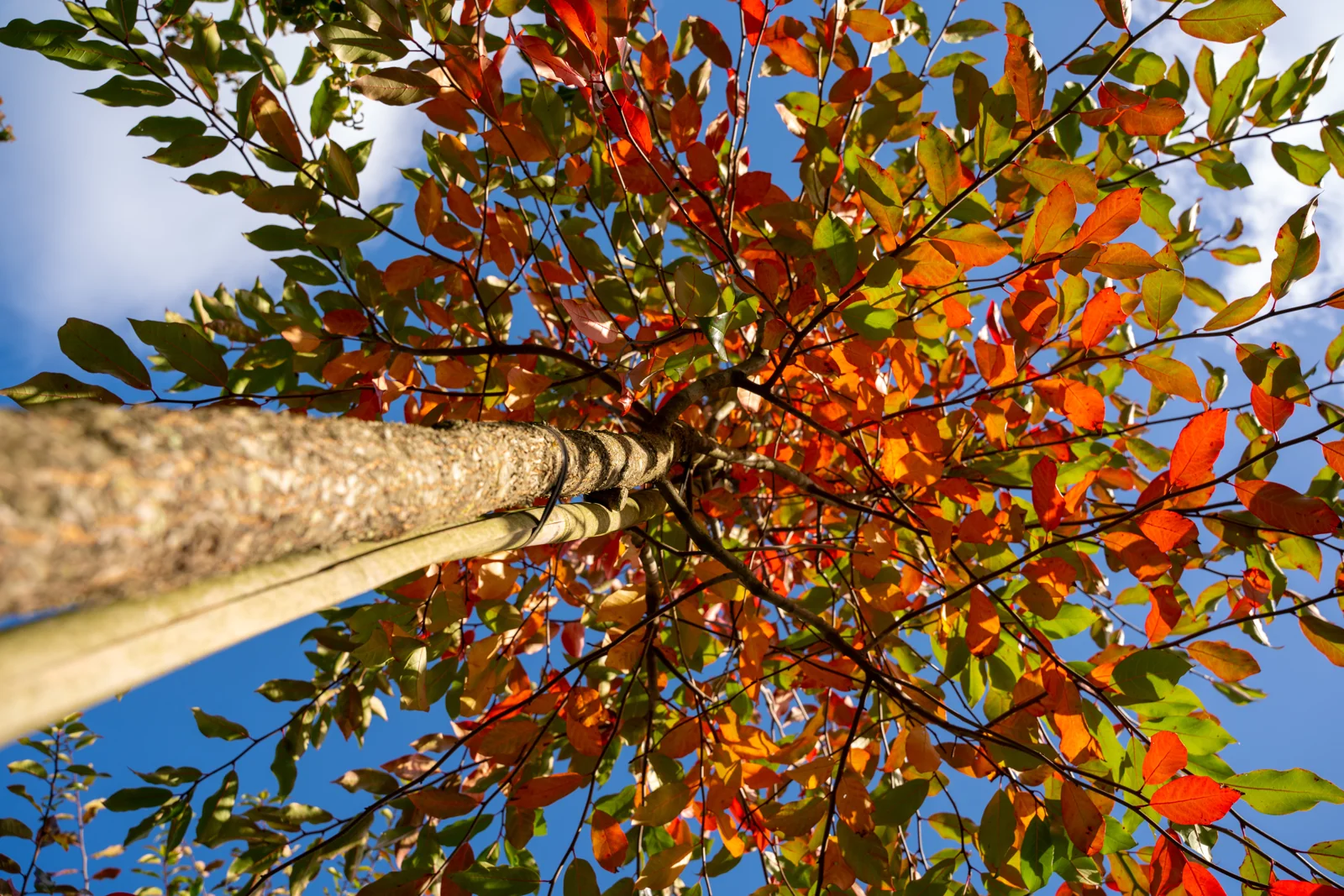
- Between October and November it turns scarlet, purple and orange on the same tree
- Saturated, lasting colour that holds for two to three weeks
- Glossy dark green foliage in layers that gives cool, dappled shade
About this species
Nyssa sylvatica has a conical to pyramidal habit, with a straight stem and lateral branching at right angles, reaching 10 to 20 m in height and 6 to 10 m in crown spread at maturity. The structured silhouette needs no intensive formative pruning and suits urban avenue plantings of medium width. In a project context, it takes the place of a Liquidambar styraciflua with the…Read moreShow less
Nyssa sylvatica has a conical to pyramidal habit, with a straight stem and lateral branching at right angles, reaching 10 to 20 m in height and 6 to 10 m in crown spread at maturity. The structured silhouette needs no intensive formative pruning and suits urban avenue plantings of medium width. In a project context, it takes the place of a Liquidambar styraciflua with the advantage of a less shallow root system and less tendency to lift paving in a tree pit.
The foliage is dense, dark green and glossy during the summer, with an autumn change that runs through yellow, orange, scarlet and purple and stays stable for two to three weeks. This colour range is one of the most reliable among the deciduous trees available on the Iberian market and is a specification criterion in municipal projects where autumn colour is valued as a functional element of public space.
The species requires acidic soil: it performs well in clay loam and sandy loam soils with a pH below 6.5, tolerates seasonal waterlogging and poor drainage, but rejects compact chalky soils. This soil requirement restricts its use in Lisbon and the inland Algarve, but makes it suitable for the Minho, western Trás-os-Montes, the Beira Litoral and areas of Greater Porto where acidic granite soils predominate. It withstands minimum temperatures of -35 °C, so winter cold in Portugal is not a limitation.
The root system is a deep taproot, which favours wind stability and reduces conflicts with underground infrastructure, but makes transplanting difficult in poorly prepared specimens. In nursery-grown trees with a well-formed rootball and trained roots, establishment is viable provided planting takes place during dormancy. Growth is slow: in favourable conditions, eight to ten years can be expected before the crown is established in a project.
Plant-health resistance is high, with no pests or diseases of significance documented in Europe. This robustness, combined with the proven longevity of the species (specimens more than 650 years old documented in its native range), gives confidence to its specification in long-term projects where the early replacement of trees represents a significant cost.
Advice on this species
Want to know more about Nyssa sylvatica?
Tell us about your project and we will advise on this species — where it does well, what size makes sense and what to expect once it is planted.
- Own production
- Mature specimens
- Reply within 1–2 days
No obligation · tailored quote