

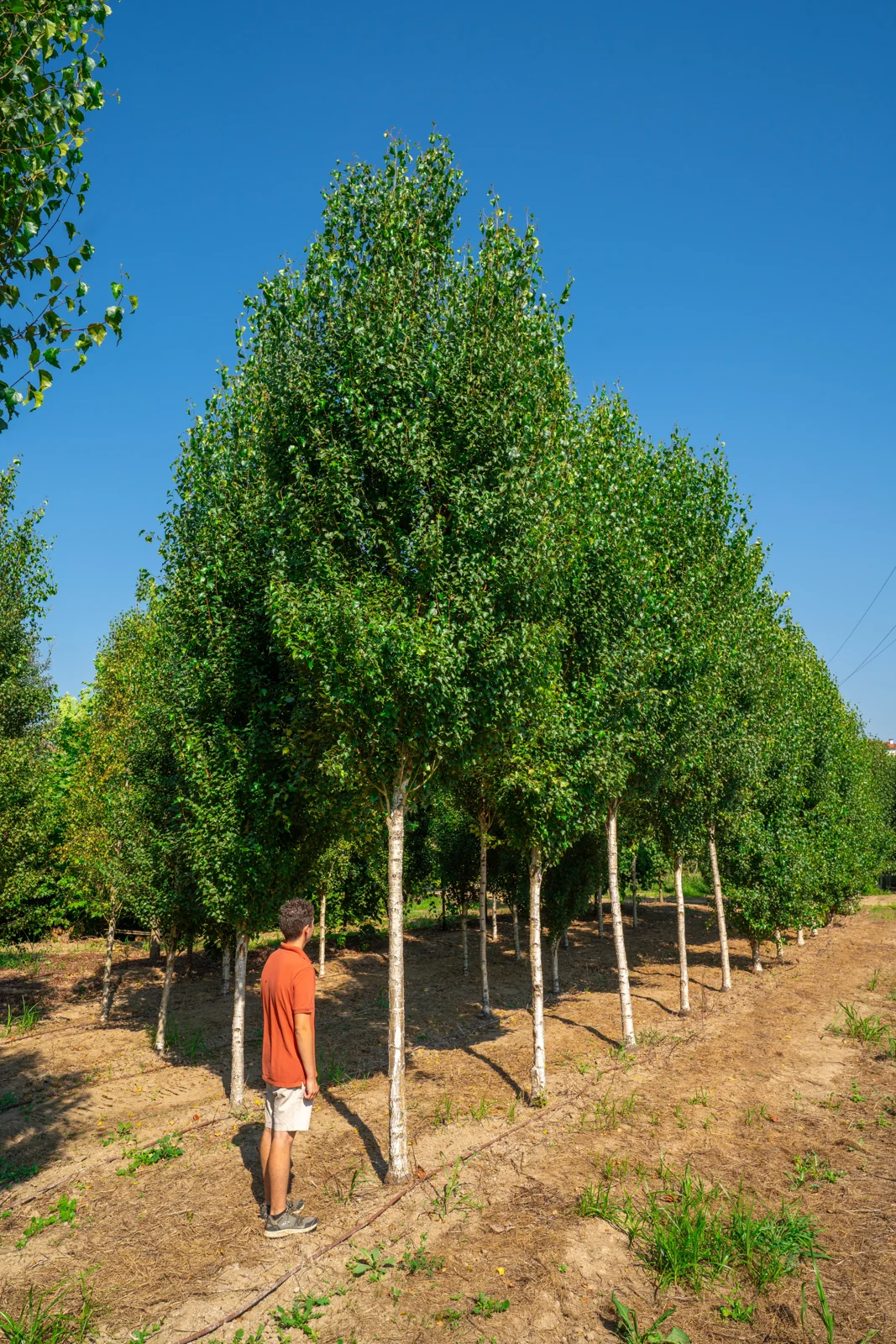
Betula pendula 'Fastigiata'Silver birch
A fastigiate cultivar of Betula pendula, suited to urban avenue planting with small tree pits, narrow dividing strips and courtyards where a vertical silhouette and white bark are wanted, performing most reliably north of the River Mondego.
- Narrow columnar crown two to four metres wide, height without width
- Silvery-white trunk that peels in fine strips, a visible focal point in winter
- Triangular leaf turns a clean yellow between mid-October and November
About this cultivar
It differs from the straight species in its narrow columnar crown, 2 to 4 m wide by 10 to 15 m tall in cultivation in Portugal, while keeping the silvery-white bark that peels in fine strips and is a diagnostic mark of the genus. The fastigiate habit needs no formative pruning to contain lateral growth, which makes it a relevant alternative…Read moreShow less
It differs from the straight species in its narrow columnar crown, 2 to 4 m wide by 10 to 15 m tall in cultivation in Portugal, while keeping the silvery-white bark that peels in fine strips and is a diagnostic mark of the genus. The fastigiate habit needs no formative pruning to contain lateral growth, which makes it a relevant alternative to Populus nigra 'Italica' in situations that call for verticality without the aggressive root system and short lifespan of the Lombardy poplar, and it covers parts of the brief that the Italian cypress cannot fill because it is evergreen.
It performs most reliably north of the River Mondego and at altitude inland, where moist soils and a shorter summer match its Euro-Siberian ecology. Heat tolerance is low and drought tolerance only moderate, so projects in the interior of the Alentejo or on the Algarve coast require continued maintenance watering and a position protected from full afternoon sun. It adapts to acidic, sandy and clay soils, with a clear preference for moist, well-drained substrates; prolonged waterlogging compromises establishment.
The shallow, fibrous root system is compatible with urban tree pits of ordinary size and does not lift paving with the aggressiveness of planes or poplars, although it needs moisture available in the root zone during the long dry summer. Resistant to pests and diseases to an average degree for the genus, it should not be planted where there is chronic water stress, a condition that in other regions predisposes birch to borer attack and premature defoliation; the choice of site therefore matters more than the plant-health calendar.
The light green triangular foliage turns bright yellow in late autumn, a cycle that remains stable in Atlantic conditions and offers colour interest that can be coordinated with evergreen foliage. In winter, the white stem set alone against a dark background anchors the reading of the composition, a role that can be specified in squares, institutional atria and central reservations where the bare silhouette is drawn as a design element.
Advice on this species
Want to know more about Betula pendula 'Fastigiata'?
Tell us about your project and we will advise on this species — where it does well, what size makes sense and what to expect once it is planted.
- Own production
- Mature specimens
- Reply within 1–2 days
No obligation · tailored quote