

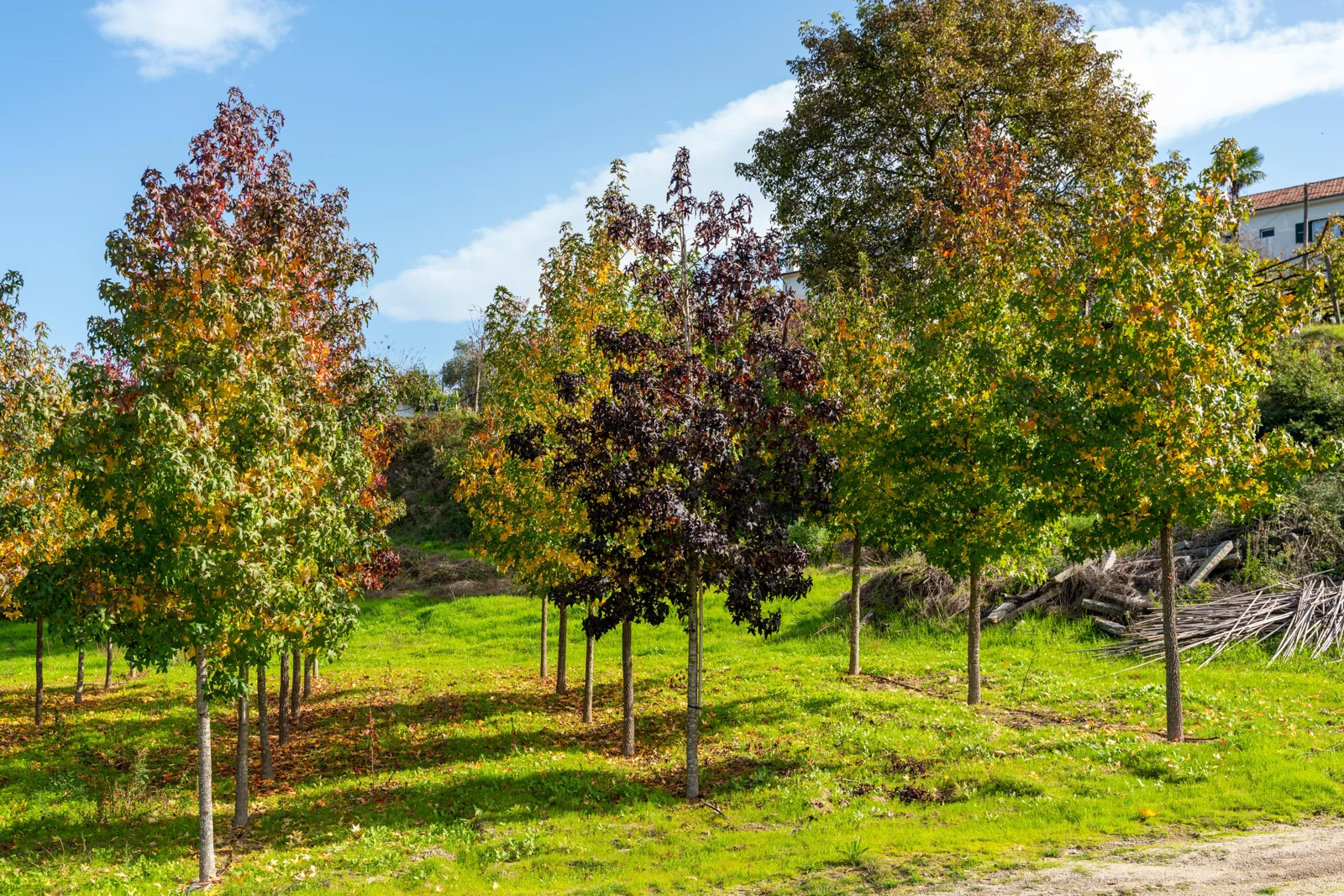
Liquidambar styracifluaSweetgum
A conical-crowned species for projects that require stable autumn colour in avenue planting or as a structural group, particularly where the soil is acidic to neutral and well drained and the mature size can be accommodated at generous spacing.
- Foliage that turns red, purple and orange through a long autumn
- Colour that holds on the tree for weeks on end, until December
- Star-shaped palmate leaf, with a resinous scent when crushed
About this species
In cultivation it reaches 15 to 25 m, with an initially conical habit that rounds into an egg shape after the first years, and a straight stem that accepts formative pruning for classic avenue planting. The palmate leaf of five to seven lobes, glabrous and glossy, turns in stages through yellow, orange, red and purple, extending autumn interest for several weeks in…Read moreShow less
In cultivation it reaches 15 to 25 m, with an initially conical habit that rounds into an egg shape after the first years, and a straight stem that accepts formative pruning for classic avenue planting. The palmate leaf of five to seven lobes, glabrous and glossy, turns in stages through yellow, orange, red and purple, extending autumn interest for several weeks in Atlantic conditions. Where Acer is the automatic reflex for autumn colour, sweetgum offers a taller, more regular silhouette, with a mature size compatible with medium to large-scale avenues and parks.
It prefers deep, moist, acidic to neutral soils, and copes well with heavy clay soils and seasonal waterlogging, a legacy of the riparian floodplains it comes from. In compact chalky soils, typical of many housing developments in the Lisbon belt, it establishes poorly and develops iron chlorosis; in those conditions the specification should fall back on another species. It is hardy well below Portuguese minimum temperatures, so stress in Portugal comes from summer and soil, not winter; in severe drought it drops its leaves early and the autumn colour comes out dull.
The root system is shallow and spreading, with a documented tendency to lift paving when planted in a narrow tree pit or close to buildings; the recommended minimum spacing is 5 to 6 m in street planting. The dry, spiny fruit (gumball) falls between December and April and is a real drawback in pedestrian squares, playgrounds and barefoot circulation areas, so the species works better in a group, on a slope or in avenue planting over lawn than in a consolidated urban centre. Where the fruit rules it out, there are sterile cultivars such as 'Rotundiloba' that keep the colour without producing balls.
The plant-health profile is untroubled in the Portuguese context: it is not included in the Xylella demarcations and shares no hosts with ash dieback or with canker stain of plane, making it defensible as an autumn-colour alternative in avenue plantings where pressure on the genus Platanus advises against new planting. Growth is medium to fast in suitable soil, with a functional crown in a square or avenue from the fifth year after planting an already formed specimen.
Advice on this species
Want to know more about Liquidambar styraciflua?
Tell us about your project and we will advise on this species — where it does well, what size makes sense and what to expect once it is planted.
- Own production
- Mature specimens
- Reply within 1–2 days
No obligation · tailored quote