

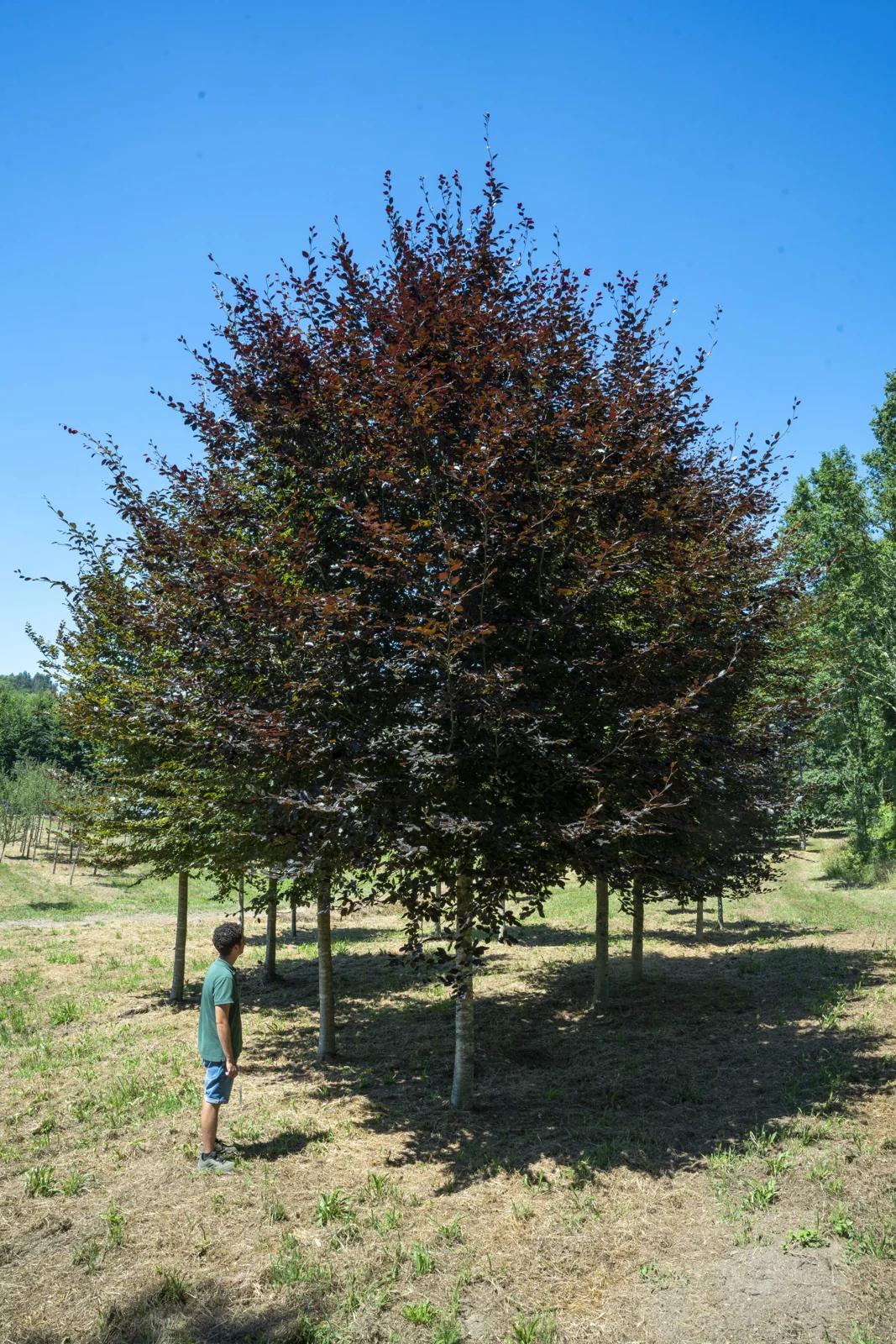
Fagus sylvatica 'Atropurpureum'European beech
The European beech in its dark-leaved version: intense purple in spring, deep all summer, copper and scarlet in autumn. A broad, dense crown on a smooth grey trunk, for a specimen tree in large gardens, parks and estates in the North and the cool interior.
- Intense purple leaf in spring that turns copper and scarlet in autumn
- Broad, dense crown, 20 to 25 metres at maturity, for a specimen tree
- Needs a cool climate and deep soil, with low drought tolerance
About this cultivar
The copper beech is the European beech in its dark-leaved version, and it is for that foliage that it is planted. The leaves, ovate and glossy, open an intense purple in spring, hold that deep tone all summer and turn copper and scarlet red in autumn. The crown is broad, rounded and dense, carried on a straight, smooth trunk with grey bark that gains a presence of its own in winter.
It is a tree that asks for space and time. It grows at a slow to moderate rate and, when mature, reaches 20 to 25 metres in height by 12 to 18 metres in spread, so it is intended for large gardens, parks and estates where the crown can open out without constraint. As a single specimen, on a lawn or against a mass of green foliage, is where the contrast of the purple leaf reads best.
The beech is, by nature, a tree of cool, humid climates, and that is the first thing to consider. It prefers deep, fertile, well-drained soils, and does best where the summer is neither too dry nor too hot: the northern coast and the estates of the inland Douro offer it conditions close to ideal. In Greater Lisbon, on the Silver Coast or in the cooler strip of the western Algarve it can be grown in a sheltered position, with partial shade in the hottest hours and supplementary watering in the first summers, while it establishes.
Drought tolerance is low, and in the hot, dry areas of the interior or the central Algarve it only thrives with regular watering throughout the life of the tree. On the other hand, it withstands cold well and, once established in the right place, needs little maintenance. The discreet triangular fruits, the beechnuts, feed wildlife, and the purple foliage remains decorative from April to November, closing the season with one of the most drawn-out colour transitions in the garden.
Read moreShow less
The copper beech is the European beech in its dark-leaved version, and it is for that foliage that it is planted. The leaves, ovate and glossy, open an intense purple in spring, hold that deep tone all summer and turn copper and scarlet red in autumn. The crown is broad, rounded and dense, carried on a straight, smooth trunk with grey bark that gains a presence of its own in winter.
It is a tree that asks for space and time. It grows at a slow to moderate rate and, when mature, reaches 20 to 25 metres in height by 12 to 18 metres in spread, so it is intended for large gardens, parks and estates where the crown can open out without constraint. As a single specimen, on a lawn or against a mass of green foliage, is where the contrast of the purple leaf reads best.
The beech is, by nature, a tree of cool, humid climates, and that is the first thing to consider. It prefers deep, fertile, well-drained soils, and does best where the summer is neither too dry nor too hot: the northern coast and the estates of the inland Douro offer it conditions close to ideal. In Greater Lisbon, on the Silver Coast or in the cooler strip of the western Algarve it can be grown in a sheltered position, with partial shade in the hottest hours and supplementary watering in the first summers, while it establishes.
Drought tolerance is low, and in the hot, dry areas of the interior or the central Algarve it only thrives with regular watering throughout the life of the tree. On the other hand, it withstands cold well and, once established in the right place, needs little maintenance. The discreet triangular fruits, the beechnuts, feed wildlife, and the purple foliage remains decorative from April to November, closing the season with one of the most drawn-out colour transitions in the garden.
Advice on this species
Want to know more about Fagus sylvatica 'Atropurpureum'?
Tell us about your project and we will advise on this species — where it does well, what size makes sense and what to expect once it is planted.
- Own production
- Mature specimens
- Reply within 1–2 days
No obligation · tailored quote