

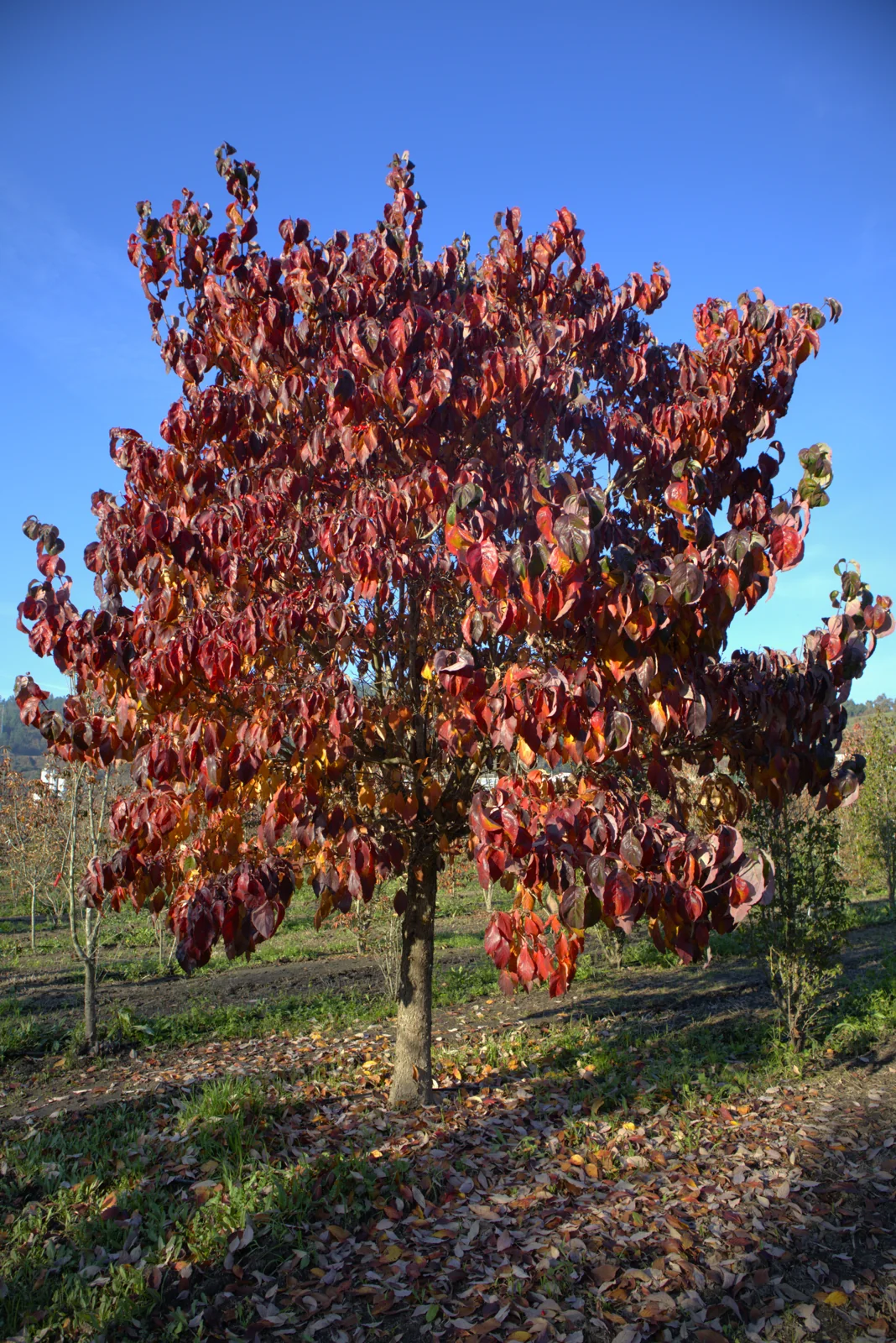
Cornus floridaFlowering dogwood
Native to eastern North America, Cornus florida announces spring by covering its still sparsely leaved crown with four large white bracts, recognisable by their notched tip. Red fruits follow, then a scarlet to violet autumn colour and, in mature specimens, a finely chequered bark.
- Early white flowering, before the foliage in late winter, forming a white cloud in full bloom
- Fruits made up of separate red drupes, distinct from the aggregate fruits of Cornus kousa
- Foliage that turns wine-red and purple in late October
About this species
Cornus florida forms a large shrub or a slow-growing small tree, often with several stems. The crown, high at first, becomes rounded and progressively broader, generally reaching 4 to 7 metres in height and 4 to 6 metres in spread.Read moreShow less
Cornus florida forms a large shrub or a slow-growing small tree, often with several stems. The crown, high at first, becomes rounded and progressively broader, generally reaching 4 to 7 metres in height and 4 to 6 metres in spread.
In early spring, before the foliage has fully developed, small yellowish-green flowers open, gathered at the centre of four large bracts. These are generally white, sometimes slightly pink, and have a small notch at the tip. Spread along the branches, they create the appearance of a crown covered in very large flowers.
After flowering, clusters of oval, glossy, scarlet-red drupes appear. The dark green leaves take on intense tones of red, crimson and violet in autumn. With maturity, the grey bark begins to break into small plates, extending the ornamental interest after leaf fall.
It prefers gentle sun or partial shade and a humus-rich soil, acidic to neutral, moist and well drained. The shallow root system benefits from an organic mulch, which conserves moisture and keeps the root zone protected during the hottest periods.
It is suited as a single specimen, beside entrances, in gardens of naturalistic inspiration or under the partial protection of larger trees. A mature specimen from Diaplant immediately brings a broad, branched crown, flower buds already formed and enough maturity to produce expressive flowering, ornamental fruits and a strong autumn transformation.
Advice on this species
Want to know more about Cornus florida?
Tell us about your project and we will advise on this species — where it does well, what size makes sense and what to expect once it is planted.
- Own production
- Mature specimens
- Reply within 1–2 days
No obligation · tailored quote