

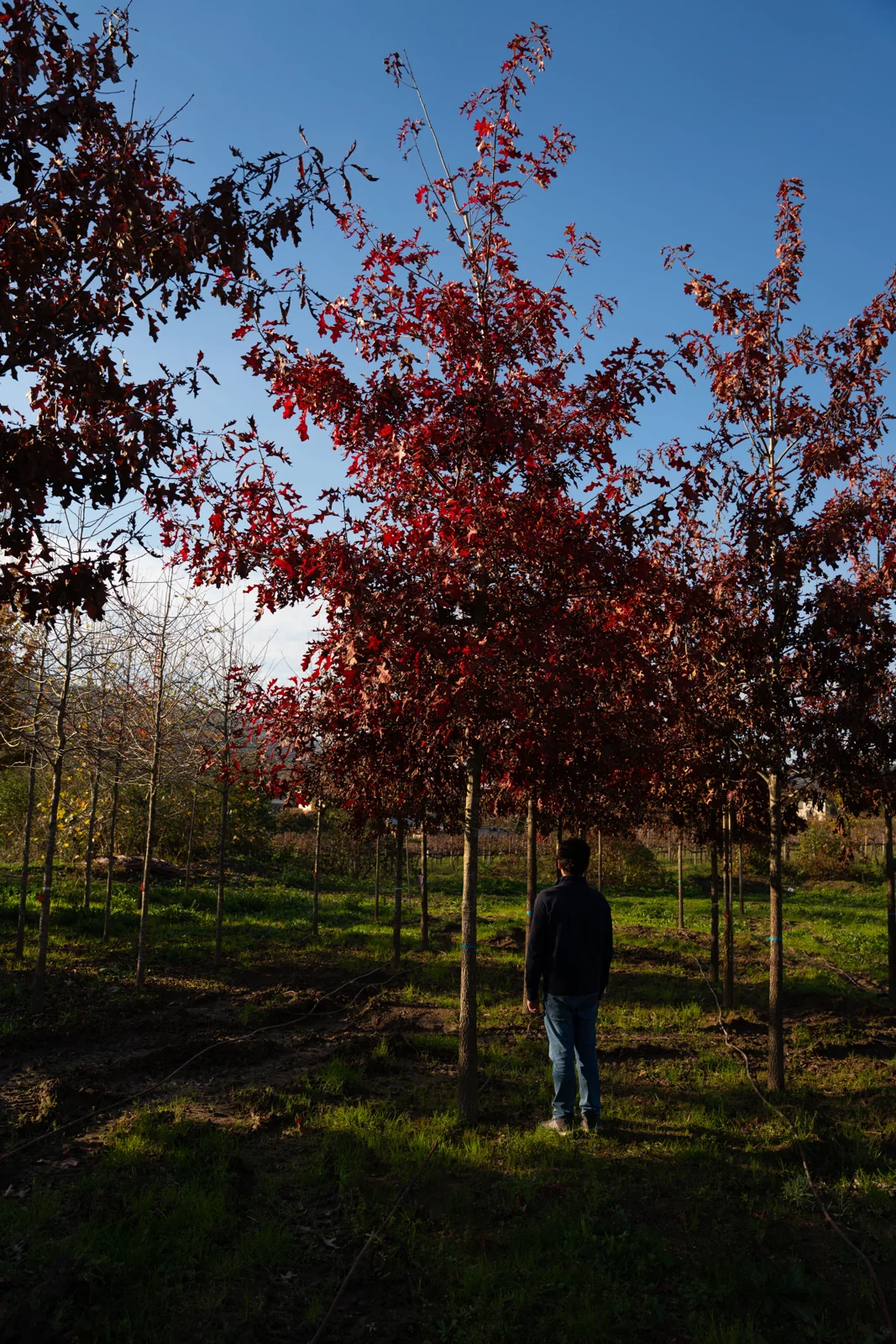
Quercus coccineaScarlet oak
It is sought after for the most intense autumn colour in the red oak section: a rounded, open crown, light shade that allows underplanting, and good performance in acidic, free-draining soils where the plane or the lime offer no seasonal interest.
- Scarlet autumn colour, late, lasting six to eight weeks
- Open, deeply cut crown that lets shrubs and planting grow beneath
- Establishes quickly for an oak, with glossy, finely lobed summer foliage
About this species
In a wide avenue planting, a square or an urban lawn it fills the functional role of a Quercus rubra or a shade plane, but stands apart for its more open crown and dappled shade, which lets through enough light to sustain a shrub planting or underplanting at its base. The rounded, spreading crown calls for lateral space: it is a tree for the urban park, for…Read moreShow less
In a wide avenue planting, a square or an urban lawn it fills the functional role of a Quercus rubra or a shade plane, but stands apart for its more open crown and dappled shade, which lets through enough light to sustain a shrub planting or underplanting at its base. The rounded, spreading crown calls for lateral space: it is a tree for the urban park, for single planting in a lawn or for a broad avenue, not for a confined street planting.
The argument for specifying it is the autumn colour. The foliage, glossy and dark green in summer, turns vivid scarlet, later than most oaks, and holds for six to eight weeks. The intensity depends on provenance: well-selected specimens guarantee the colour that justifies the species in a specification, whereas unselected seed-raised material can colour unevenly.
Its main technical advantage lies in its soil tolerance. It prefers acidic, sandy, dry soils, but tolerates heavier soils provided they are well drained, and unlike the related Quercus palustris it does not develop marked chlorosis on chalky soils, which widens the range of sites where it can be planted. It does not cope with prolonged waterlogging or poor drainage, a condition to be checked before specifying.
It withstands cold well below -10 °C, so winter stress is not a limiting factor in Portuguese conditions; drought tolerance is moderate, requiring supplementary watering in the first summers and in hot inland situations. Tolerance of salt spray is low, which makes shelter advisable on an exposed seafront. In practical terms, its growth is among the fastest of the oaks, reaching the size of a shade tree within a reasonable time for the species.
Unlike the plane with canker stain or the ash with ash dieback, it is under no recognised plant-health pressure in the Portuguese market, which makes it a defensible alternative where those genera are compromised. The taproot system, with few lateral roots, demands a well-prepared and stabilised rootball at transplanting, a requirement that controlled growing-on in the nursery takes care of.
Advice on this species
Want to know more about Quercus coccinea?
Tell us about your project and we will advise on this species — where it does well, what size makes sense and what to expect once it is planted.
- Own production
- Mature specimens
- Reply within 1–2 days
No obligation · tailored quote