

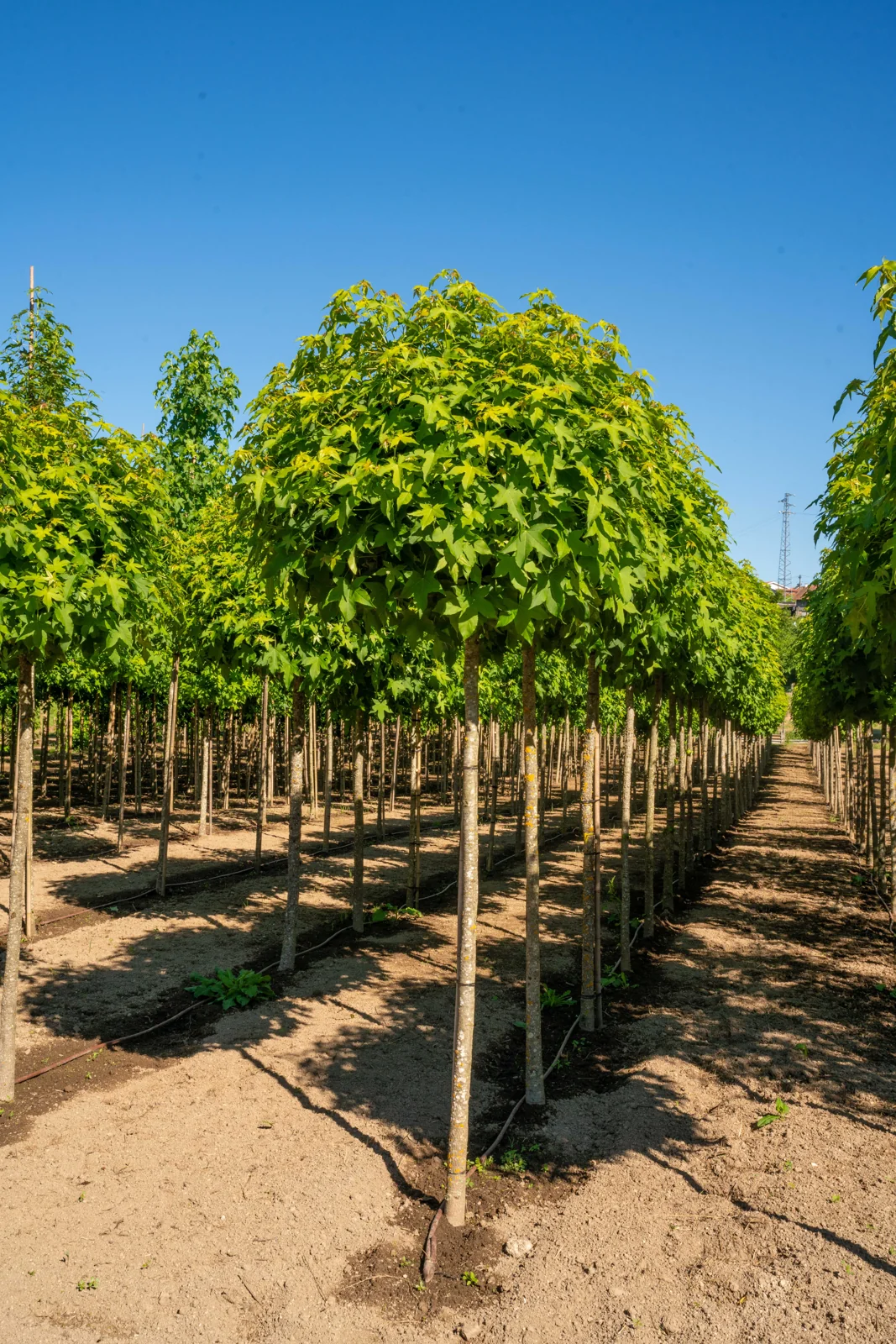
Liquidambar styraciflua 'Globosum'Sweetgum
A compact form of sweetgum, with a spherical crown that shapes itself and stays at 3 to 5 metres for decades. The same palmate leaf and the same autumn in layers of yellow, orange, red and purple, on a scale that fits narrow streets, courtyards and beds beside the house.
- Spherical crown of 3 to 5 metres that needs no formative pruning
- Autumn in yellow, orange, red and purple, from late October to mid-November
- Tolerates urban pollution and fits narrow streets and courtyards
About this cultivar
'Globosa' is one of the few forms of sweetgum that truly fits in a private garden. The crown grows dense, rounded and symmetrically closed without the owner having to train it; it reaches three to five metres in height and a similar width, staying at that scale for decades. It has the presence of a finished tree, not of an overgrown shrub, which makes it useful where a full-sized sweetgum would be out of proportion.
The foliage is the same as that of the species: palmate, deeply lobed leaves, glossy green in spring and summer. Between late October and mid-November they turn in layers of yellow, orange, red and purple, often on the same tree at the same time, and stay in the crown until the first winter rains. The intensity of the colour depends on full exposure to the sun, and falls noticeably in partial shade.
It performs well in the areas where most Diaplant customers plant: Greater Lisbon, Sintra, Cascais, the Alentejo coast, the Costa de Prata and the coast of Greater Porto. It needs moist, well-drained soil, slightly acidic or neutral, and responds poorly to heavy chalk and prolonged dryness. Drought tolerance is moderate: after three summers established it withstands short periods without watering, but in the drier Algarve and the Alentejo interior it requires regular supplementary watering to maintain foliage and colour.
It grows slowly, especially in the first years after planting, and needs no formative pruning because the crown shapes itself. It tolerates urban pollution well, which makes it suitable for narrow streets, enclosed courtyards and beds beside the house. It produces the spherical, spiny fruits typical of the genus, which fall between December and April; it is worth choosing the position with this in mind, especially near a lawn or a pavement.
Read moreShow less
'Globosa' is one of the few forms of sweetgum that truly fits in a private garden. The crown grows dense, rounded and symmetrically closed without the owner having to train it; it reaches three to five metres in height and a similar width, staying at that scale for decades. It has the presence of a finished tree, not of an overgrown shrub, which makes it useful where a full-sized sweetgum would be out of proportion.
The foliage is the same as that of the species: palmate, deeply lobed leaves, glossy green in spring and summer. Between late October and mid-November they turn in layers of yellow, orange, red and purple, often on the same tree at the same time, and stay in the crown until the first winter rains. The intensity of the colour depends on full exposure to the sun, and falls noticeably in partial shade.
It performs well in the areas where most Diaplant customers plant: Greater Lisbon, Sintra, Cascais, the Alentejo coast, the Costa de Prata and the coast of Greater Porto. It needs moist, well-drained soil, slightly acidic or neutral, and responds poorly to heavy chalk and prolonged dryness. Drought tolerance is moderate: after three summers established it withstands short periods without watering, but in the drier Algarve and the Alentejo interior it requires regular supplementary watering to maintain foliage and colour.
It grows slowly, especially in the first years after planting, and needs no formative pruning because the crown shapes itself. It tolerates urban pollution well, which makes it suitable for narrow streets, enclosed courtyards and beds beside the house. It produces the spherical, spiny fruits typical of the genus, which fall between December and April; it is worth choosing the position with this in mind, especially near a lawn or a pavement.
Advice on this species
Want to know more about Liquidambar styraciflua 'Globosum'?
Tell us about your project and we will advise on this species — where it does well, what size makes sense and what to expect once it is planted.
- Own production
- Mature specimens
- Reply within 1–2 days
No obligation · tailored quote