

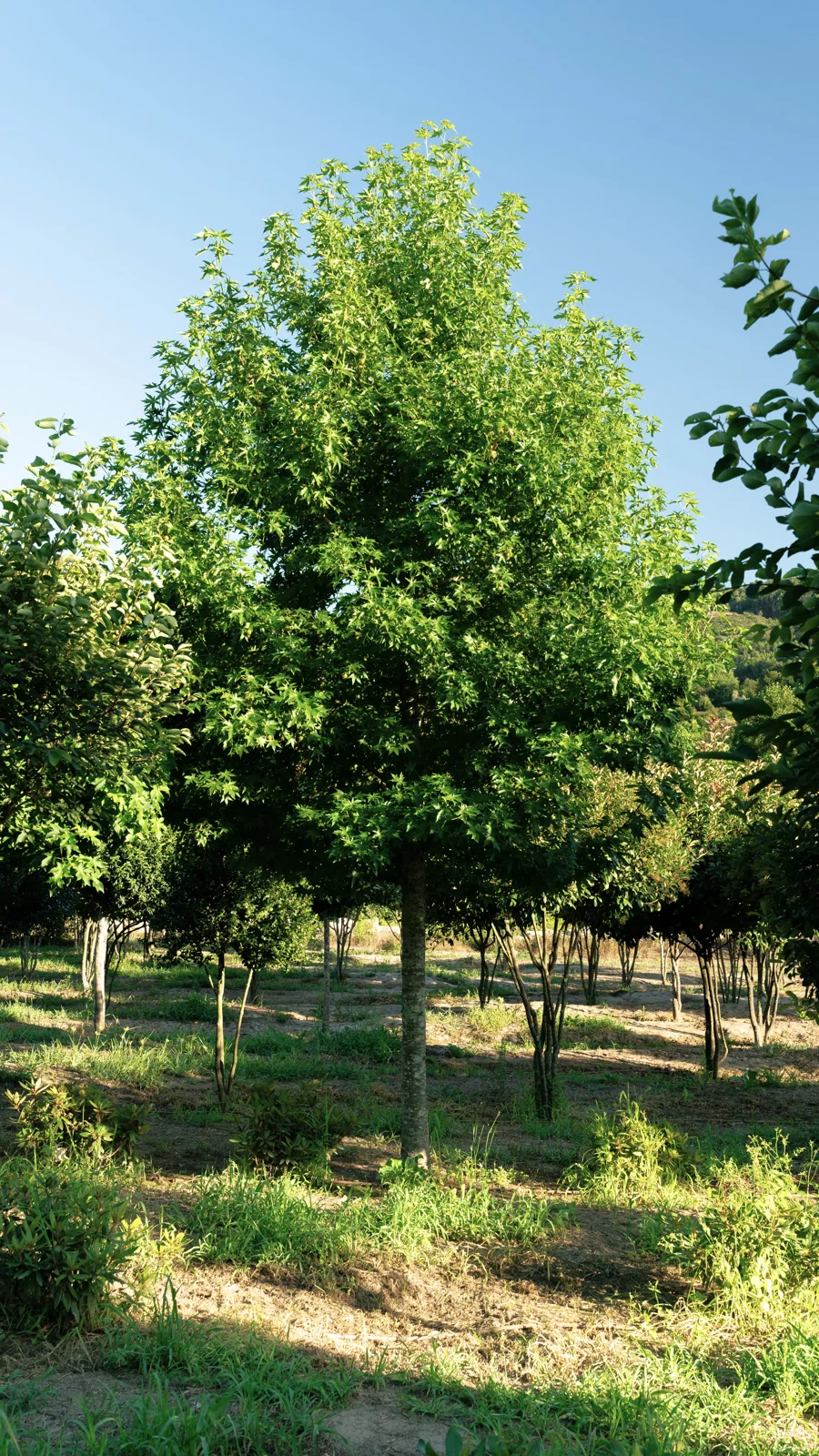
Liquidambar styraciflua 'Worplesdon'Sweetgum
A cultivar of Liquidambar styraciflua chosen for street planting and avenues that call for a narrow pyramidal silhouette, an ascending crown and reliable autumn colour, without the lateral spread that limits the straight species in a tree pit.
- Early, consistent autumn colour in orange, red and purple
- Compact pyramidal crown, 6 to 8 metres in spread for 15 to 20 in height
- Deeply lobed palmate leaves, a light texture in high summer
About this cultivar
It differs from the straight species in its markedly pyramidal, upright crown, with a mature height of 15 to 20 m and a spread of only 6 to 8 m, which frees the cultivar for avenue planting along streets, central reservations and squares where a sweetgum with a more open crown would lose technical margin. The palmate, deeply lobed leaf turns red, orange and…Read moreShow less
It differs from the straight species in its markedly pyramidal, upright crown, with a mature height of 15 to 20 m and a spread of only 6 to 8 m, which frees the cultivar for avenue planting along streets, central reservations and squares where a sweetgum with a more open crown would lose technical margin. The palmate, deeply lobed leaf turns red, orange and purple in a colour display that is earlier and more consistent than in the species, lasting in Atlantic conditions until the end of November.
It performs well in the fertile, moist, well-drained soils of the Minho and the central coast, and tolerates a wide range of pH, including sandy and clay soils; in compact chalky soils it may show iron chlorosis, so prior soil confirmation is recommended in projects south of the Tagus. It sustains prolonged summer heat in Lisbon and on the Algarve coast provided it has a generous tree pit and establishment watering in the first three summers. Hardiness extends to around -20 °C, with no documented winter stress in any Portuguese region.
It is resistant to urban pollution and to fire in a landscape context, and the relatively shallow root system calls for a tree pit of 1.5 m or larger, or clear separation from underground services, to avoid interference with paving after two decades. It is under no significant plant-health pressure in Portugal and does not need the kind of scheduled plant-health programme required by Platanus or Fraxinus.
Growth is moderate, with establishment helped by a rootball consolidated over successive growing-on seasons; in favourable conditions it reaches project girth size in five to seven years from planting. The spiny, globular fruit remains on the tree through the winter, which is an additional ornamental interest but justifies caution in busy pedestrian areas, where its fall between December and April creates a need for additional sweeping.
Advice on this species
Want to know more about Liquidambar styraciflua 'Worplesdon'?
Tell us about your project and we will advise on this species — where it does well, what size makes sense and what to expect once it is planted.
- Own production
- Mature specimens
- Reply within 1–2 days
No obligation · tailored quote