

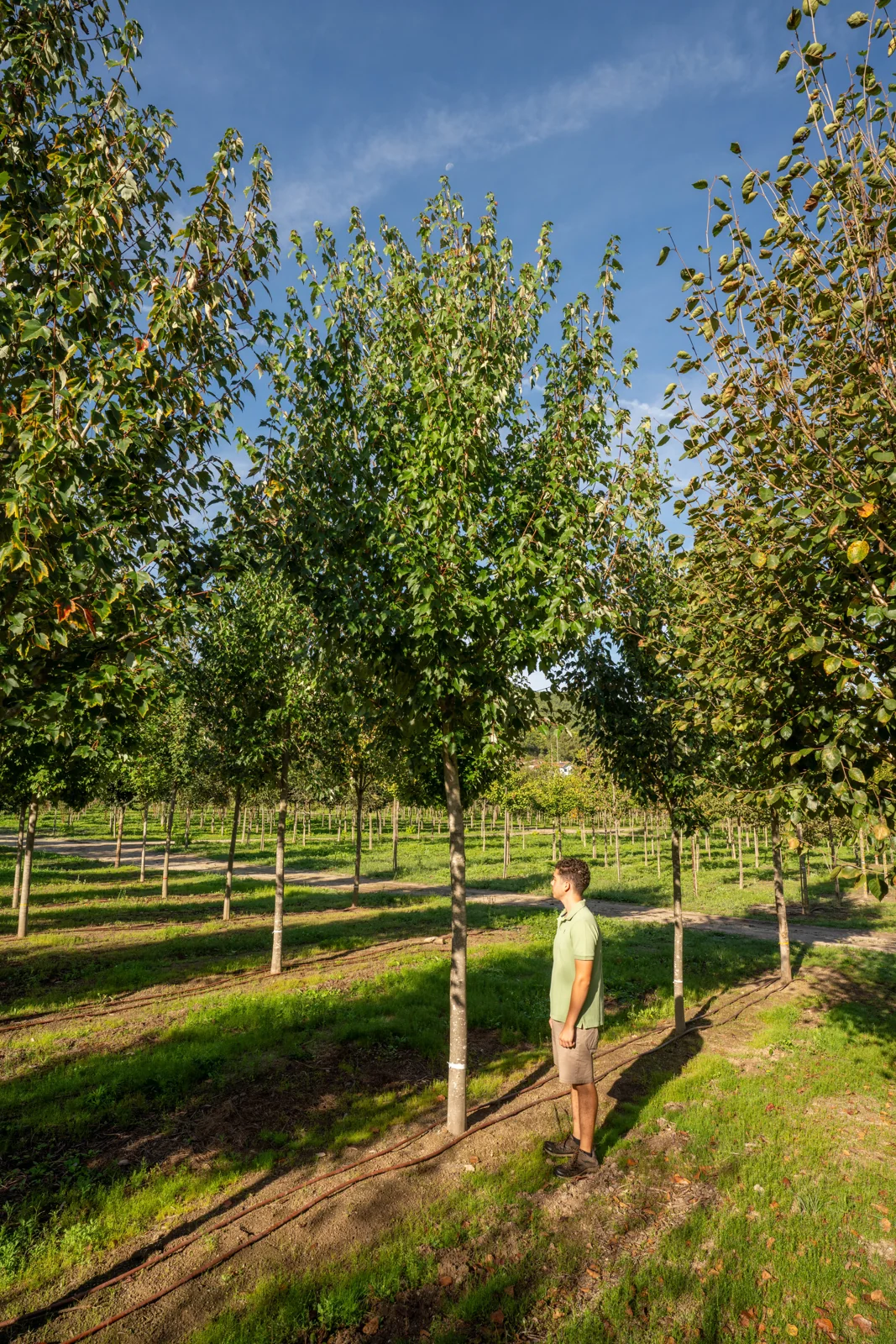
Acer rubrumRed maple
A medium to large maple, specified by landscape architects in parks, university campuses and residential streets on the acidic soils of the North and Centre, whenever the overriding criterion is the reliability of the scarlet autumn turn.
- Foliage that turns a dense scarlet in late October
- Autumn colour that holds on the tree for weeks on end
- Red flowers in March, before the leaves, along the branches
About this species
In avenue planting and in groups, Acer rubrum occupies a place close to the sycamore (Acer pseudoplatanus), with a more regular silhouette under formative pruning and an ascending oval crown that develops into a rounded form in the mature specimen. In European cultivation it reaches 18 to 25 m in height, with a straight stem and orderly branching, and tolerates crown lifting well to provide…Read moreShow less
In avenue planting and in groups, Acer rubrum occupies a place close to the sycamore (Acer pseudoplatanus), with a more regular silhouette under formative pruning and an ascending oval crown that develops into a rounded form in the mature specimen. In European cultivation it reaches 18 to 25 m in height, with a straight stem and orderly branching, and tolerates crown lifting well to provide clearance for traffic in street planting.
The decisive technical point with this species is its soil requirement: it performs reliably only in acidic to slightly acidic soils, showing iron and manganese chlorosis in chalky or high-pH soils, with a progressive loss of vigour and autumn colour. This characteristic defines where it can be used in Portugal: the granite and schist soils of the Minho, the Beira interior and Trás-os-Montes offer ideal conditions, while the compact limestones of Estremadura and the coastal Algarve require prior soil correction or rule the species out.
It tolerates seasonal waterlogging well, a trait inherited from its riparian habitat in eastern North America, which makes it useful in slow-draining areas and on the banks of permanent watercourses. Tolerance of summer drought is moderate and improves after the third year in moist, acidic conditions, but it still needs maintenance watering in a prolonged summer inland. It withstands, without damage, minimum temperatures well below those recorded in mainland Portugal. Tolerance of salt spray is moderate, sufficient for urban streets on the coast but not for the exposed Atlantic seafront.
Flowering comes before the leaves in early spring, in small, showy red clusters on bare wood, followed by samaras that are also reddish. The summer foliage is mid-green and dense, giving the full shade of a closed crown from the fifth year in a favourable situation. The autumn turn is the central argument for specifying it: an intense, stable scarlet red, more reliable than that of any other large maple planted in Europe, lasting until the end of November in Atlantic conditions. In a municipal project where the specification calls for autumn colour, it is one of the few species that delivers on that criterion with low variability between specimens.
Advice on this species
Want to know more about Acer rubrum?
Tell us about your project and we will advise on this species — where it does well, what size makes sense and what to expect once it is planted.
- Own production
- Mature specimens
- Reply within 1–2 days
No obligation · tailored quote