

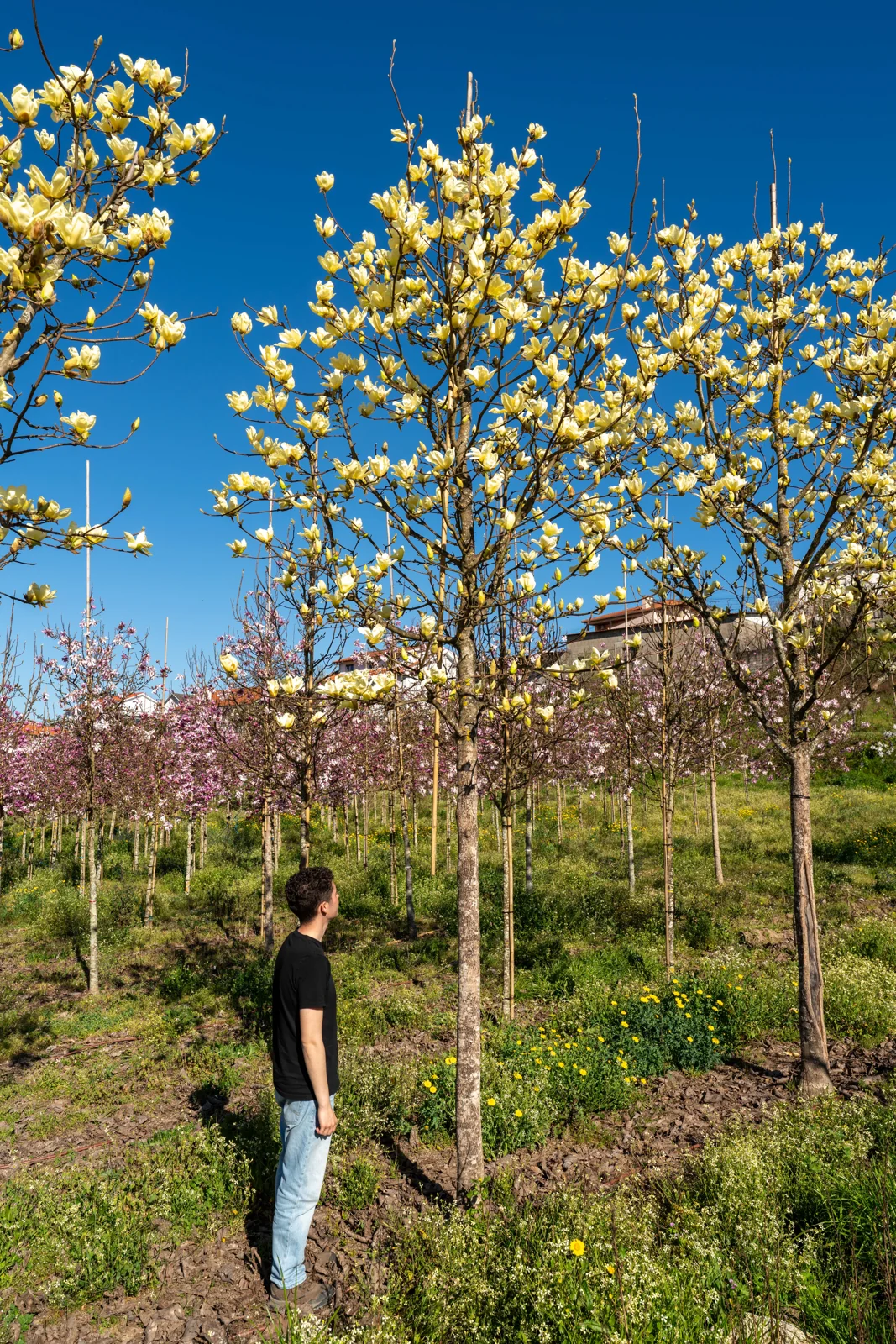
Magnolia denudata 'Yellow River'Yulan magnolia
Selected for its creamy-yellow flowering, rare in the genus, which appears before the leaves emerge. Its contained size and rounded crown make this cultivar a focal specimen in spaces where large-growing magnolias do not fit.
- Large cup-shaped flowers, in a luminous pale yellow that is almost cream
- They open between February and April, before the tree comes into leaf
- Lightly scented, they announce spring weeks earlier
About this cultivar
'Yellow River' differs from the straight species in the colour of its flowers and in its smaller size. While M. denudata reaches 8 to 12 m in height with a spreading crown, this cultivar settles at 6 to 8 m in height by 3 to 5 m in spread, with a rounded crown and a short stem. This difference in scale is decisive in specification: it allows it to be used…Read moreShow less
'Yellow River' differs from the straight species in the colour of its flowers and in its smaller size. While M. denudata reaches 8 to 12 m in height with a spreading crown, this cultivar settles at 6 to 8 m in height by 3 to 5 m in spread, with a rounded crown and a short stem. This difference in scale is decisive in specification: it allows it to be used as a single specimen in squares of contained size, walled gardens or institutional courtyards where a mature Magnolia x soulangeana or M. grandiflora would exceed the space available.
Flowering takes place in late winter or early spring, before the foliage emerges, in solitary cup-shaped flowers 12 to 15 cm in diameter. The colour varies between pale yellow and creamy yellow, a shade unusual in the genus that offers effective contrast when combined with white- or pink-flowering magnolias in the same project. The tepals are sensitive to late frosts, which cause rapid browning; in areas where March frosts are frequent, siting it in a protected spot or next to façades with thermal mass significantly reduces the risk of damage to the flowers.
The species requires fertile, deep, slightly acidic, well-drained soil. It does not tolerate prolonged waterlogging or excessively chalky soils. In the compacted clay soils of urban settings, drainage of the tree pit is a condition for successful establishment. Tolerance of water stress is low: in conditions of prolonged summer drought, supplementary watering is needed to maintain vigour and ensure flowering the following year. The ideal exposure is full sun to partial shade, with protection from the prevailing winds that dry out the flower buds and damage the tepals.
The plant-health profile is favourable. The genus Magnolia is not subject to the plant-health pressures that constrain the specification of Platanus, Fraxinus or Castanea in the Portuguese market. It has no serious pest or disease problems in suitable growing conditions. The bark is thin and vulnerable to mechanical damage, which calls for stem protection in an urban context with pedestrian traffic or maintenance equipment. Growth is slow to moderate, with full development of the crown in 15 to 20 years in favourable conditions.
Advice on this species
Want to know more about Magnolia denudata 'Yellow River'?
Tell us about your project and we will advise on this species — where it does well, what size makes sense and what to expect once it is planted.
- Own production
- Mature specimens
- Reply within 1–2 days
No obligation · tailored quote