

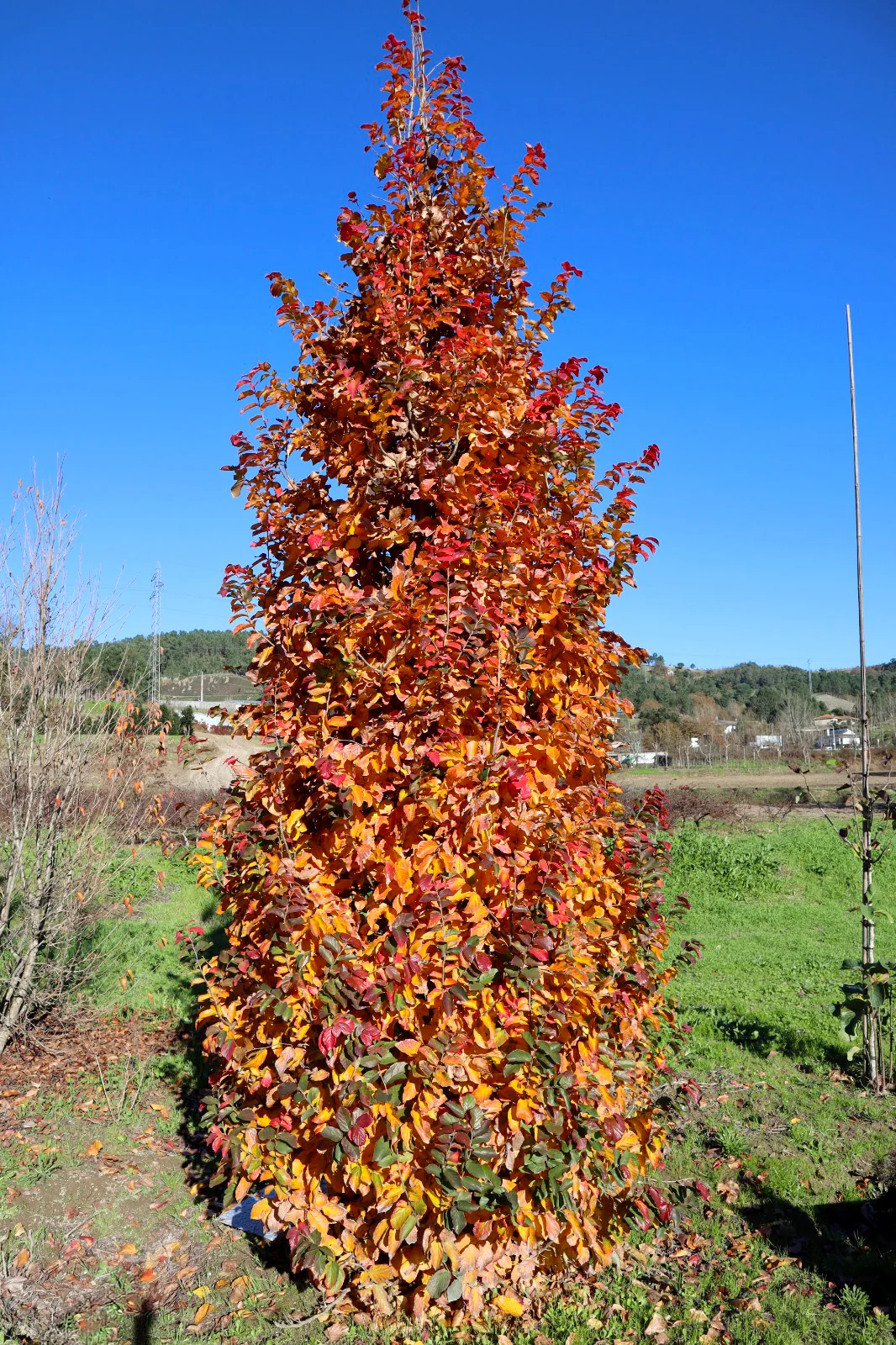
Parrotia persica 'Vanessa'Persian ironwood
A columnar cultivar of the Persian ironwood, suited to urban avenue plantings where the specification requires an upright habit and a contained crown, while retaining the autumn colour and the winter interest of the flaking bark.
- Autumn in yellow, orange, scarlet and purple, often on the same tree
- Upright silhouette of eight to ten metres, contained and legible in volume
- Red flower clusters on bare branches in January and February
About this cultivar
It differs from the straight species in its columnar habit and narrow crown, reaching in Portuguese conditions 8 to 10 m in height by 3 to 5 m in width, against the 6 to 10 m spread of an ordinary Parrotia persica. In avenue planting it takes the place of a Carpinus betulus ‘Fastigiata’ or an Acer platanoides ‘Columnare’, with the advantage of the triple ornamental interest…Read moreShow less
It differs from the straight species in its columnar habit and narrow crown, reaching in Portuguese conditions 8 to 10 m in height by 3 to 5 m in width, against the 6 to 10 m spread of an ordinary Parrotia persica. In avenue planting it takes the place of a Carpinus betulus ‘Fastigiata’ or an Acer platanoides ‘Columnare’, with the advantage of the triple ornamental interest that defines the genus: late-winter flowering, decorative flaking bark and autumn colour.
It adapts to fertile, moist, well-drained soils, preferring an acidic to neutral pH. On well-drained chalky soils it holds its own, but it loses vigour on compact limestones; in those contexts the landscape architect will have to weigh up substitutions. It tolerates partial shade, but it is in full exposure that the autumn colour is expressed reliably. Unreservedly cold-hardy throughout mainland Portugal, it tolerates urban pollution well and withstands short droughts once established, though it still needs supplementary watering in the first three to four summers.
The root system is discreet and does not become woody at the surface, behaving in a way compatible with tree pits of 1.2 to 1.5 m and with the usual separation from underground services in new streets. Growth is slow to moderate: planted from girth size 18/20, the crown settles within four to six years of aftercare, a period to be adjusted according to exposure and water availability. The Hamamelidaceae are not currently under any recognised plant-health pressure in Portugal, which makes this cultivar an interesting alternative where the specification provided for Fraxinus now held back by ash dieback.
The foliage is dense, oval and dark green in summer, with an autumn turn that combines yellow, orange, scarlet and purple, and a marked tendency towards the intense red that characterises this cultivar. The flaking bark reveals plates in shades of grey, green and light brown, sustaining interest in winter in squares and central reservations where it is seen at close range. Flowering occurs in late winter, before bud burst, in small red apetalous flowers that mark the season without competing with the architecture of the crown.
Advice on this species
Want to know more about Parrotia persica 'Vanessa'?
Tell us about your project and we will advise on this species — where it does well, what size makes sense and what to expect once it is planted.
- Own production
- Mature specimens
- Reply within 1–2 days
No obligation · tailored quote