

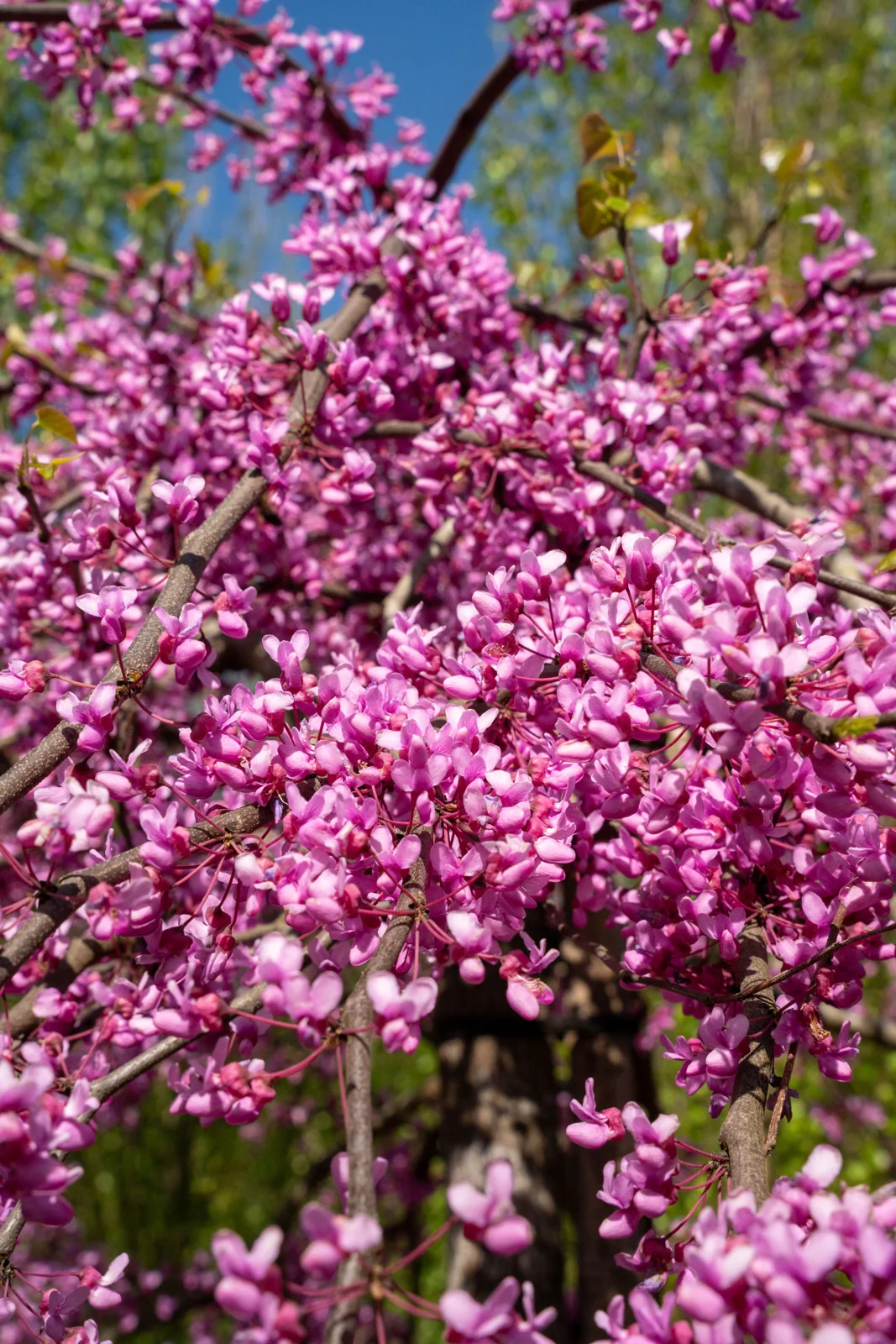
Cercis siliquastrum 'Pendula'Judas tree
A small deciduous tree of weeping habit, it combines a cascading crown with the intense purple-pink flowering characteristic of the species. The flowers appear directly on the mature branches and the trunk, before the heart-shaped leaves, turning the whole structure of the tree into a spring event.
- Long, weeping branches that form a cascading crown
- Purple-pink flowers produced directly on the mature wood
- Sculptural silhouette with interest even in winter
About this species
It has a compact, markedly weeping architecture, formed by branches that arch over and descend towards the ground. The final height and silhouette depend on the initial training and on the point from which the crown develops. Over time, it forms a broad, irregular, umbrella-like structure, generally more restrained than the species.Read moreShow less
It has a compact, markedly weeping architecture, formed by branches that arch over and descend towards the ground. The final height and silhouette depend on the initial training and on the point from which the crown develops. Over time, it forms a broad, irregular, umbrella-like structure, generally more restrained than the species.
In early spring, before or at the same time as the leaves appear, the branches are clothed in numerous clusters of purple-pink flowers. Flowering takes place on old wood and can occur directly on the trunk, combining the phenomenon of cauliflory with the downward movement of the branching.
The leaves are rounded and deeply heart-shaped, appearing along the weeping branches and forming a green curtain during the summer. In autumn they take on yellow tones before falling. The long, flattened pods, purplish at first and later brown, may remain visible after the foliage has gone.
It grows best in full sun or partial shade and in deep, well-drained soils. Once established, it has good tolerance of heat and periods of drought. It is suited as a free-standing specimen in small gardens, courtyards, entrances, beside walls, on banks or in compositions where the crown can develop its weeping form freely.
In Diaplant’s mature specimens, the individual architecture and the distribution of the branches can already be assessed before selection. The mature wood also offers a far greater flowering surface than that of a young plant, making it possible to introduce immediately a cascading living sculpture, covered in flowers in spring and expressive all year round.
Advice on this species
Want to know more about Cercis siliquastrum 'Pendula'?
Tell us about your project and we will advise on this species — where it does well, what size makes sense and what to expect once it is planted.
- Own production
- Mature specimens
- Reply within 1–2 days
No obligation · tailored quote