

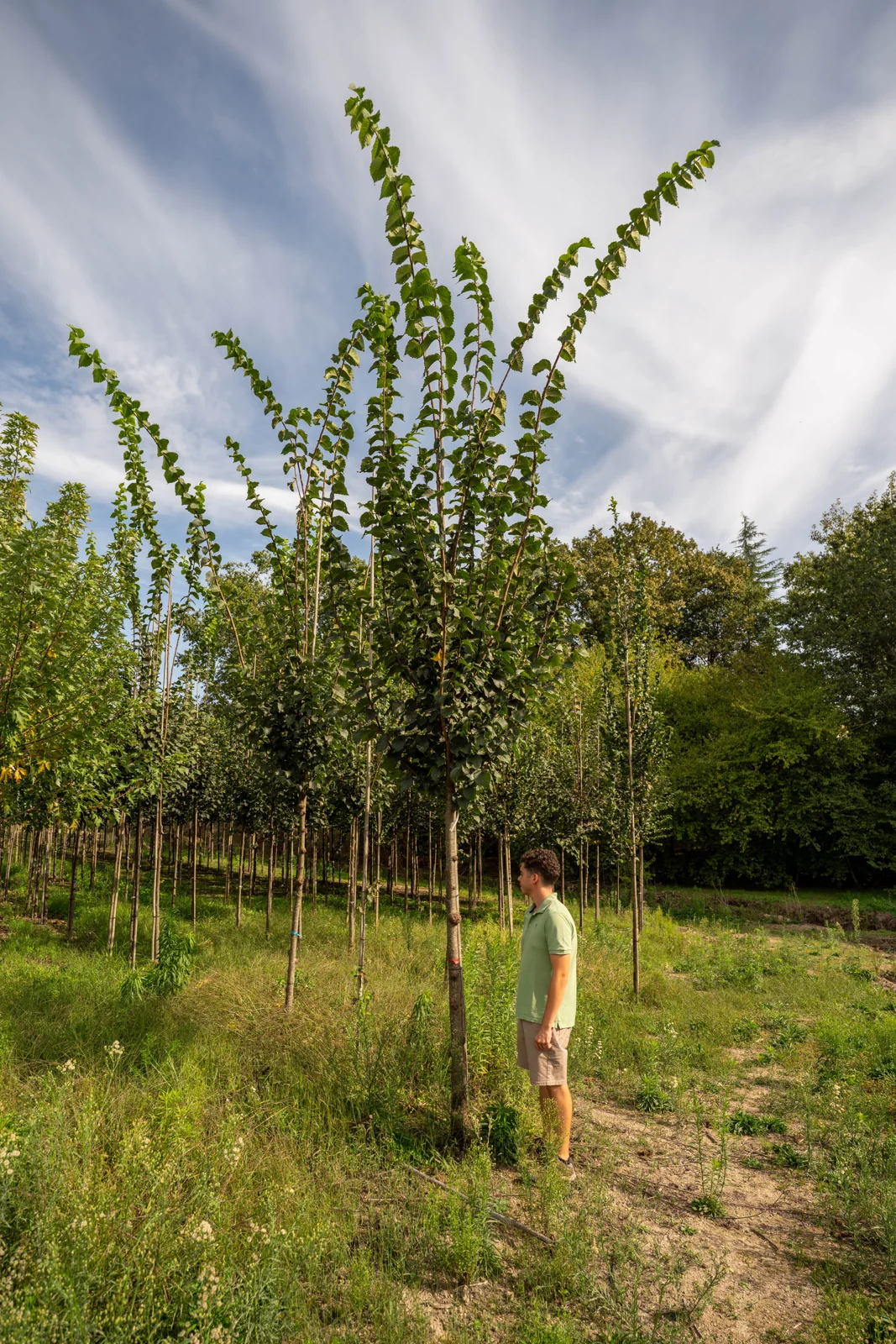
Ulmus 'Lobel'Elm 'Lobel'
An elm of vigorous growth with a crown that is narrow at first, it becomes progressively pyramidal to oval without losing its vertical expression. Its dense, dark green, long-lasting foliage, excellent resistance to sea wind and tolerance of urban conditions make it a particularly functional tree for avenue planting and large spaces.
- Vertical, dense and relatively narrow crown
- Excellent wind resistance, including sea wind
- Reasonable tolerance of Dutch elm disease
Ulmus ‘Lobel’ is a hybrid cultivar developed in the Dutch elm breeding programme at De Dorschkamp, in Wageningen, and introduced commercially in 1973. It has vigorous growth and a strongly vertical architecture. The crown, narrow and pyramidal in the first years, becomes progressively broadly pyramidal to oval, keeping a relatively restrained spread for a tree that can reach approximately 15 to 18 metres in height and 4 to 6 metres in diameter.Read moreShow less
The ascending branching, formed by short, relatively closely spaced branches, produces a dense, uniform crown. The leaves are small for an elm, around 6 to 9 centimetres, rough, dark green and matt-surfaced. The new growth shows bronze tones and the foliage stays on the tree until quite late, often close to the end of autumn, turning yellow before it falls. In March or April discreet light green flowers appear, followed by small winged samaras. The bark, smooth and silvery grey at first, darkens and becomes progressively furrowed.
It adapts to sun or partial shade and to different textures and pH values, although it shows a preference for deep, moist, well-aerated soils containing lime. It tolerates paving, air pollution, urban heat, dry periods once established and temporary episodes of waterlogging. Its wind resistance is particularly high, including in coastal areas exposed to salt-laden sea air. A newly transplanted mature specimen nevertheless still needs deep watering and aftercare during the rooting phase.
‘Lobel’ has reasonable resistance to Dutch elm disease, but should not be described as immune nor placed on the same level as the more recent cultivars with high resistance. In large-scale projects it remains advisable to diversify the species and cultivars used. The combination of height, a relatively narrow crown and urban tolerance makes it suited to avenues, wide streets, parks, car parks, industrial areas and large gardens.
Diaplant’s mature specimens make it possible to introduce immediately a continuous, vertical avenue planting, a dense crown and a scale in keeping with large buildings and infrastructure. Sufficient soil volume, an adequate distance from façades and underground services, and formative pruning directed at the clearance height needed beneath the crown should be allowed for.
Advice on this species
Want to know more about Ulmus 'Lobel'?
Tell us about your project and we will advise on this species — where it does well, what size makes sense and what to expect once it is planted.
- Own production
- Mature specimens
- Reply within 1–2 days
No obligation · tailored quote