

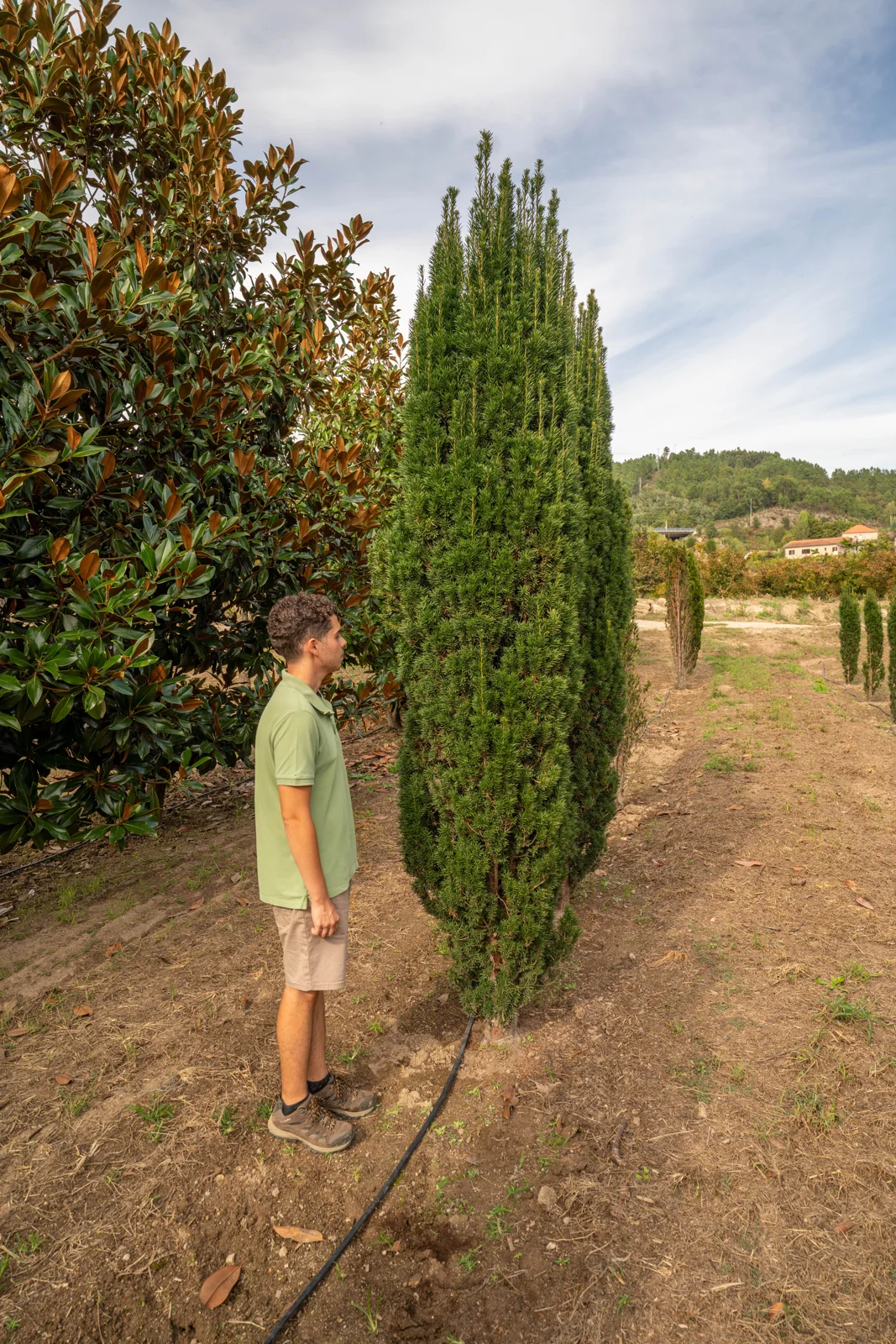
Taxus baccata 'Fastigiata Robusta'Yew
Where a formal scheme calls for an evergreen vertical axis with a firm presence, this fastigiate selection of yew offers a tighter, more upright column than the usual 'Fastigiata', keeping architectural scale without widening the crown.
- Narrow, upright column that gives vertical structure all year round
- Evergreen needles, dark and glossy, longer than those of the wild yew
- Accepts precise clipping for formal designs, pairs and avenues
About this cultivar
It differs from the ordinary 'Fastigiata' in its tighter, more compact columnar habit, with close, upright branching that resists opening with age. The foliage is dark green and glossy, with longer needles than the straight species, ensuring a dense, opaque mass that keeps the vertical axis legible throughout the year. In avenue planting or in massed planting, it occupies a…Read moreShow less
It differs from the ordinary 'Fastigiata' in its tighter, more compact columnar habit, with close, upright branching that resists opening with age. The foliage is dark green and glossy, with longer needles than the straight species, ensuring a dense, opaque mass that keeps the vertical axis legible throughout the year. In avenue planting or in massed planting, it occupies a narrow, predictable space, an advantage in central reservations and contained tree pits where a spreading crown has no place.
As a yew, it inherits a root system that penetrates compacted soils without lifting paving, which makes it compatible with narrow tree pits and with the separation of underground services in an urban context. It tolerates chalky soil well, including the compact limestone soils of the Lisbon region, and adapts to clay substrates as long as drainage is reasonable; prolonged waterlogging is the limit to manage, so the foot of a poorly drained bank is avoided.
Its shade tolerance is among the widest of the European conifers, keeping its density under a canopy and in shady courtyards where other vertical structures thin out. In full exposure it performs equally well in the Atlantic conditions of the centre and north; in the hotter, drier interior, it benefits from supplementary watering in the first summers and from partial shade in the afternoon to avoid scorching of the new foliage.
Growth is slow, a fact to build into the project forecast: the column gains girth slowly, which is why the mature specimen, supplied with its habit already established, immediately resolves the structural function that would otherwise take decades to obtain. It withstands temperatures well below zero, coping with the frosts of the northern interior without significant winter stress.
In early spring, discreet flowers appear, followed in late summer by fleshy red arils against the dark foliage. It tolerates regular clipping with the docility of the yew, sustaining formal shapes and containment pruning without losing vigour.
Advice on this species
Want to know more about Taxus baccata 'Fastigiata Robusta'?
Tell us about your project and we will advise on this species — where it does well, what size makes sense and what to expect once it is planted.
- Own production
- Mature specimens
- Reply within 1–2 days
No obligation · tailored quote