

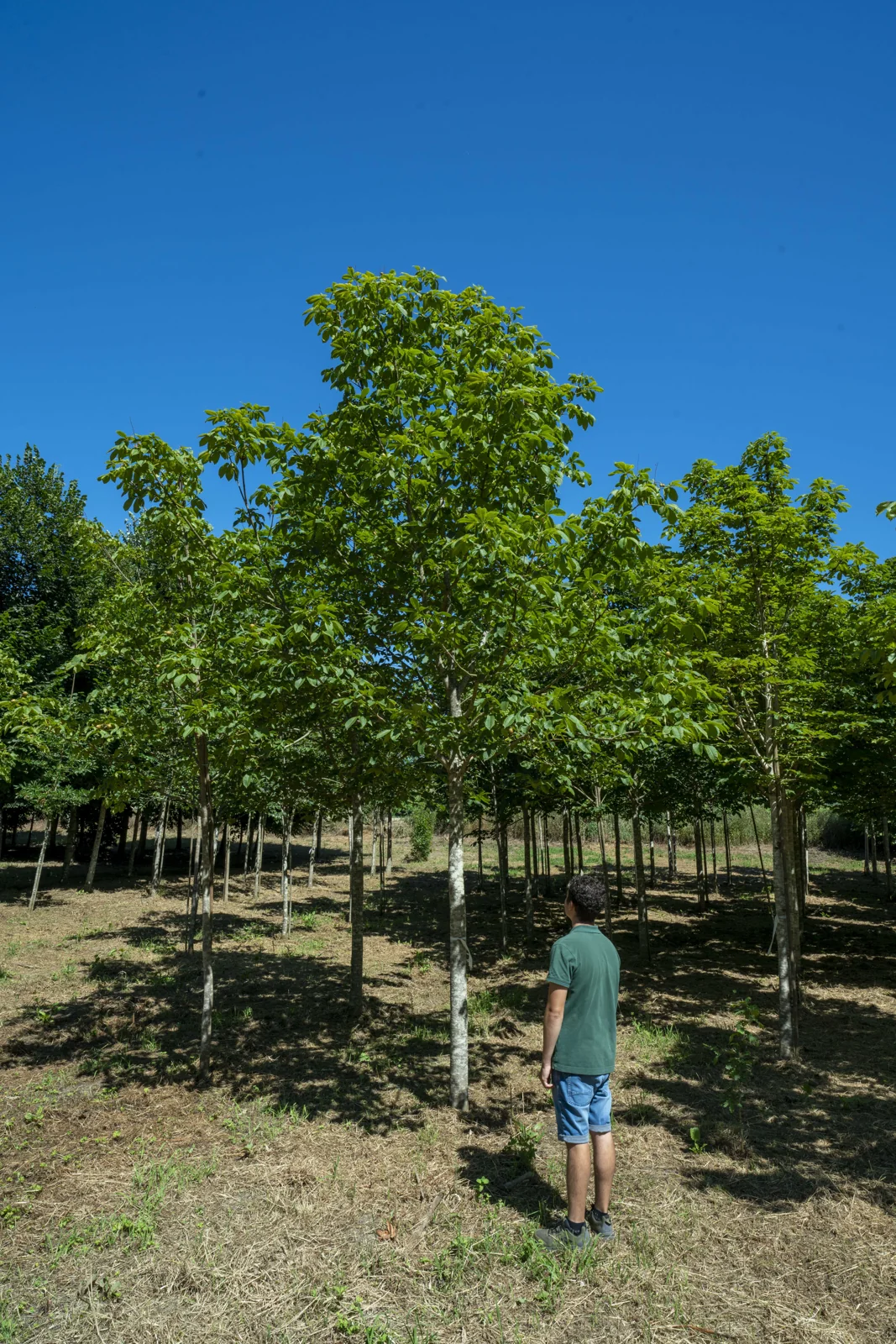
Aesculus x carnea 'Briotii'Red horse chestnut
An ornamental hybrid that combines the architecture and foliage of the horse chestnut with the intense red flowering of Aesculus pavia. Its rounded crown, more compact than that of the straight species, and its reduced fruit production make it particularly interesting for avenues, parks and gardens where a shade tree with truly striking flowers is wanted.
- Large upright panicles of ruby-red flowers in late spring
- Rounded crown, more compact than that of the common horse chestnut
- Reduced fruit production, with only slightly spiny capsules
About this cultivar
Aesculus × carnea ‘Briotii’ is the result of a cross between Aesculus hippocastanum and Aesculus pavia, combining the structural robustness of the former with the colourful flowering of the latter. It develops a dense crown, rounded to broadly oval, generally more regular and contained than that of the common horse chestnut. It can reach about 10 to 15 metres in height and a similar spread, occasionally exceeding these dimensions in favourable conditions.Read moreShow less
Aesculus × carnea ‘Briotii’ is the result of a cross between Aesculus hippocastanum and Aesculus pavia, combining the structural robustness of the former with the colourful flowering of the latter. It develops a dense crown, rounded to broadly oval, generally more regular and contained than that of the common horse chestnut. It can reach about 10 to 15 metres in height and a similar spread, occasionally exceeding these dimensions in favourable conditions.
The leaves emerge early and stay on the tree for a long period. They are made up of five to seven dark green leaflets, slightly glossy and more deeply creased than those of the straight species, forming a dense, shady crown. In autumn they take on yellow to golden-brown tones.
In May, the foliage is punctuated by large upright panicles of ruby-red flowers, sometimes about 20 centimetres long. The intensity of the colour and the abundance of the inflorescences give it an expression that is unusual among trees of this size, making the flowering visible from a distance. The flowers are also an important source of nectar and pollen for bees and other pollinators.
It prefers sun or partial shade and deep, fertile soils with a regular supply of water. It tolerates different textures and pH values, but benefits from an area of permeable soil large enough to sustain the development of the crown. It is suited to parks, large gardens, avenues, central reservations and prestigious entrances, producing few fruits and capsules less spiny than those of Aesculus hippocastanum.
The intense flowering shows mainly when the tree reaches greater maturity, and may be modest during the first years. A mature specimen from Diaplant makes it possible to bypass this long juvenile phase and bring to the project immediately a structured crown, effective shade and greater flowering potential, making visible from the outset the ornamental feature that truly distinguishes ‘Briotii’.
Advice on this species
Want to know more about Aesculus x carnea 'Briotii'?
Tell us about your project and we will advise on this species — where it does well, what size makes sense and what to expect once it is planted.
- Own production
- Mature specimens
- Reply within 1–2 days
No obligation · tailored quote